
Researchers have shown a much more efficient holographic approach to volumetric 3D printing.
Volumetric additive manufacturing is one of those technologies that always seems to be just over the horizon. Instead of building parts layer by layer, it exposes a full volume of resin with carefully calculated light patterns, causing the intended 3D geometry to solidify all at once.
That makes it very different from SLA, DLP, MSLA, or material extrusion. There are no layers, no recoating steps, and potentially far less waiting. In principle, volumetric systems could print delicate shapes very quickly, especially where layer interfaces would be a problem. Imagine obtaining 3D prints in minutes or seconds instead of hours.
But there’s one issue: the optics are difficult.
Most tomographic volumetric additive manufacturing systems use digital micromirror devices, or DMDs, to project patterns into a rotating vial of photocurable resin. DMDs are excellent for many forms of light based 3D printing, but in this context their binary amplitude operation wastes a great deal of light. The researchers have found that typical projection efficiency can be below a few percent.
A Different Light Engine
The new work, from researchers at EPFL, replaces the usual amplitude light modulation approach with a phase light modulator, or PLM. Specifically, the system uses a Texas Instruments MEMS based PLM that operates with tiny piston like micromirrors.
That is important because the device modifies the phase of light rather than simply turning pixels on or off. The EPFL researchers report that their PLM based holographic volumetric additive manufacturing system achieved about 24% pattern light efficiency. That is roughly 70 times more efficient than amplitude projection in their comparison, and about twice as efficient as a previous DMD based holographic method using Lee holograms.
The team could use a relatively low power 405nm laser diode rather than the multi watt light sources commonly associated with larger volumetric prints.
The PLM also runs quickly. The paper reports frame rates of 720 Hz over HDMI and 1440 Hz over DisplayPort, with the resin vial rotating in synchronization with the hologram sequence.
Speckle, Hydrogels, And Scale
Holography brings its own problem: speckle. Anyone who has worked with coherent laser projection knows the grainy interference pattern can be big trouble. In a printing system, that granularity can cause poor surface quality, striations, or weak regions.
The researchers addressed this with a speckle reduction method based on time multiplexing. They shifted the holographic reconstructions laterally using multiple axicon phase patterns, allowing the polymerization process to average out the speckle over time.
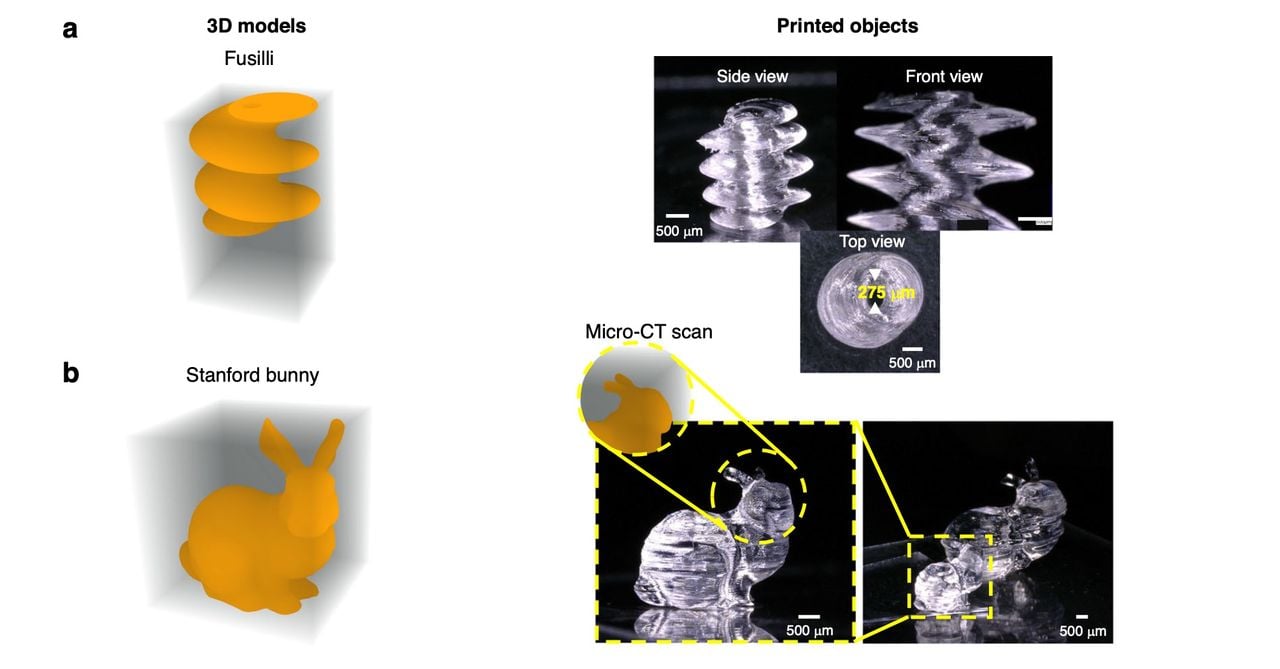
The paper shows smoother DNA helix prints when the technique is used, along with micro CT comparisons against the target geometry. The smallest positive feature reported was about 30.3 microns, although the researchers also point out that oxygen diffusion and post processing fragility affected sub 100 micron details.
They also demonstrated larger prints. A human ear model measuring up to 3 cm × 3 cm × 4 cm was printed in 2m12s using only 150 mW of laser power. A comparable acrylate sample at the same scale took 7m45s.
If lower optical power can produce useful volumetric prints at centimeter scale, it could simplify future machine designs and reduce cost.
This development looks very promising. Many volumetric systems have looked impressive but are less practical because of optical power, material limits, or print fidelity. This research suggests that a better light engine could make holographic VAM lead towards a proper manufacturing system.
Via Nature
