
Trinckle 3D has published a pair of German patent applications that point toward a very specific problem in additive manufacturing: how do you let less experienced users customize 3D printed parts without letting them break the part?
The Berlin software company is not a 3D printer manufacturer. Trinckle is best known for parametric design automation, particularly in applications where a part must be adapted to a customer, patient, machine, or use case. That makes these filings interesting, because they read like a controlled design workflow for additive manufacturing.
The two patent publications were both published on 21 May 2026. The first is directed at manufacturing at least one segment of a dental part. The second is broader, covering the manufacture of at least one three-dimensional object.
The core idea is similar in both cases.
Trinckle describes a system where a provider supplies “base data” defining a base design. That base design includes fixed, predefined parameters that the end user cannot freely change. These would represent the essential geometry, function, construction, or material properties needed for the part to work safely.
Then the system presents a set of freely selectable open parameters. These are the aspects a user is allowed to configure. Once the user selects from those open parameters, the system can generate the construction data or build data needed to manufacture the object.
In other words, it is not simply a CAD configurator. It is a guardrailed manufacturing configurator.
A Dental and Industrial Version
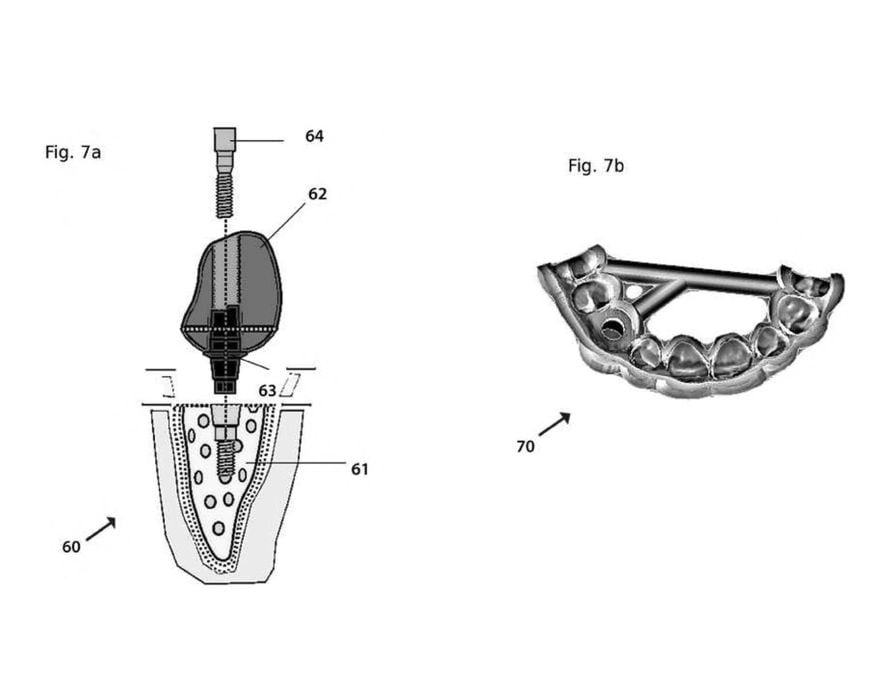
The dental filing adds an extra wrinkle: segmentation. It describes splitting a dental part into at least a first and second segment, each representing a partial volume of the dental object. Those segments can be derived from digital dental representations such as STL or DICOM data, including scans of teeth, jaws, gums, or surrounding anatomy.
That is a natural fit for dental workflows, where patient geometry varies constantly, but clinical function cannot be left to guesswork. A user might customize patient-specific aspects, while the system preserves required constraints in the base design.
The broader patent applies the same principle to general three-dimensional objects made from ceramics, glass, concrete, metals, polymers, composites, or related material structures. It explicitly mentions additive manufacturing, but does not limit the method to 3D printing.
The process could apply to jigs, fixtures, orthoses, grippers, medical devices, spare parts, or any other product where the final shape needs local customization but must remain manufacturable and functional.
That’s likely the real benefit here.
3D printing has always promised mass customization, but customization is not the same as letting anyone freely edit a CAD file. In most industrial settings, uncontrolled customization creates risk: bad geometry, weak sections, wrong clearances, missing offsets, impossible support situations, or parts that technically print but do not perform.
Trinckle’s patent approach tries to separate expert decisions from user choices. Experts, software, or possibly AI define the locked base parameters. Users adjust only the permitted variables. The system then produces data suitable for manufacturing.
This could reduce manual labour in application engineering, especially in service bureau or distributed manufacturing environments. It could also support software as a service business models where customers configure parts online, while the provider maintains control over the engineering rules.
This is a sensible concept. The AM industry does not need more generic “upload your model and print it” workflows. It needs smarter systems that capture engineering intent, protect critical constraints, and expose only the right choices to the right users.
Via Espacenet
