
Researchers at DLR say they have identified a LBPF aluminum alloy made from scrap that prints crack free with low porosity.
The German Aerospace Center, working with ESRF and French partners, combined computational screening with 3D and 4D synchrotron tomography to design and validate an Al-Si-Cu-Mg-Ni alloy derived by mixing common aluminum scrap streams. They wanted to match LPBF printability while reducing the brittle, fully connected results typical of AlSi10Mg.
Aluminum is one of LPBF’s toughest material families due to hot cracking in 2xxx and 6xxx grades and the tradeoff between silicon for processability and the ductility designers want. Most operators fall back to AlSi10Mg or AlSi7Mg because they actually print, not because they are ideal for performance or post-processing.
How They Found A Printable Scrap Alloy
The team built a high-throughput pipeline that starts with realistic scrap inputs to compute 60-plus microstructural and thermophysical parameters per composition. A Random Forest surrogate model learned from 760 Thermo-Calc points to predict properties quickly across more than twenty thousand mixture designs, feeding multi-objective optimization (NSGA-II/SPEA2) for printability, thermal conductivity, strength targets and copper levels.
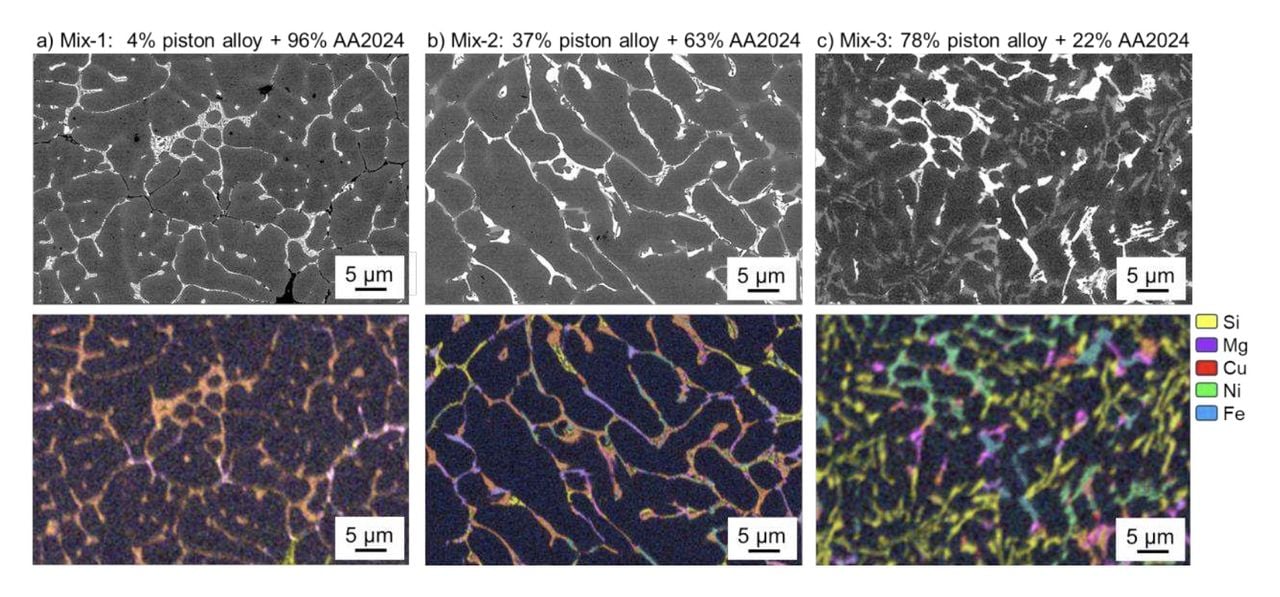
Two things stand out. First, they handled scrap variability with uncertainty analysis, selecting only designs that could withstand likely element variability. Second, they validated with hierarchical 3D nano-holotomography and LPBF microtomography to reveal their morphology, connectivity and defect rate layer by layer.
The final optimized candidate material combines about sixty-three percent AA2024 with thirty-seven percent piston alloy, yielding roughly Al-Si5-Cu4.4-Mg1.5-Ni0.7-Fe0.5 plus minor refiners. Powder atomized for trials showed a mean particle size near 82 μm, and the researchers printed with layer thicknesses of 80 to 150 μm using a miniature LPBF rig.
Across four strategies, the best result came at 350 W, 800 mm/s and 80 μm layers (about 39 J/mm3): no bulk cracks were observed, and porosity was only 0.4 vol.% with pores mostly under 100 μm and a mean diameter around 14 μm. At higher energy densities or thicker layers, the builds showed more porosity and, in one case, bulk cracking.
What It Could Mean For Aluminum AM
This is a very interesting development because it validates a scrap-to-spec concept with real defect data. The material’s lower silicon content compared to AlSi10Mg should translate into better ductility, toughness and post-processing flexibility, since it should have a less brittle microstructure.
Their materials search workflow did more than just spit out a specific material: it found a composition that can be printed and then showed why, in 3D and over time. If this approach holds up with further testing, the same approach could shorten alloy development time and possibly even let manufacturers respond to supply constraints by tuning to whatever scrap mix is available.
Via Research Square
