
Charles R. Goulding and Preeti Sulibhavi take a closer look at Russia’s longevity program, separating the scientific realities of 3D bioprinting from the hype surrounding claims of life-extending technologies.
Russia has launched one of the world’s most ambitious government-backed longevity initiatives, committing roughly $26 billion toward technologies designed to extend healthy human lifespan and combat age-related disease. The program has attracted global attention not only because of its size, but also because of the technologies it is pursuing, including gene therapy, xenotransplantation, regenerative medicine, and perhaps most interesting to Fabbaloo readers, 3D bioprinting.
Russian President Vladimir Putin has publicly championed the initiative, which is reportedly being guided by endocrinologist Maria Vorontsova, one of Putin’s daughters, together with prominent Russian physicist Mikhail Kovalchuk. The effort forms part of a broader national strategy focused on what Russian officials describe as “health preservation technologies” intended to increase longevity and reduce mortality from chronic diseases.
Putin’s personal interest in health and physical fitness has long been part of his public image. For years, state media has highlighted his participation in cold-water plunges, ice baths, martial arts, horseback riding, and other activities intended to project vigor and resilience. The longevity initiative appears to align closely with that image, although officials frame the program as a national healthcare priority rather than a personal project.
While headlines have focused on anti-aging research and speculative reports about extending lifespan, the most intriguing aspect from a technology perspective may be Russia’s investment in 3D bioprinting.
Why 3D Bioprinting Matters
Traditional organ transplantation faces a severe global shortage of donor organs. Thousands of patients die every year while waiting for hearts, kidneys, livers, and other critical organs. Bioprinting offers a potential long-term solution by manufacturing living tissues and eventually entire organs using a patient’s own cells.
The concept sounds straightforward but remains one of the most difficult engineering and biological challenges ever attempted.
Unlike conventional 3D printing, bioprinting involves depositing living cells, biomaterials, and biological scaffolds in precise patterns that must survive, grow, and function after fabrication. A printed structure must develop blood vessels, maintain cellular viability, and integrate with the body’s existing systems.
The greatest challenge remains vascularization. Human organs require dense networks of blood vessels to deliver oxygen and nutrients. Without these networks, larger printed tissues quickly die. This remains a major hurdle for researchers worldwide.
As a result, while researchers have successfully bioprinted simple tissues, cartilage structures, skin, and miniature organ models, fully functional transplantable human organs remain largely a future goal.
Russia’s Early Bioprinting Efforts
Russia’s interest in bioprinting predates the current longevity initiative by more than a decade.
One of the country’s most visible organizations in the field is 3D Bioprinting Solutions, a Moscow-based laboratory founded in 2013. The organization developed the Fabion bioprinter and assembled an international team of scientists under the leadership of bioprinting pioneer Vladimir Mironov.
The company gained international attention after reporting successful experiments involving bioprinted thyroid tissue and cartilage constructs. In 2017, researchers affiliated with the organization published a peer-reviewed paper describing the creation of a vascularized mouse thyroid gland construct. The study demonstrated that bioprinted thyroid tissue could function after transplantation in mice, representing an important proof-of-concept milestone.
Russia also became known for conducting bioprinting experiments aboard the International Space Station. Using a specialized bioprinter known as Organ.Aut, Russian researchers reported the production of living tissue structures in microgravity, including cartilage tissue and a rodent thyroid gland construct. Microgravity environments can eliminate some of the structural limitations encountered during Earth-based bioprinting, making them useful research platforms.
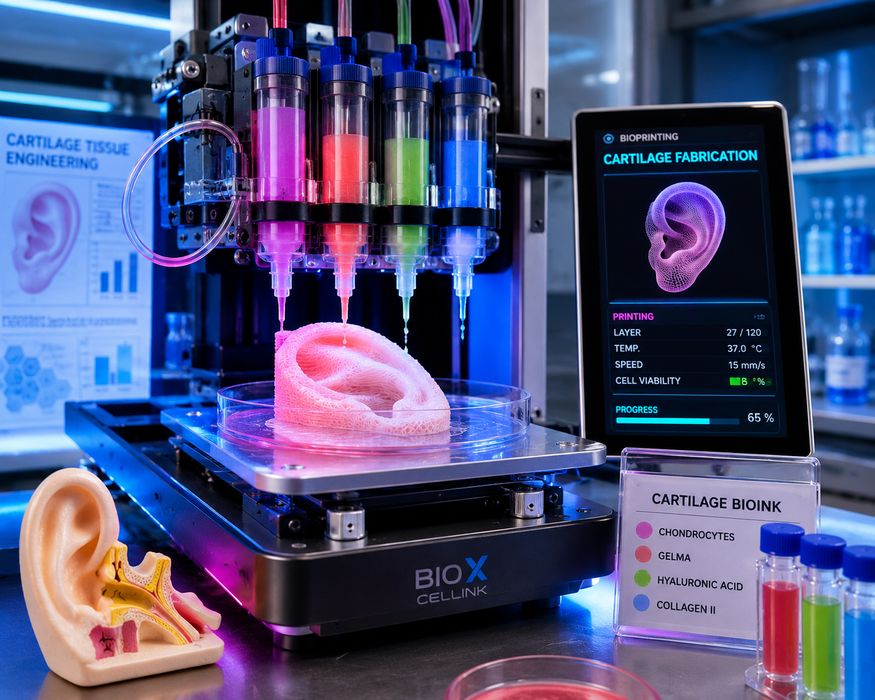
More recently, researchers at MISIS University reported progress toward bioprinted cartilage implants intended for reconstructive surgery applications. The project focuses on creating patient-specific thyroid cartilage replacements for individuals suffering from trauma or cancer-related tissue loss.
These projects suggest that Russia possesses genuine expertise in several specialized areas of bioprinting, particularly cartilage fabrication and experimental tissue engineering.
Bioprinting and the Longevity Initiative
The new longevity program reportedly envisions much larger goals.
According to multiple reports, Russian researchers aim to make organ replacement technologies practical by 2030. The initiative includes efforts involving both 3D bioprinting and xenotransplantation, two complementary approaches intended to address organ shortages.
Bioprinting seeks to manufacture tissues directly from cells.
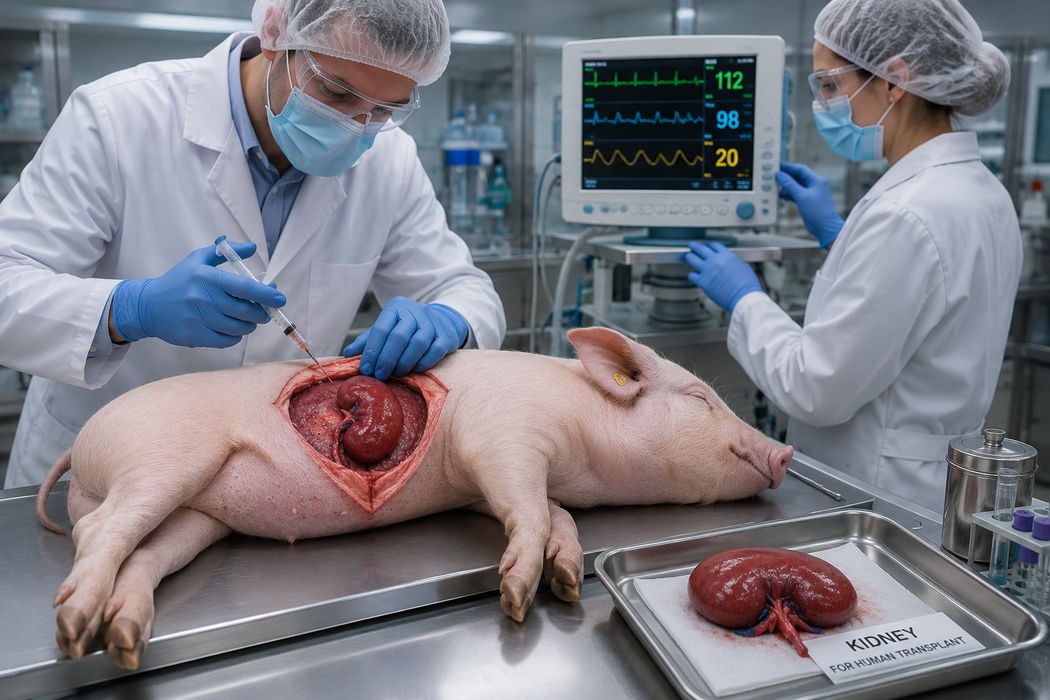
Xenotransplantation takes a different approach. Instead of printing organs, scientists grow human-compatible organs inside genetically modified animals, typically pigs. Pigs are frequently selected because their organ size and anatomy are relatively similar to humans.
The Russian program reportedly includes research into genetically engineered miniature pigs that could potentially serve as hosts for growing transplantable organs. This approach has attracted attention worldwide, with researchers in the United States and Europe pursuing similar investigations.
From an engineering standpoint, both approaches face enormous challenges.
Bioprinting must solve vascularization, tissue maturation, and long-term functionality. Xenotransplantation must overcome immune rejection, disease transmission concerns, and ethical questions.
Neither technology has yet achieved widespread clinical deployment.
A Modern Sputnik Moment?
Supporters of the Russian initiative argue that concentrated state investment can accelerate scientific progress.
History provides examples. The Soviet Union shocked the world in 1957 with Sputnik, the first artificial satellite. That achievement demonstrated how a nation could rapidly advance a strategic technology when government agencies, universities, research institutes, and industry aligned behind a common objective.
Some observers believe the longevity initiative represents a similar effort, with biotechnology replacing aerospace as the strategic target.
Russia continues to possess strong scientific institutions, highly trained engineers, and a tradition of state-directed research programs. If substantial funding is sustained over many years, meaningful advances in regenerative medicine and bioprinting could emerge.
However, biotechnology differs from rocketry in one important respect. Biological systems are vastly more complex, less predictable, and harder to engineer than mechanical systems.
Progress tends to occur incrementally rather than through dramatic breakthroughs.
What We Know and What We Don’t
One of the biggest challenges in evaluating Russia’s longevity initiative is the limited amount of publicly available technical information.
Reports describe ambitious goals, including organ bioprinting, anti-aging therapies, gene-editing research, and xenotransplantation programs. Yet relatively little peer-reviewed scientific literature has emerged describing the specific achievements of the new initiative itself.
That makes independent assessment difficult.
Russia’s earlier bioprinting accomplishments, including the mouse thyroid gland work and cartilage research, have been documented in scientific publications and conference presentations. Those projects represent legitimate contributions to the broader bioprinting field.
The current longevity program, however, remains much more opaque.
For the additive manufacturing industry, the most significant question is whether Russia can translate laboratory-scale tissue fabrication into clinically useful human organs. That challenge has not yet been solved anywhere in the world.
Researchers across North America, Europe, Asia, and the Middle East continue to make steady progress toward that goal. As recently highlighted in comprehensive reviews from 3DPrint.com and other industry sources, the global bioprinting ecosystem is advancing, but no organization has yet demonstrated routine manufacturing of transplantable human organs.
That reality should temper expectations.
How Do Bioprinting Experiments Qualify for R&D Tax Incentives?
Synthesizing bio-inks, validating cell deposition software, and overcoming mechanical extrusion limits involves resolving deep technological uncertainties, aligning directly with Section 41 criteria.
| Core R&D Technical Activity | IRS Four-Part Test Alignment | Financial Recovery Impact |
| Bio-Ink & Hydrogel Tuning | Resolves technological uncertainty regarding cellular survival, cross-linking kinetics, and structural scaffold stability. | Captures qualified engineering and laboratory hours spent synthesizing novel biocompatible polymer mixtures. |
| Vascularization Protocol Trials | Conducts a systematic process of experimentation to design and test viable micro-networks of blood vessels within printed tissues. | Recovers internal labor costs of biomedical technicians and the direct cost of chemical reagents consumed during testing. |
| Printer Hardware & Toolpath Optimization | Overcomes mechanical and software engineering challenges regarding material viscosity, nozzle deposition, and multi-axis print profiles. | Offsets internal labor expenditures of computational, mechanical, and systems engineers developing automated systems. |
Strategic Insight for CFOs: While global state initiatives project rapid timelines for transplantable organ production by 2030, the real financial opportunity for private firms rests in capturing localized R&D tax incentives. Commercial innovators developing laboratory-scale tissue fabrication platforms generate highly defensible, year-over-year QREs long before broad clinical deployment occurs.
Fact or Fiction?
The Russian program is undeniably ambitious and may produce valuable advances in tissue engineering, regenerative medicine, and bioprinting. Yet readers should note that many of the most dramatic claims associated with the initiative have not been supported by openly available technical documentation.
At present, much of the reported research has not been fully described in peer-reviewed scientific journals widely circulated within the international biomedical community. Until more data, publications, and independent validation become available, it is prudent to view some of the program’s more ambitious claims with caution. The technologies involved are real, the scientific challenges are enormous, and while progress is certainly possible, the current public evidence remains limited.