
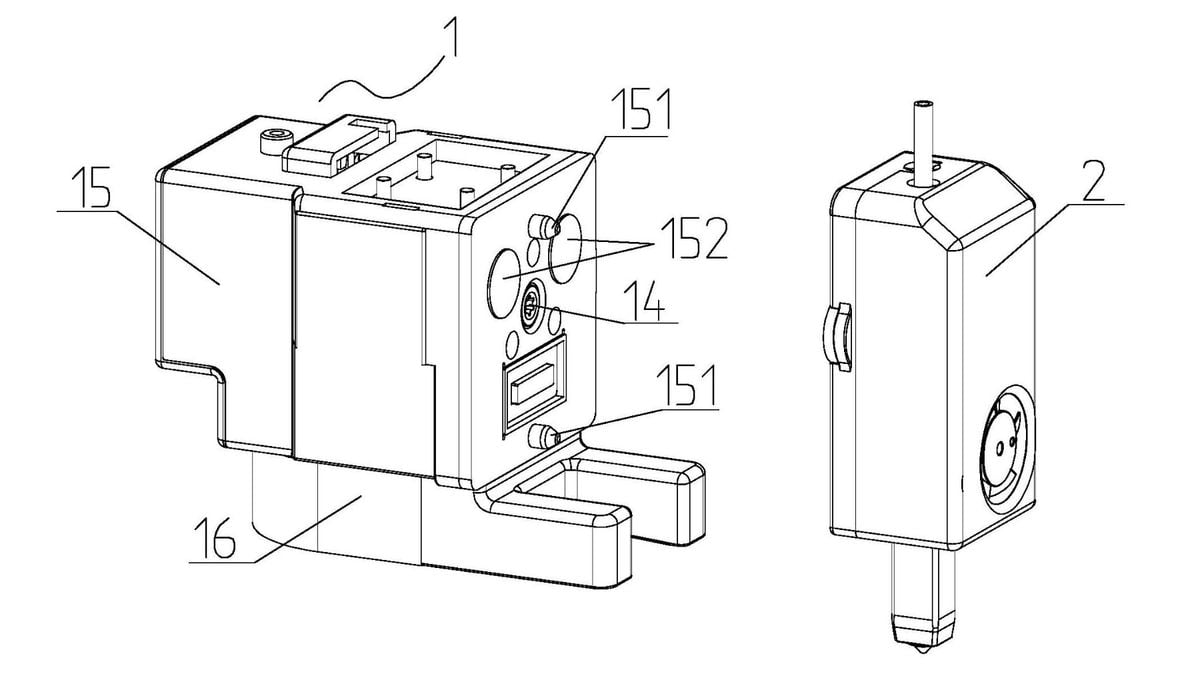
FlashForge has patented a new way to make detachable FFF toolheads dock more reliably.
In multi material or multi color FFF systems, docking reliability is everything. If a toolhead misses its connection even slightly, the print job can fail, the machine can jam, or the whole toolchanging idea becomes more trouble than it is worth.
The patent is Chinese utility model CN224426517U, assigned to Zhejiang FlashForge Group Co., Ltd. It was granted on June 30, 2026. As always, this is a patent, not a product announcement. It does not mean FlashForge is shipping this system today.
But it does show what the company has been thinking about.
The patent describes a printhead assembly for an FFF 3D printer. The system includes a printhead seat mounted on the printer’s motion system, and a removable printhead that can be docked to that seat. The removable printhead includes the hot end and extrusion mechanism, while the moving seat includes a drive motor, reduction gearing, an elastic mechanism, and a female coupling.
The printhead has a matching male coupling connected to the extrusion mechanism. When the carriage moves to a parked printhead, the female and male couplings plug together. The motor on the carriage can then drive the extruder in the selected printhead.
In other words, FlashForge is describing a shared drive system for multiple toolheads.
Instead of putting a complete motorized extruder drive on every individual toolhead, the machine could place the motor and reduction system on the moving carriage and use it to drive whichever head is currently attached. The patent specifically notes that multiple printheads could be used for different colors or materials.
This could reduce the cost, mass, and space required for each parked toolhead. That is important because toolchanging FFF systems can become mechanically bulky very quickly. Every extra motor, cable, heater, sensor, and latch adds cost and complexity. Extra mass can cause challenges in maintaining position during high speed moves.
The twist here is the elastic coupling.
FlashForge’s design places a spring based mechanism between the female coupling and the reduction gear system. If the male and female couplings do not align perfectly on the first attempt, the female side can compress backward slightly, creating a small buffer space. The parts can then realign and complete the connection more smoothly.
Toolchanging systems need to dock hundreds or thousands of times without requiring operator adjustment during a print job. A bit of fit tolerance in the coupling can ensure printhead swaps proceed smoothly.
The patent also describes several supporting features. A planetary reduction mechanism can lower motor speed and increase torque. Positioning pins and matching holes help align the toolhead. Spring pins can tighten the fit, and a magnetic or electromagnetic holding system can secure and release the removable printhead.
One interesting detail is that the patent prefers placing the spring mechanism on the carriage side rather than the printhead side. The stated reason is that when filament is already inside the extrusion mechanism, there may be limited room for spring travel inside the printhead. Putting the compliance on the motor side avoids that problem.
This patent sounds like the kind of engineering tech that might be needed for a more serious future multicolor FlashForge machine.
If FlashForge can build a compact, inexpensive, and repeatable docking system, it could give the company a path into low waste multimaterial FFF with their own system design. That could position them alongside Vortek, INDX, KliTek and other low waste processes.
Via Espacenet
