
INSTATIQ has patented a construction 3D printing system designed to place concrete directly against existing walls and other awkward building features.
The German patent application, DE102025100368A1, was filed by Stuttgart-based INSTATIQ GmbH and published this month. It describes a mobile extrusion system that combines a large positioning boom with a smaller, faster positioning mechanism at the print head.
That combination is the key part of their concept.
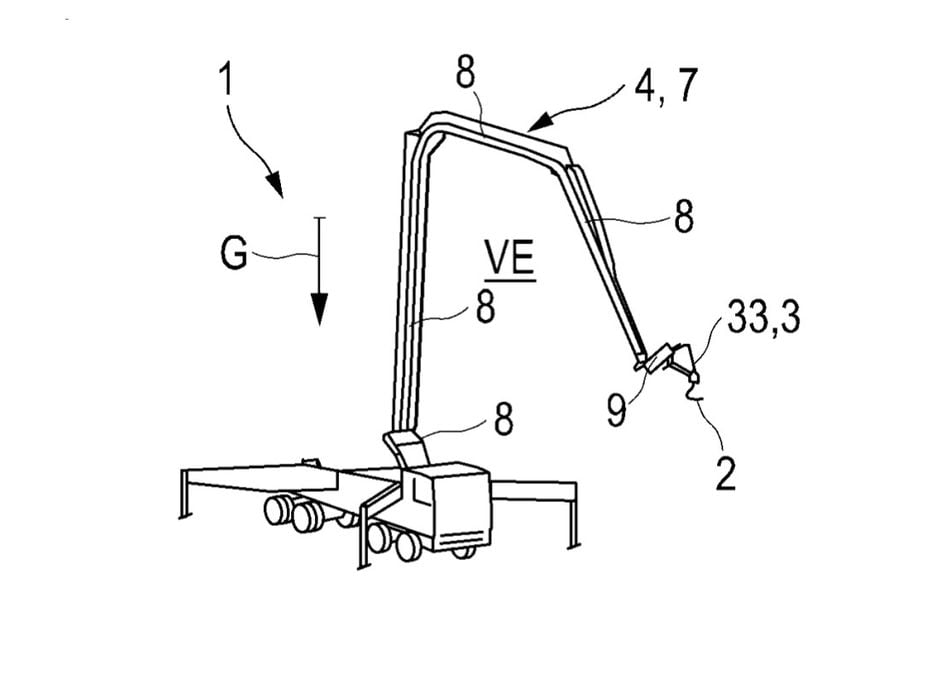
The large structure performs the coarse movement required to cover a building-scale work area. In several patent illustrations shown, this is a multi-section concrete pump boom mounted on a truck chassis.
At the end of the boom is a fine positioning system, preferably a delta robot. This smaller mechanism continuously adjusts the concrete extrusion head relative to the boom, potentially compensating for positioning errors, structural movement, and even vibration.
In other words, the boom provides reach, while the delta robot provides precision. It’s a hybrid of two technologies.
INSTATIQ proposes extruding a continuous strand of fresh concrete through a mostly horizontal outlet. The opening could measure from 100 to 800 mm wide and from 15 to 400 mm high, although preferred dimensions mentioned in the document are 400 by 50 mm. That’s typical for 3DCP systems.
The motion system would move backward at approximately the same speed that material exits the nozzle. That should allow the strand to retain the cross-section of the outlet instead of being compressed and reshaped against the previous layer.
But the most interesting feature is a special “press-on” operating mode.
Conventional construction 3D printer toolheads can have difficulty beginning a toolpath directly beside a tall existing wall. The nozzle may reach the required location, but the robot, hoses, or surrounding print head structure can collide with the wall before extrusion begins. Not enough reach!
INSTATIQ’s solution shifts the nozzle outlet sideways past the outer profile of the delta robot. The delta mechanism may also tilt its base plane, potentially by around 45 degrees, so the extrusion opening can reach the wall while the larger mechanism remains clear.
Concrete can then begin flowing with the extrusion already touching the existing structure. The print head subsequently moves away from the wall while continuing to extrude.
This could be useful when printing intersecting walls, attaching a new section to an existing building component, or depositing material inside tight corners. That’s something most current 3DCP systems cannot do. The patent specifically suggests the system could handle right-angle and acute interior locations that would otherwise be difficult to access.
The print head and fine positioning mechanism may also rotate, allowing curved or angled strands to be deposited. A normal printing mode would return the nozzle to a more central position beneath the delta robot, where the arrangement should offer better stability.
This is a quite sensible mechanical solution to a real 3DCP problem that isn’t often mentioned by manufacturers. Building-scale geometry is rarely isolated and convenient. Real projects involve columns, existing walls, embedded components, and previously completed sections that limit robot access.
However, you have to remember that this is merely a patent application, not an actual product announcement. A product might come in the future, and that could even be likely given the interesting possibilities presented by this tech.
It’s all fascinating, but 3DCP customers will ultimately need proof that the resulting interface meets structural, durability, and certification requirements.
The patent nevertheless shows that INSTATIQ is thinking beyond simply printing freestanding walls. If they are successful in making this a product, it could put them ahead of the 3DCP competition and make construction 3D printing far more practical on complicated sites.
Via Espacenet
