
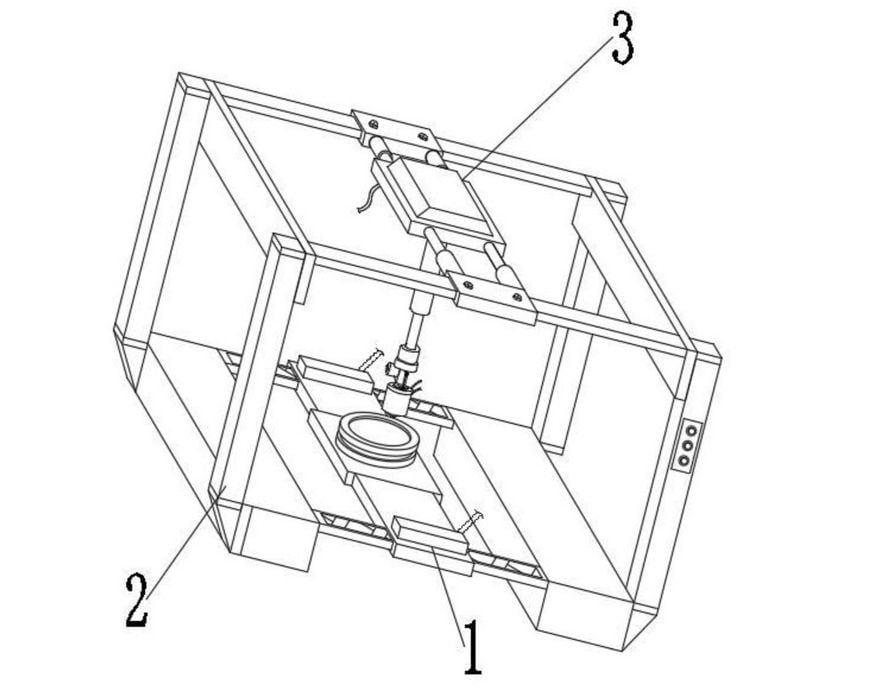
A newly granted Chinese utility patent describes an unusual FFF 3D printer arrangement combining a magnetically driven platform, a rotating work area and a vertically actuated extrusion head.
The patent number is CN224465274U, assigned to Suzhou Jintuo New Material Technology Co., Ltd. Its translated title (the patent is in Chinese) refers to a “blended masterbatch embedded extrusion nozzle structure” for 3D printing filament.
That title suggests a specialized material mixing system, perhaps one able to introduce masterbatch (colouring)pellets into a polymer extrusion. However, the actual claims describe something very different.
The proposed machine has a rectangular frame with an extrusion head suspended above a movable processing platform. Filament enters the hot end through a guide tube, which is intended to prevent the material from shifting, falling away or feeding inconsistently.
That portion is the usual configuration. The more interesting stuff is underneath the build area.
The platform assembly rides along what the patent calls a “drive magnetic plate.” Stator coils mounted to the moving base generate a changing magnetic field, pushing the platform horizontally along the fixed magnetic structure.
In other words, the design appears to use a linear electromagnetic drive rather than the belts, screws or conventional linear motors found in most FFF equipment.
The work area also sits on an electrically driven rotary base. Meanwhile, the extrusion head is positioned using hydraulic adjustment rods and an electric lifting actuator. Together, these elements are claimed to provide wide positioning capability around the workpiece.
This could allow the machine to approach printing more like an automated deposition cell than a standard Cartesian desktop 3D printer. Moving and rotating the part while independently adjusting the nozzle might support deposition onto curved surfaces, component insertion or other nonplanar operations.
The background section discusses embedded electronics, including sensors, antennas, batteries, conductive traces and structural materials. That suggests Suzhou Jintuo New Material may be considering a machine that pauses deposition, repositions a component or workpiece, and then continues printing around it.
However, the patent does not clearly describe how any electronic component is inserted.
It also does not explain how blended masterbatch is produced, metered or combined with the filament. There is only one pictured material guide and one extrusion head. No secondary pellet feeder, mixing chamber, dosing mechanism or multiple material system is claimed.
The patent title and the mechanism described seem poorly aligned.
There are some unanswered questions. The patent does not explain how the electromagnetic platform would maintain precise position under changing loads and nozzle forces.
The hydraulic positioning system is another odd choice. Hydraulic actuators can deliver considerable force, but they are generally less convenient for precise, rapid FFF motion than servo driven screws or linear stages. This could lead to accuracy concerns during printing.
As a Chinese utility model, this document mainly protects a physical arrangement rather than proving a complete manufacturing process. It should not be interpreted as evidence that a commercial machine exists. It’s possible that a proper system could be built around the concepts described in the patent later.
Anyway, the combination of a magnetic platform, rotary system and independently actuated nozzle is pretty interesting. It suggests Suzhou Jintuo may be exploring hybrid equipment for deposition around inserts or preexisting components.
Via Espacenet
