
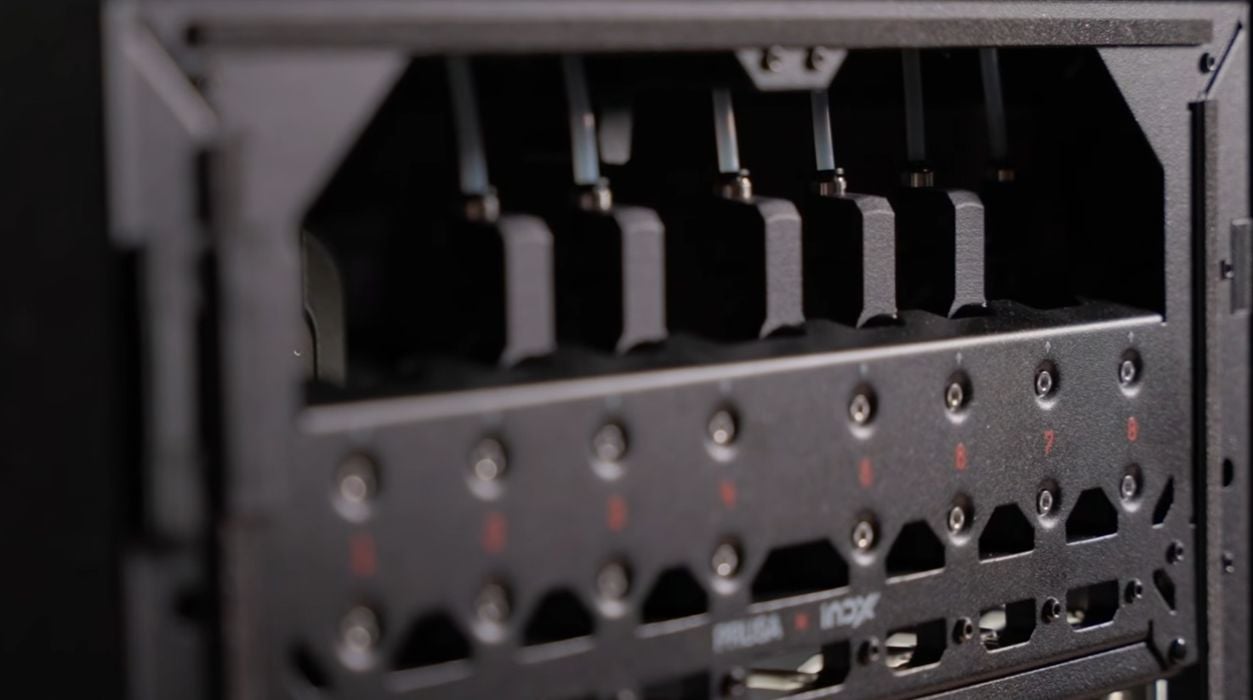
Controversy erupted over Prusa Research’s latest technology: INDX.
The INDX technology, developed by Bondtech, promises to provide a near waste-free 3D print experience, unlike many competing filament-swapping systems. Because of this capability, Prusa’s CORE One INDX version was heavily anticipated.
Now these units are starting to ship, and it seems that operators have made a discovery about the system: the nozzles are not as hardened as they were led to believe.
Hardened nozzles are critical when printing abrasive filaments. Typically used soft brass nozzles rapidly erode when printing materials such as carbon/glass fiber reinforced filament, or especially glow in the dark filament. To counteract the abrasion, “hardened” nozzles are normally used. These are simply nozzles of the same geometry, but made from a much harder material, like steel.
Hardened nozzles have been around for a while now, and the basic understanding of all 3D printer operators is this: a “hardened” nozzle is required when printing abrasive filaments; otherwise brass nozzles are suitable for non-abrasive filaments. It’s an easy thing to know: you need hardened or you don’t.
The discovery here was that the INDX nozzles are not exactly “hardened”. They are sort of hardened.
Let me explain what’s going on here. The INDX system is able to quickly switch filaments because the incoming nozzle can be very rapidly heated up. This is done using induction heating.
However, induction heating requires certain types of metal that react to the induction field. Brass won’t work, for example.
Bondtech has now reportedly acknowledged to Prusa Founder’s Edition customers that the supplied nozzles are not traditional hardened steel. Instead, they are ordinary steel treated by nitrocarburizing, a surface-treatment process that diffuses nitrogen and carbon into the outside layer. Community posts say Bondtech encountered technical problems producing the originally intended hardened nozzle and substituted this version late in product development.
In other words, instead of a nozzle made 100% from hardened material, we have a softer nozzle that has a hardened coating.
This means that its durability will be somewhat different than a real hardened nozzle: it won’t last as long. How long? It depends on what you’re printing and how thick the hardened layer might be.
Interestingly, Bondtech said that the nozzle material should be able to handle typical CF or GF-reinforced filaments, but not glow in the dark materials, which are usually much more abrasive.
This is quite confusing for the 3D print community, which up to now understood that a hardened nozzle is all you require for ALL abrasive filaments. Not just some of them.
Meanwhile, the Prusa Research promotional material refers to “hardened” nozzles, leading buyers to mistakenly use the original understanding of the terminology.
So we’ve ended up with an expectation gap: buyers expect “real” hardened nozzle capability, but the system doesn’t exactly do that. Bondtech apparently supplied a different and potentially less wear-resistant component than buyers were led to expect, without clearly disclosing the change beforehand.
The issue for Prusa Research is quite awkward because its product pages still talk about hardened nozzles. Unless Prusa has a separate, genuinely hardened nozzle supply for its retail kits, it must now do one of four things:
- Delay the Prusa-edition INDX
- Ship the nitrocarburized nozzles with corrected specifications and compensation
- Supply the softer nozzles temporarily and replace them later
- Produce a different, truly hardened nozzle before shipment
After all the delays in shipping the INDX, I can’t imagine the company would want to introduce yet another delay.
I also suspect that Bondtech is quite busy behind the scenes rapidly developing a proper hardened nozzle that will at some point appear.
Note that this issue is relevant ONLY to those who intend on printing abrasive materials with their INDX system. Anyone printing PLA, ASA, ABS, PETG, etc., will have no difficulties at all.
It’s likely Prusa Research will issue some type of update on this situation this week. Stay tuned!
Via Prusa Forum and Reddit
