
Flashforge appears to be thinking about a different way to handle multiple toolheads on desktop FFF 3D printers.
Chinese patent application CN122425892A, assigned to Zhejiang Flashforge Group Co., describes a “multi nozzle switching device” for a 3D printer. It was published on July 21, 2026.
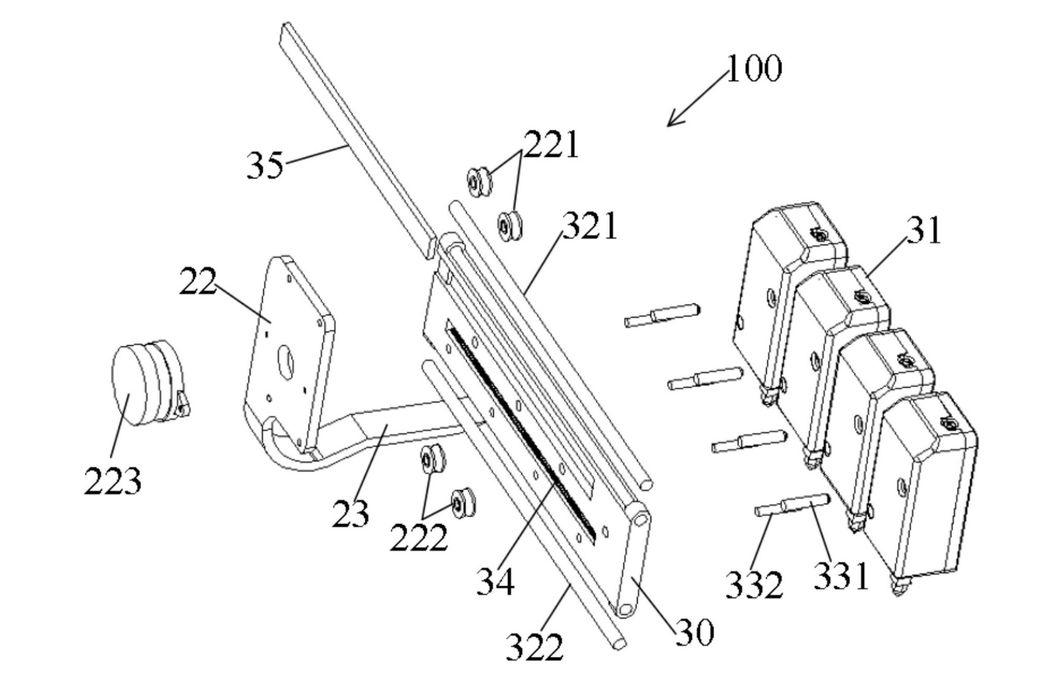
The idea is not just another fixed dual extruder. Instead, the patent describes a movable toolhead seat on the printer’s motion rail, plus a separate toolhead mounting rack positioned near one end of that rail. Multiple printheads sit on the rack in a row. When a printhead is needed, the rack moves sideways until the selected head lines up with the carriage. The carriage moves to the end of the rail, locks onto the head, and then carries it away for printing.
In other words, the printer does not need to drag every nozzle around all the time.
Multi material and multi nozzle FFF systems often become heavy, bulky, or mechanically awkward. A fixed dual nozzle adds mass to the carriage and can cause ooze, alignment, and idle nozzle problems. Toolchanger systems can avoid some of that, but they usually require a frame and parking system designed around the toolchanger from the beginning.
Flashforge’s patent is trying to separate the tool storage system from the printer frame. The document specifically notes that existing approaches are often tied to CoreXY layouts and may not easily fit other common structures, including Prusa i3 style machines. The proposed support bracket is described as detachable and mounted near the end of the printer’s motion rail.
That suggests a possible retrofit or platform sharing angle. If Flashforge can make one head storage and switching module work across several printer architectures, it could reduce engineering duplication across product lines.
The patent also hints at scalability. Because the printheads are stored on a moving rack outside the main print motion path, the number of available heads is less directly limited by the printer’s frame volume. The figures describe four printheads, but the claims are broader than that.
The locking mechanism is also interesting. One version uses an electromagnet on the carriage and a magnetic metal plate on each printhead. Another uses a locking ring and protruding locking boss. The patent also describes locating pins, a sensing circuit board, and a rack and pinion or belt driven linear movement system for indexing the stored printheads. It even specifies that the head and carriage may meet with no gap or within plus or minus 0.1mm.
However, toolchanging is only partly a mechanical problem. The hard parts include nozzle offsets, temperature management, filament paths, cable routing, purge strategy, slicing support, and making the process reliable after thousands of swaps.
There is also a commercial question. A multi head FFF machine must justify its complexity. 3D printer operators will tolerate toolchanging only if it clearly improves material combinations, color workflows, support removal, maintenance, or throughput. Otherwise, a simpler single nozzle machine plus an automated filament system may be good enough.
Nevertheless, this is a very interesting concept from Flashforge. A compact toolchanger that is less dependent on the printer’s frame could give Flashforge a way to differentiate their future FFF machines from the competition.
Via Espacenet
