
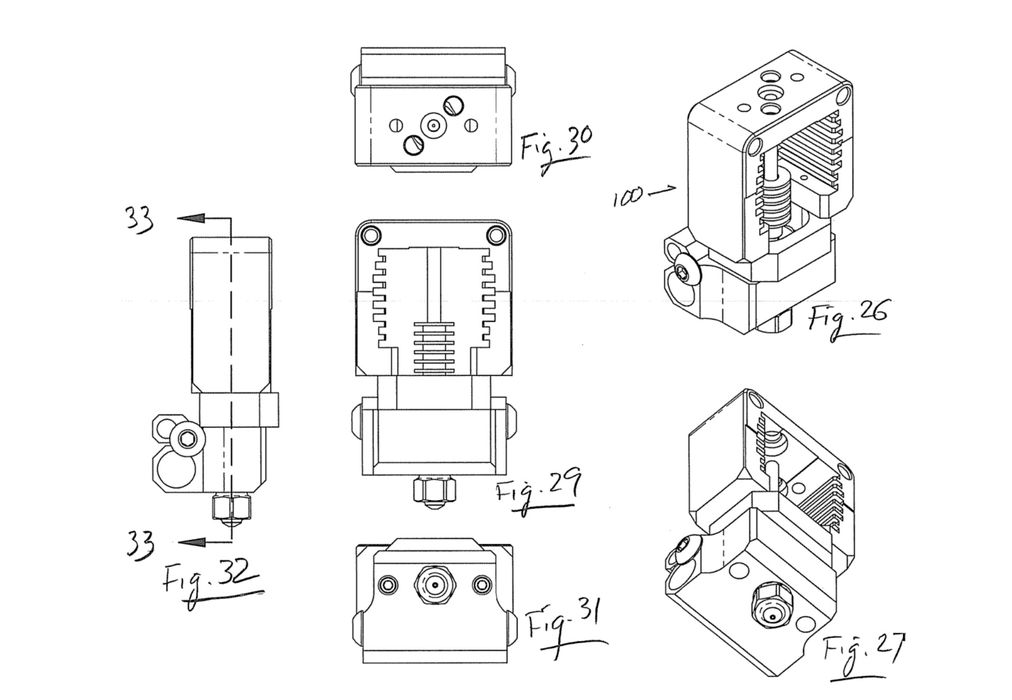
Slice Engineering has secured a European patent covering an FFF hotend design that simplifies the heatbreak.
European patent EP3625025B1, assigned to Slice Engineering LLC, was granted in March 2026. The patent describes an “adaptable, high performance extrusion head” for Fused Filament Fabrication (FFF) systems.
The idea is all about separating thermal and mechanical functions inside the hotend.
Why is that so important? Traditional all metal hotends typically use a thin stainless steel heatbreak connecting the heater block to the cold side. That component has to minimize heat transfer, but it also has to physically support the heater block and withstand forces generated by filament feeding, failed prints and accidental impacts.
Those requirements can cause problems. Have you ever encountered a bent hot end?
A thinner wall provides better thermal isolation, while a thicker wall provides more mechanical strength. The patent describes this compromise as a limitation on FFF machine performance, and it certainly is.
Moving The Mechanical Load
Slice Engineering’s design changes the load path.
The filament passes through a very thin metal feed tube spanning the hot and cold sections. Meanwhile, separate spacer and tension components form a rigid mechanical bridge between the heater and cooler. The patent claims these components partially remove mechanical loading from the filament tube.
In other words, the heatbreak can just be a heatbreak, and the strength function happens elsewhere.
The patent suggests stainless steel or zirconia feed tubes with wall thicknesses as low as 0.025mm, with prototypes using commercially available 14XX hypodermic tubing approximately 0.08mm thick. Because this tube no longer has to carry the entire structure, it can be dramatically thinner than conventional designs.
That reduced cross section area means less heat can conduct toward the cold end. This should make the heartbreak more effective. The patent document says prototypes could potentially dispense with a conventional finned heatsink or liquid cooling, while also allowing a smaller cooling fan, reduced hotend dimensions and lower mass.
This is quite an interesting design.
FFF hotends often have a tradeoff between throughput and detail when changing the length of the melt zone. A longer hot zone can transfer more energy into rapidly moving filament (higher throughput), while a shorter arrangement is better suited to smaller nozzles and lower flow (the detail).
Slice Engineering proposes interchangeable sleeves that extend upward toward the cold zone instead. Different sleeve lengths could therefore alter the effective hot zone without changing the overall nozzle position.
That could make switching between high flow and high resolution configurations considerably less troublesome.
The patent even anticipates adapters for different FFF machines, noting that the relatively cool adapter region could be made from nonmetal materials and potentially fabricated by 3D printer operators themselves.
This idea is fascinating. Instead of improving the heatbreak material by itself, the design here removes the structural requirement that makes heatbreak design difficult in the first place. That opens considerably more freedom for future high flow FFF hotends: lighter weight toolheads and improved performance.
Via Espacenet
