
Hybrid Manufacturing Technologies has published a European patent application describing a way to make toolheads work like CNC tools.
The application, EP4786088A2, was published on August 5, 2026, with Hybrid Manufacturing Technologies Limited as the applicant. It is a divisional application derived from an earlier European filing, ultimately claiming priority from a 2017 British application.
That history is kinda important: this isn’t necessarily a brand new invention appearing in 2026. Instead, it shows the company continuing to develop and protect an architecture it has been working on for years.
Hybrid Manufacturing Technologies specializes in turning conventional CNC equipment into hybrid systems capable of both additive and subtractive operations. The obvious challenge is that a milling cutter is quite easy to change automatically, while an additive head may require powder, wire, polymer, shielding gas, cooling water, electrical power, sensors or even laser energy, and a ton of calibration, too.
Connecting all of that automatically — and correctly —- gets pretty complicated.
The patent proposes putting a manifold into or alongside the CNC machine’s existing stop block, the structure normally used with an anti-rotation arm to prevent certain tools from spinning with the spindle. The processing head carries a corresponding manifold.
When the machine loads the processing head, the anti-rotation mechanism simultaneously positions the two manifolds so that energy and media can pass into the head.
In other words, the ordinary CNC tool changing mechanism effectively becomes an automated process changing system.
A machine might automatically switch from milling to material deposition, then to inspection, and back again without an operator manually connecting hoses and cables.
The patent is, of course, deliberately broad about what those connections could carry. It describes additive heads handling metals, polymers and ceramics, with feedstock including powder, filament, wire, pellets and other forms. Inspection and measurement heads are also contemplated.
A More Sophisticated Dock
One particularly interesting portion of the patent covers multistage docking.
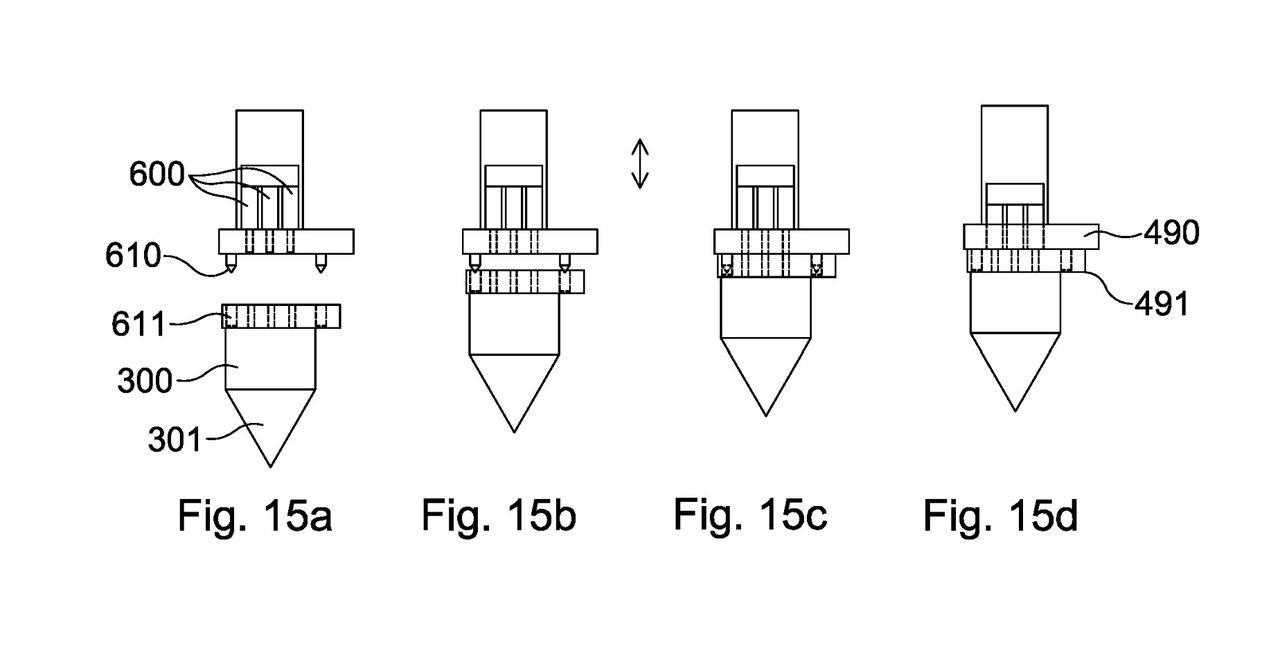
Rather than forcing every electrical, gas, water and media connector together during the initial tool change movement, the system can first make a coarse mechanical connection and then perform another, much smaller movement to align delicate connections.
The patent describes initial alignment errors potentially in the 1-20mm range, followed by fine movements of less than 1mm and potentially down to only a few tens of microns.
That approach could also reduce the stiffness required from the machine or robot performing the exchange. A single docking movement involving multiple connectors can generate surprisingly large forces, potentially requiring heavier and more expensive hardware.
There is also provision for protective covers to keep chips, cutting fluid and other contamination away from sensitive interfaces. That’s important when combining additive equipment with CNC machining, where the working platform can be hazardous for optical, electrical and fluid connectors.
The concept could eventually make hybrid manufacturing considerably more automated. Instead of buying a machine permanently configured around one additive process, manufacturers could theoretically maintain a collection of processing heads and have the CNC controller select them as required.
If additive heads can be exchanged as casually as CNC cutters, hybrid manufacturing becomes far more easier to automate.
Via Espacenet
