
Researchers have developed a 3D printing technique that can program opposite actuation behaviors into different sections of the same printed filament.
Liquid crystal elastomers, or LCEs, are unusual polymers capable of significant reversible deformation when heated. Their molecular orientation can be set during fabrication, effectively programming how the finished structure will move.
Direct ink writing has become an important method for producing these structures because flow through a nozzle can orient the liquid crystal molecules. Once the material is cured, that molecular alignment remains encoded in the printed object.
But there’s been a limitation: Typical DIW processes use nematic liquid crystal inks, whose molecules tend to align parallel with the extrusion path. That means each filament generally has one basic response: contraction along its printed direction.
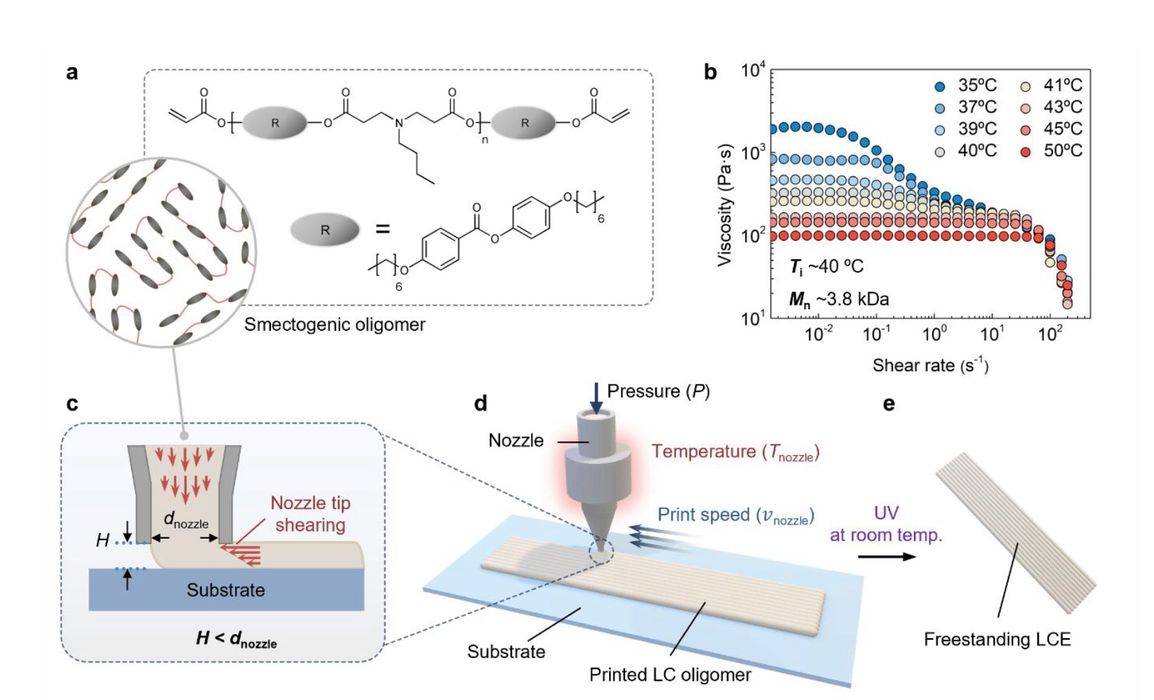
Researchers from Pusan National University and Oak Ridge National Laboratory have now demonstrated a different approach using smectic liquid crystal elastomers.
Switching Alignment During Printing
Smectic liquid crystals have a layered molecular structure, and that turns out to provide another degree of control.
At relatively low shear rates, those layers remain intact and the molecular director becomes oriented perpendicular to the extrusion direction. Increase the shear rate or temperature enough to disrupt the layers, and the molecules instead align parallel with the flow.
In other words, changing printer settings can switch the eventual direction of actuation without changing either the material or toolpath.
The researchers used a Dr. INVIVO 4D DIW system with a 0.4 mm nozzle, typically printing about 0.2 mm above the substrate at 500 kPa. Experiments varied nozzle temperature and travel speed to control shear conditions.
The interesting part is that speed control could make the transition essentially instantaneous. Temperature changes require time for heating and cooling, while changing print speed can happen continuously within a toolpath.
This allowed individual filament sections as short as about one millimeter (!) to receive different molecular orientations.
The resulting actuation range was substantial. By adjusting nozzle temperature between 35C and 45C and print speed between two and 20 mm/s, single filaments ranged from 28% elongation to 31% contraction.
From Filaments to Moving Surfaces
The team printed structures that transformed into cones, saddle shapes, lattices and other geometries when heated.
Some were surprisingly strong. An egg crate structure supported roughly 266 times its own weight, while a multi cone design lifted around 887 times its weight.
The researchers also combined the printed LCE with a shape memory polymer substrate. By varying print speed along individual paths, they produced surfaces that formed waves, dimples and even a three dimensional facial topography under near infrared heating.
Durability testing is encouraging as well. A sample underwent 100 heating and cooling cycles between 10C and 100C with only about a 1.5% change in actuation strain.
There are quite a few potential applications for this type of programmable material:
- Morphing aerodynamic surfaces that develop dimples, ribs or other textures to alter airflow.
- Dynamic Braille and tactile displays capable of raising buttons, dots or directional cues.
- Soft robotic grippers with different regions programmed to curl, contract or expand.
- Artificial muscles and tendons containing multiple actuation behaviors within a single filament.
- Adaptive vents, filters and louvers whose openings increase or decrease with temperature.
- Seating, footwear or support surfaces able to change local shape or texture.
- Deployable medical devices that enter the body compactly and subsequently reshape.
- Adaptive gripping pads that generate temporary ridges or dimples around an object.
- Shape changing controls that remain flat until buttons or other interface elements are required.
- Variable optical or acoustic surfaces that alter their geometry to change how waves are reflected.
Some of these are extrapolations beyond the demonstrations in the research, but the underlying capability makes them conceivable.
Programming Material With GCODE
This concept is quite intriguing because some of the complexity moves from geometry into GCODE. Instead of designing elaborate toolpaths or combining several active materials to produce different movements, the printer can alter molecular behavior merely by changing speed.
Future design software could conceivably use a second data layer alongside the conventional CAD geometry. That layer would describe which regions should later expand, contract, curl, flatten or buckle, with the slicer translating those instructions into appropriate processing conditions.
At that point, print speed would no longer describe only how quickly the printer moves. It would become part of the material definition itself.
Via Nature
