
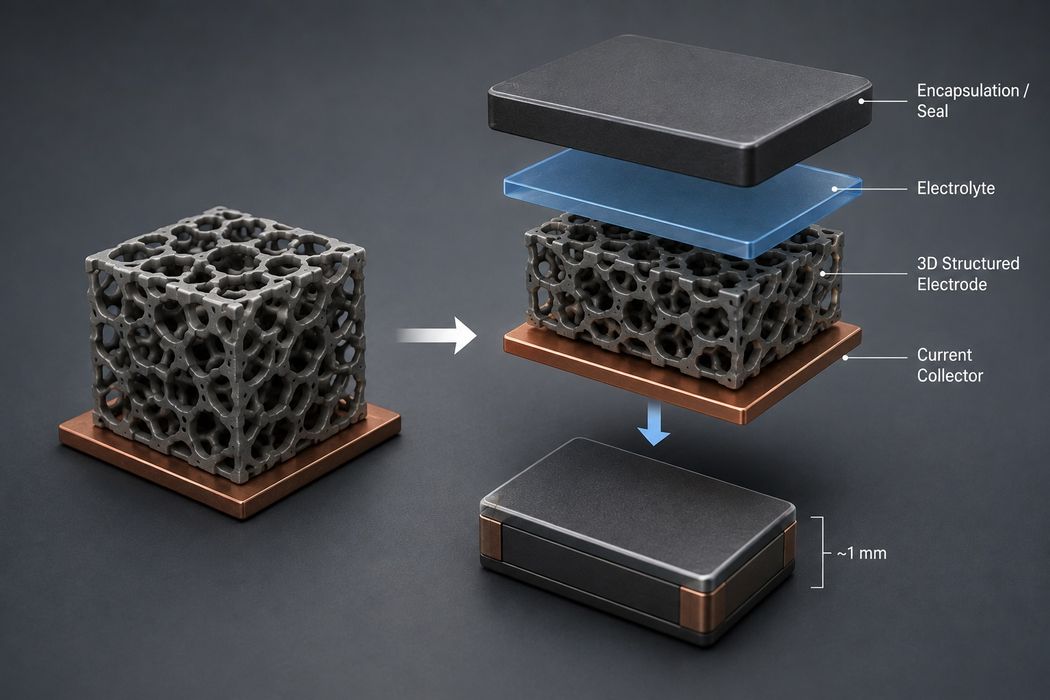
Microscale energy storage is an unusual but potentially valuable target for additive manufacturing.
Researchers at King Abdullah University of Science and Technology (KAUST) have been working on Microscale Electrochemical Capacitors & Batteries, an area focused on squeezing useful amounts of electrical energy storage into extremely small spaces.
These devices are intended for applications such as compact sensors, medical devices, wearables, Internet of Things hardware, and other electronics where there simply isn’t much room for a conventional battery.
At that scale, the shape of the battery starts to matter quite a bit.
Going Up Instead Of Out
Traditional microelectronics manufacturing is very good at producing thin, flat structures. That works well for circuits, but batteries face a simple problem: adding more active material usually means taking up more surface area.
One way around that is to build upward.
A three dimensional electrode can potentially pack more active material and more electrode surface into the same footprint. It can also include channels and gaps that help electrolyte move through the structure.
That’s where additive manufacturing becomes interesting.
Instead of merely 3D printing a housing for a tiny battery, an AM process could be used to make some of the internal structures responsible for actually storing and delivering energy.
For microscale electrochemical capacitors, often called supercapacitors, this could help produce devices capable of very rapid charging and discharging. For microbatteries, the goal would generally be to increase stored energy without making the overall device much larger.
Several additive processes could play a role.
Direct ink writing is an obvious candidate because it can deposit relatively thick pastes containing electrode materials. Aerosol-based deposition and material jetting can place functional materials more precisely. Vat photopolymerization could also be used to print highly detailed structures that are later coated or metallized to produce functional electrodes.
The attraction here is less about replacing conventional batteries and more about creating energy storage in places where conventional battery shapes don’t fit very well.
A sensor manufacturer, for example, might eventually be able to design an energy storage structure around other components inside a device rather than reserving a rectangular space for a separate battery.
That’s a very AM-like proposition.
The Hard Part Comes After Printing
Unfortunately, making a complicated electrode shape doesn’t automatically make a better battery.
The printed structure still has to deal with conductivity, porosity, electrode chemistry, electrolyte movement, current collection, sealing, charging behavior, and hundreds or thousands of charge cycles.
Some of those requirements work against each other.
Increasing porosity can help electrolyte reach more of the electrode, but it can also reduce the amount of active material in a given volume. Adding conductive materials can improve electrical performance, but again leaves less space for the material actually storing energy.
Even the printing process creates problems. Fine structures may shrink or crack during drying and curing. Thick regions can slow ion transport. Microscopic batteries also have to be sealed against moisture and contamination, which can be difficult regardless of how the electrodes were produced.
This is one reason many impressive laboratory demonstrations never turn into commercial products.
The available KAUST research record also doesn’t provide enough information to judge a particular printing process, battery chemistry, cycle life, capacity, manufacturing cost, or commercialization path. Those numbers would ultimately determine whether this approach is genuinely useful.
There is also the issue of speed.
Semiconductor manufacturing is already extraordinarily good at making huge numbers of small planar devices. Additive manufacturing will probably have to offer something conventional processes cannot easily provide, such as unusually complex geometry, integrated structures, customization, or better use of limited space.
That may still be enough.
A microscopic power source could be extremely valuable if its shape allows an entirely new sensor, medical device, or autonomous system to exist. In those applications, the amount of material involved is almost irrelevant.
