
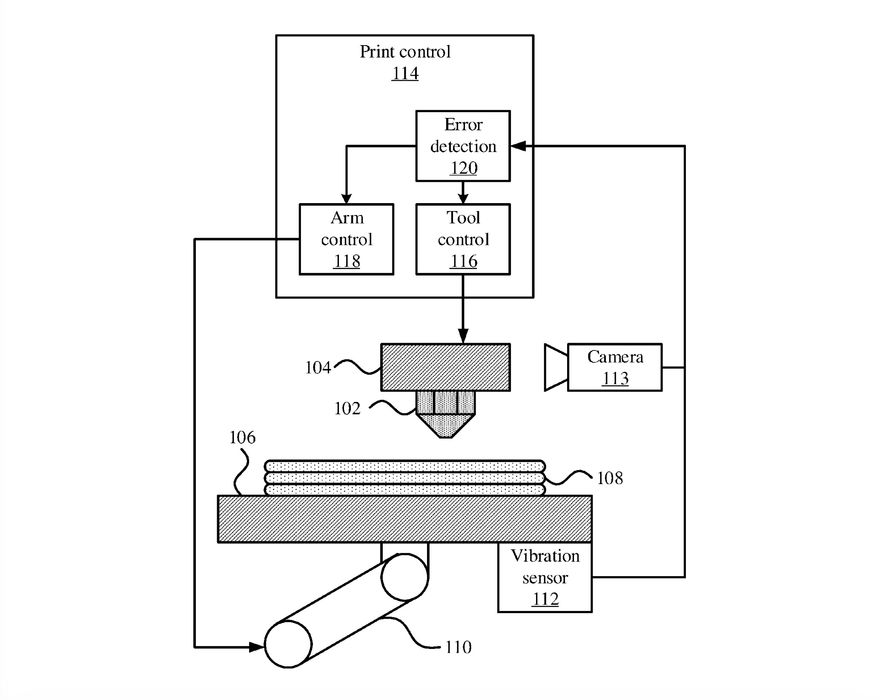
IBM has patented a way to make robotic “5D printing” compensate automatically when the workpiece moves during fabrication.
The concept appears in US patent application US20260225318A1, assigned to International Business Machines Corporation, a.k.a IBM, and is titled “5D Printing With Dynamically Collaborating Robotic Systems.”
We’ve already heard of “4D printing”, which is simply 3D printing an object that later can change its shape.
Here, IBM’s term “5D printing” has a very specific meaning. IBM describes a manufacturing setup where the orientation between the tool and the workpiece can change in two rotational dimensions, in addition to the usual three spatial axes.
That allows deposition or machining to occur on surfaces that would otherwise be difficult to reach. The workpiece could be rotated while an additive tool deposits material, for example, potentially avoiding the conventional stack of parallel layers.
But moving the workpiece creates another problem: keeping it exactly where the control software thinks it is.
Two Robots Have To Work Together
IBM’s proposed system uses one robotic system to hold and orient the part, while another system operates the manufacturing tool.
That tool could be an additive manufacturing nozzle, laser, mill, drill or another process head. IBM even contemplates switching between additive and subtractive operations during production.
The difficulty is that the tool can push, vibrate or otherwise disturb the workpiece. Depositing additional material also changes the part’s weight and center of mass as the job proceeds.
IBM’s idea is to monitor those effects continuously.
A vibration sensor can detect movement of the print bed or workpiece, while one or more cameras can identify positional errors. The patent also contemplates temperature, torque and force sensors.
When unwanted movement is detected, the controller can alter either side of the process. It could change filament feed rate, spindle speed or laser intensity, for example. Alternatively, the gripping robot could change its position, grip force or the counterforce it applies against the manufacturing tool.
In other words, the two robots dynamically cooperate rather than simply following independent motion programs — and eventually running into a conflict.
Closed Loop Control For Complex Toolpaths
Multi axis additive manufacturing works best when the tool and workpiece remain precisely synchronized. A tiny positional error that might be harmless in a conventional flat layer could put material on the wrong surface when the part has been rotated to a new orientation.
IBM proposes continuously measuring that error and compensating while manufacturing continues.
The controller could even recalculate the workpiece’s center of mass as material is added or removed, then redistribute gripping forces to keep the part stable.
That could reduce one of the common problems with robotic additive systems: carefully calibrating a particular tool, robot and fixture combination before production. IBM specifically suggests that arbitrary robotic systems could potentially work together without extensive recalibration — that could lead to some very interesting machine combinations.
The patent goes further by describing repeated changes in orientation and process. A part might undergo additive deposition in one orientation, rotate, receive another operation, and eventually move into inspection or finishing.
This starts to look less like a conventional 3D printer and more like an automated manufacturing cell with additive capability.
If this approach really works, multi axis additive manufacturing could become considerably easier to deploy.
Then the question becomes a bit different: should device manufacturers continue design better robotic 3D printers — or instead design robots that cooperate with each other?
Via Espacenet
