
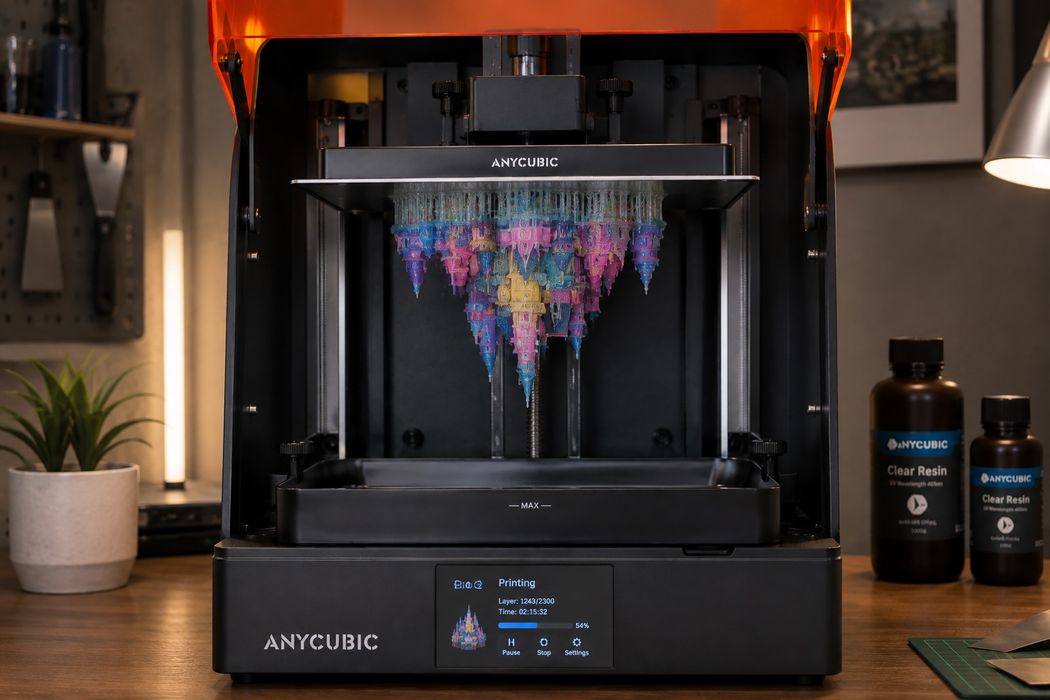
Anycubic has patented an unusual way to produce multicolor resin prints without painting them afterwards.
Chinese patent application CN122539644A was published on August 11, 2026, with applicant Shenzhen Zongwei Lifang Technology Co., Ltd., that’s the company behind Anycubic.
Resin 3D printers generally produce parts in whatever color resin happens to be in the vat. Switching resins can produce color changes along the Z axis, while genuinely multicolor parts normally require painting or another post processing operation.
Anycubic’s concept moves the coloring operation inside the printing process.
Printing Color Before The Resin
The proposed machine first deposits a thin color layer directly onto the build surface or release film. A transparent or translucent photopolymer forming material is then placed over that color, and the normal image for the layer is exposed.
The pigment and resin therefore become part of the same printed layer. Repeating the operation builds color into the model as printing proceeds.
The patent describes a coating mechanism with individually controllable nozzles that moves across the release film. Multiple paints could be supplied, including combinations such as cyan, magenta, yellow, black and white. Colors could also be mixed before deposition or directly on the film.
More importantly, different portions of a single layer can receive different colors. That opens the door to details that cannot be produced simply by swapping an entire vat of resin between layers.
The system doesn’t necessarily have to color the whole cross section either. Anycubic describes depositing pigment mainly around the perimeter of a layer, where it will remain visible through the transparent resin. Interior areas could remain uncolored, reducing both paint consumption and coating time.
A Much More Complicated Layer Cycle
There is, however, quite a bit going on between exposures.
The machine may partially cure the color coating so that it remains fixed to the release film rather than flowing or mixing when resin arrives. The resin then has to be added, the platform positioned, the complete layer exposed, and the platform lifted.
Before another colored layer can be produced, unused resin may have to be pumped away to expose the release surface again. The patent even describes a movable scraper for removing residual material before the next coating operation.
In other words, this isn’t simply an inkjet head bolted onto an MSLA machine. It potentially adds coating, color mixing, curing, resin pumping and cleaning operations to the normal layer cycle.
That could make print speed the big question. Consumer resin machines have become dramatically faster in recent years, and adding several mechanical operations to selected layers could give some (or a lot) of that throughput back.
Anycubic does suggest that color layers could be applied only periodically, with ordinary resin layers printed between them. Because resin layers are thin, the embedded colors could remain visually effective while reducing the number of coating cycles.
If implemented well, the concept could give Anycubic something quite different from today’s race for resolution and speed. Full color resin output would be immediately understandable to buyers producing figurines, prototypes, educational models and display objects.
The big challenge will be making all those extra operations reliable enough that 3D printer operators consider the color worth the additional machinery. Color is easy to sell; automated resin handling, pigment registration and cleaning are considerably harder to engineer.
Via Espacenet
