
Bambu Lab has a new patent that seems to describe something beyond their advanced Vortek technology.
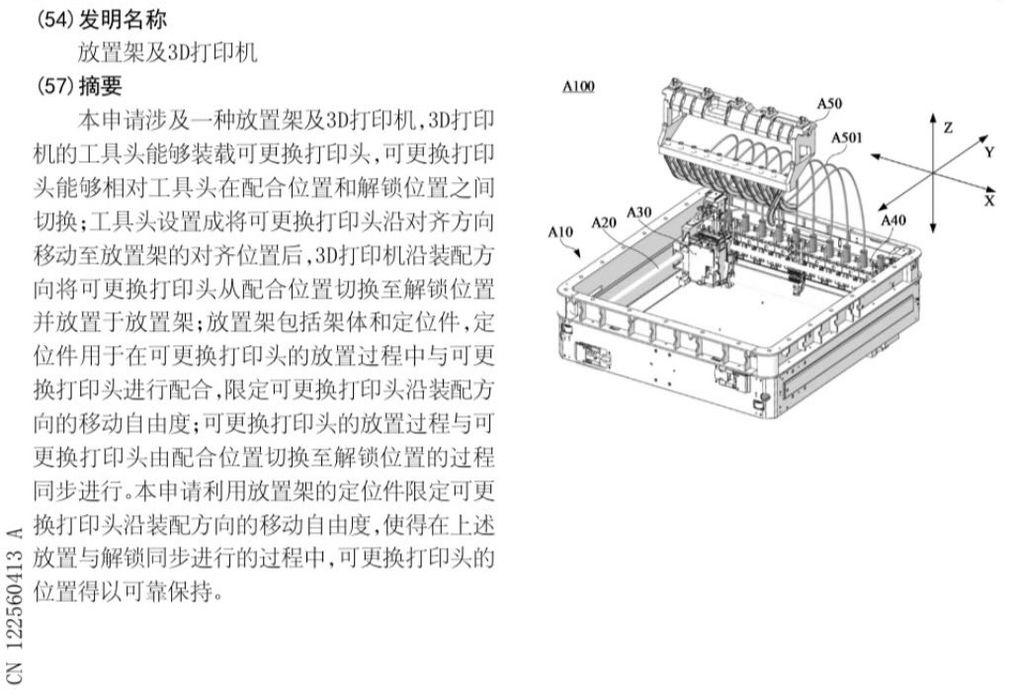
A tweet from @bokushumei showed diagrams from the Chinese patent, CN122560413A. At this time, I was unable to find a full copy of the patent in my usual sources; it’s just that new. However, @bokushumei’s diagrams give away what’s going on.
To recap: most major 3D printer manufacturers are moving away from the incredibly wasteful filament swapping technology to low waste solutions. Prusa Research has their XL toolchanger (and INDX when shipped), Snapmaker has their U1 toolchanger, and Bambu Lab itself has their Vortek technology that swaps hot ends to reduce waste.
Vortek was announced last year, and everyone believed that was Bambu Lab’s go-to technology for the future low waste 3D print universe.
But this patent seems to suggest there is another step that Bambu Lab could take, should they commercialize the concepts in the patent.
What’s in the patent? It turns out there are possibly three patents involved:
- CN122560409A — toolhead / 3D printer / 3D-printing system, involving a nozzle cooling duct that also houses nozzle illumination.
- CN122560412A — placement rack for a replaceable printhead.
- CN122560413A — another placement-rack/toolchanger architecture, apparently covering a somewhat different positioning/locking arrangement.
It is possible these are interrelated and might even support a common toolchanger concept.
The main idea is that there is a toolhead that is capable of carrying a removable printhead. In the patent diagram, you can see a group of printheads at the rear of the machine, ready for use. This is effectively a toolchanger.
Here’s how it works: the printer’s toolhead can carry a replaceable printhead. That replaceable printhead switches between a coupled position and an unlocked position. The printer moves the head to a corresponding location on a storage rack, and the rack has positioning features that constrain the replaceable head while the machine performs the unlocking motion. The key point is that placing the head onto the rack and unlocking it can occur as part of the same coordinated movement.
Bambu Lab’s H2C system has two toolhead positions, one is fixed and the other can accept any of six Vortek hot ends that are swapped in as required during a print job.
But how is the new approach different? What makes CN122560413A better than Vortek?
The patent doesn’t make clear whether this is an extension of Vortek development or a separate future architecture. What is clear from the drawings is that the removable component appears considerably more substantial than the Vortek induction hot ends used by the H2C.
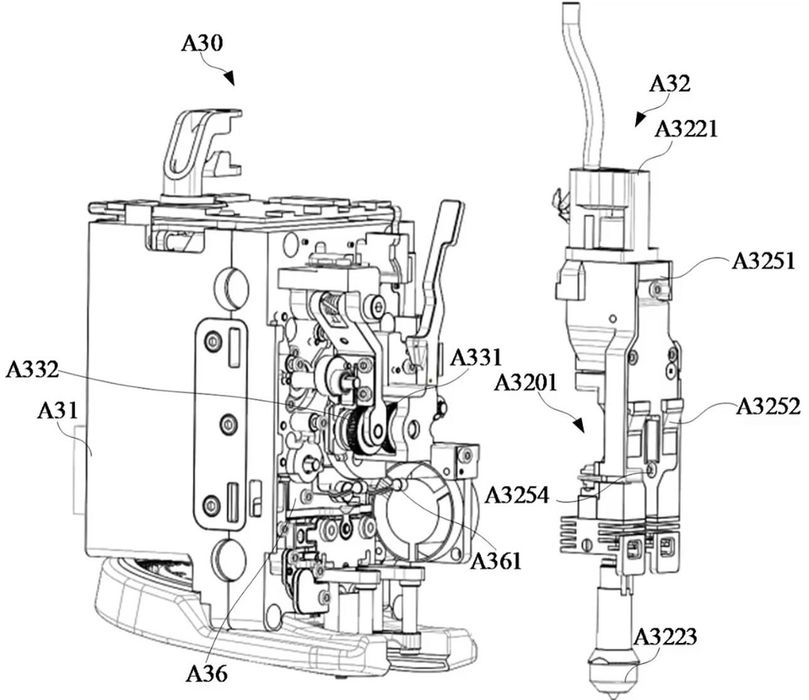
The big difference is that we’re swapping in a printhead, not just a hot end. In the diagram above you can see that there’s a lot more going on than just the hot end portion.
The other difference is that the concept seems to involve more printheads than Vortek, and that the machine is designed around the swapping concept — unlike the H2C, which is essentially a H2D with one toolhead using Vortek.
The patent seems to show that the carriage can safely deposit a printhead on the storage rack and simultaneously release it from the toolhead, and reverse the process to pick up a printhead. Patent CN122560412A seems to cover the alignment method for this process.
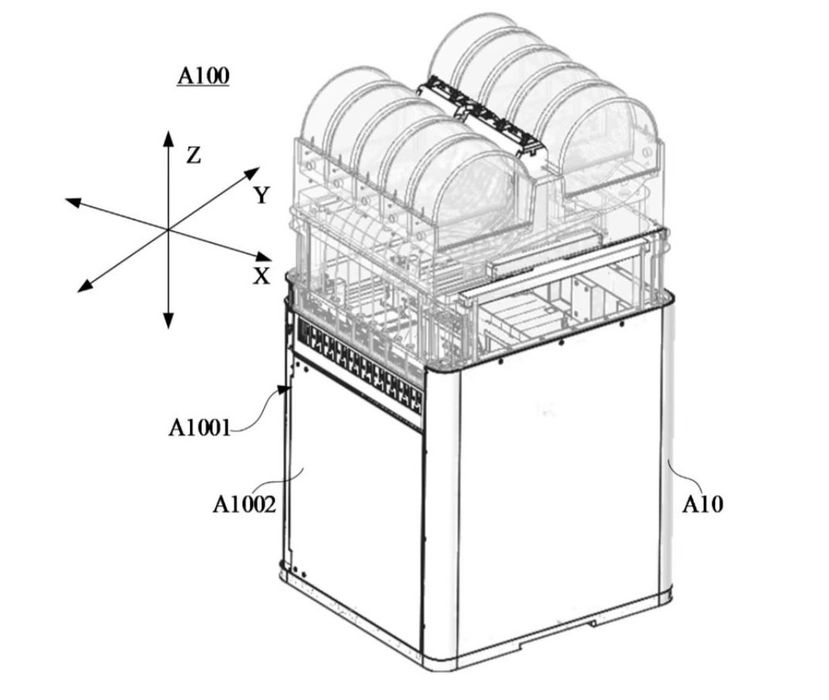
The drawing also shows a large bank of filament spools directly above the parked printheads, with what appear to be individual feed paths running downward. One intriguing possibility is that the design allows materials to remain associated with individual printheads, although the available patent pages don’t yet establish exactly how filament routing works.
In that situation, there would be no need for an AMS because all materials are available all the time. You’d have to have a pathological job that requires more than ten different materials to exceed the switching capacity in this concept.
However, this is a patent diagram that describes a concept. A real implementation of this might have more or fewer toolheads — as long as they follow the main concept.
Nevertheless, the ten spools on top are quite interesting. The machine in the diagram also looks physically substantial, with a wide bank of spool positions and printhead docks. But patent drawings should not be treated as scale drawings, so it would be premature to infer the machine’s build volume from the illustration.”
This is all quite exciting, but please remember that this is only a patent. It might not ever become a real product, and it could even be a move to block competitors that are thinking about a similar style of machine.
Whatever happens, we do know that the future of desktop 3D printing will be low waste.
Via X
