
Meshy has released a new version of their AI-powered image-to-3D model service.
They released Meshy 7, an upgrade over the previous Meshy 6. What’s different? It seems they have focused on something they call “3D geometry alignment”.
This is the fancy term for: “did it actually match the input image?” That is indeed a problem with many of today’s image-to-3D services: a very nice image is turned into a rough and poorly representative 3D model.
That is what’s powering the AI slop problem in many online 3D model repositories. I’ve written about this previously, where the 3D model is nowhere near the same as the image presented. It looks like Meshy wants to eliminate that problem with Meshy 7.
I’m glad they’re doing this, because everyone should be able to generate accurate 3D models from images. That really hasn’t been the case with most tools, unless you happen to be lucky.
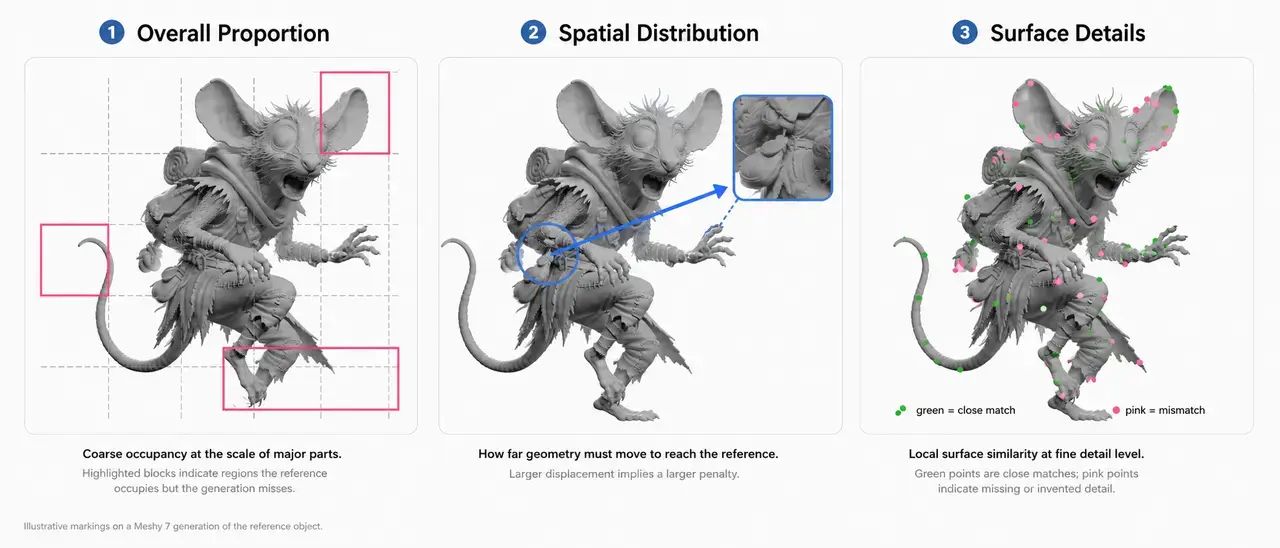
How did they do this? Their first step was to invent a method of measuring accuracy. They developed their “first” 3D Geometry Alignment Benchmark. This is a test that measures three important factors:
- Overall Proportion: measures whether major elements of the generated model occupy the same region of 3D space. This looks at the model as a whole.
- Spatial Distribution: measures the fine details, looking at how far off each generated point is from a reference model.
- Surface Details: measures the quality of the surface for missing or extra geometry.
Armed with a measurement tool, they can then do some measuring. They benchmarked the new Meshy 7 against four competitors, suspiciously named T1, H1, R1, and H2. (By mere coincidence, Meshy’s main competitors happen to be Tribo, Hi3D, Rodin, and Hunyuan.)
Here are the results of their testing:
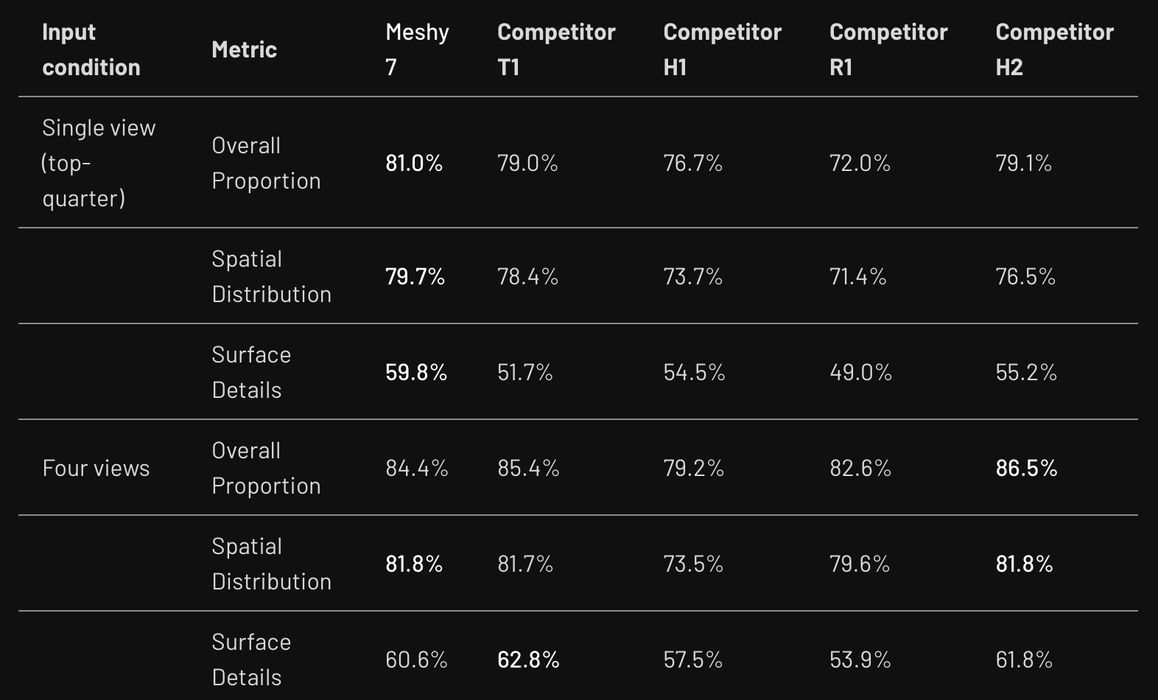
Meshy 7 comes out quite well on the testing, although the measurements in each category are really fairly close. I do notice that all of them are pretty poor on surface detail, which aligns with my experiences.
Interestingly, they didn’t list the results for Meshy 6.
Meshy does state that there are further measurements that could be taken, including texture alignment. That’s the surface colouring that is also generated during the process, and is separate from the geometry. But you have to have geometry before you can have a texture, and for 3D print purposes, the geometry matters a lot more.
What did they change in Meshy 7 to improve the results? They say they improved the image encoder to use higher resolutions, and rebuilt the training data with examples that have tighter alignment. They also now use alignment as their key metric when iterating through training loops.
For Meshy users, this just makes things better; for others, it makes the choice between Meshy and its competitors a bit more complicated.
Regardless, I see this as a continuation of the refinement of AI 3D technology. With each new release, the results are getting better and at some point will become much more usable than they are today.
Via Meshy
