
A new study looks at something most 3D printer operators might not think about: how much the nozzle diameter can change the performance of wood-filled PLA.
Normally, swapping nozzles is pretty straightforward. Want more detail? Use a smaller nozzle. Want to print faster, or push chunky material through more reliably? Install a bigger one.
It turns out that wood-filled PLA makes that decision a little bit more complex.
The PLA material contains actual wood particles mixed into the polymer, and those particles can affect flow, clogging, extrusion consistency and even how well adjacent extrusion lines bond together. That means changing nozzle diameter could do more than alter print resolution or print time.
It could change the part itself.
What Happens Inside The Print?
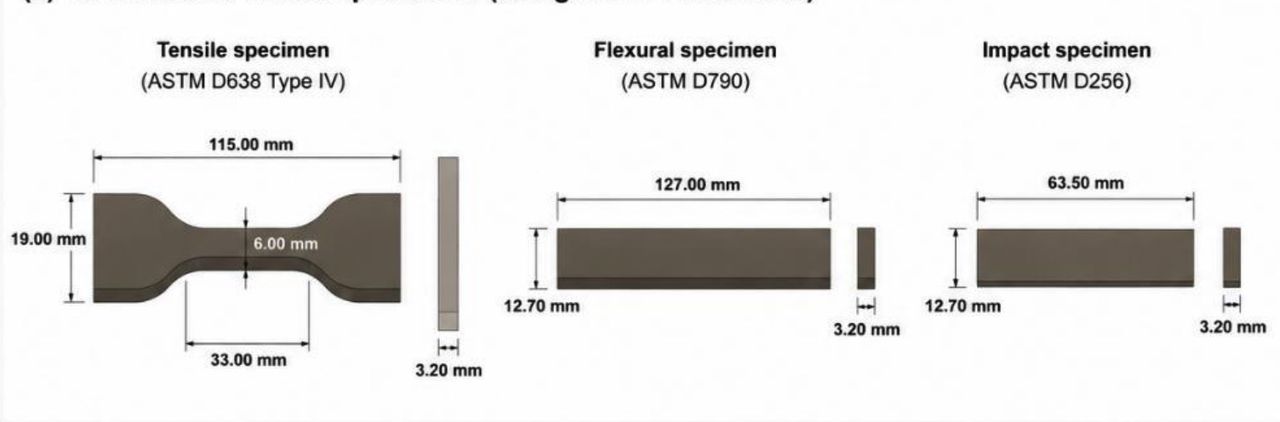
The study, titled “Influence of nozzle diameter on mechanical performance and density behavior of wood-reinforced PLA composites fabricated via Fused Filament Fabrication (FFF)”, examines the relationship between nozzle size, density and mechanical performance.
A larger nozzle produces wider extrusion lines, which means fewer toolpaths are needed to fill the same area. It also generally allows much higher flow rates. That’s why larger nozzles are often recommended for filled materials in the first place: there’s simply more room for the particles to get through, and a lower probability of clogging.
But it seems that there could be consequences.
Changing extrusion width changes how the extrusion lines overlap, how voids form, how heat moves between adjacent lines and potentially how well the material consolidates. With ordinary PLA these effects can already influence part strength.
Add wood particles and there are even more variables.
The particles may not be evenly distributed, and larger particles or clumps can behave very differently when forced through a narrow nozzle. Pressure inside the hot end will also change with nozzle diameter, as will the conditions experienced by the polymer immediately before deposition.
So while a nozzle swap might look like a simple and common productivity decision, it could also change the internal structure of the part. That’s worth knowing if you’re printing something more serious than a decorative item.
Wood-filled materials are sometimes used for prototypes, fixtures, consumer products and other low-load parts where the appearance and stiffness of the composite are useful. In those cases, increasing throughput with a larger nozzle would certainly be useful — assuming the resulting parts still perform as expected.
There’s A Catch
Wood PLA is particularly troublesome because there really isn’t one standard “wood PLA”. Different suppliers use different percentages of wood material, different particle sizes and different PLA formulations. Worse, there are many different types of wood, and even within a species samples can vary. No two pieces of wood are the same, and that should carry forward into filament.
A nozzle size that works very well with one spool might behave quite differently with another. For composite materials like wood-filled PLA, the nozzle should really be part of the material processing parameters.
Via Turkish Journal of Forest Science
