
A new research paper looks at something resin 3D printing has never been particularly good at: dealing with what happens to the leftover material after printing.
The paper, “Closed Loop Recycling and Reprinting of Vat Photopolymerized Thermosetting Resins: Recent Advances and Future Perspectives,” examines whether used photopolymer material could eventually be recovered and turned back into printable resin.
That would be a pretty big deal, and having generated lots of resin printing waste myself, I am quite interested in this solution.
SLA, DLP, MSLA and other resin processes can produce extremely detailed parts, but there has always been an tricky problem with the material. Virtually all photopolymer resins become permanently crosslinked when exposed to light.
In other words, once cured, you can’t simply melt the stuff down and print with it again. You can do that with FFF systems because they use thermplastics. But resins are typically thermosets.
Unused liquid resin is one thing: just clean it and reuse it. Failed prints, support structures and old parts are something else entirely. Once cured, they usually end up as waste.
For occasional desktop printing that may not seem like much of a problem. But imagine a dental lab, service bureau or factory running dozens of resin machines every day. Suddenly there can be quite a pile of cured resin heading out the door, every day.
Can You Turn A Printed Part Back Into Resin?
That’s the question behind closed-loop photopolymer recycling.
The goal isn’t simply to grind old prints into powder and mix them into something else. Ideally, material from a used print would somehow make its way back into a resin formulation that could be loaded into a vat and printed again.
That’s considerably harder than recycling thermoplastic filament.
A recycled resin still has to flow correctly, cure at the expected wavelength and behave properly during exposure. It also has to produce parts with reasonably predictable mechanical properties.
There are several possible ways to get there.
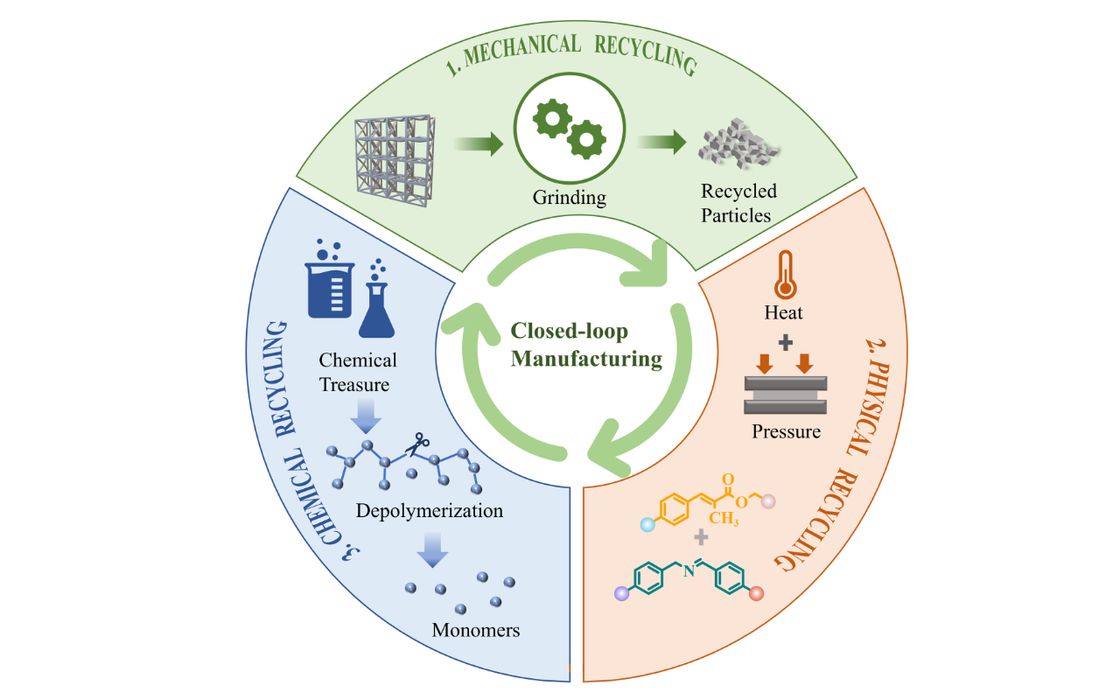
One approach is to design the original resin with chemical bonds that can later be reversed. Another is to chemically break the cured material back into useful components. A third possibility is to recover part of the material and blend it into fresh resin.
None of these approaches is particularly simple, but they point toward something the resin 3D printing world doesn’t really have today: a way back from cured parts to usable printing resin.
A company using large quantities of resin could potentially recover some value from failed builds, supports and end-of-life parts instead of paying to dispose of them.
For resin manufacturers, it could also become an important product feature. Today most sustainability advice amounts to minimizing waste and using as much of the resin as possible. Actually recycling cured material would be something quite different.
The Chemistry Isn’t The Whole Problem
There’s another complication: real-world waste isn’t clean.
A recycling system might have to deal with pigments, additives, support material, contaminants, partially cured resin and residues from washing and post-processing.
Suddenly you’ve gone from having a 3D printer and wash station to running a small materials-processing operation.
There’s also the matter of consistency.
Many of the applications that drove the growth of resin printing — dental, hearing products, engineering components and microfluidics, for example — depend on very tightly controlled materials. A recycled resin that “basically works” may not be good enough for many resin 3D printer operators.
That’s probably the biggest gap between an interesting laboratory result and something people would actually use.
A commercial system would need clear limits on how many times material could be recycled, what contamination levels are acceptable and how properties change after each cycle. Regulated applications would be even more complicated.
Even so, this is a problem worth working on to reduce waste.
The resin 3D printing industry has spent years making machines faster, larger and easier to automate. If those systems continue moving into higher-volume production, the amount of cured resin waste will inevitably rise along with them.
At some point, throwing it all away will start to be a visible problem.
If researchers can make closed-loop resin recycling reliable enough for everyday use, it could rid us of a problem we’ve been stuck with for many years.
