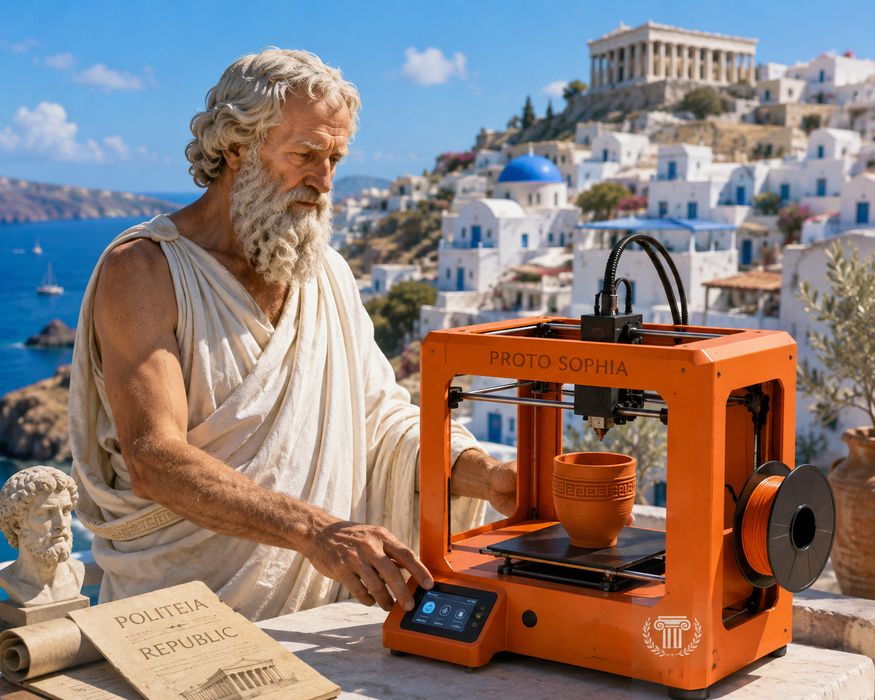
Charles R. Goulding and Preeti Sulibhavi explore how Greece is leveraging additive manufacturing to strengthen advanced manufacturing while drawing inspiration from a legacy of innovation that stretches back to antiquity.
Greece is best known as the birthplace of Western philosophy, democracy, and scientific inquiry. Today, the country is applying that same spirit of innovation to one of manufacturing’s most transformative technologies: additive manufacturing.
Home to roughly 10.4 million people, Greece has a nominal GDP of approximately US$250-270 billion, making it a mid-sized economy within the European Union. Its capital, Athens, remains not only the nation’s political and economic center but also one of the world’s oldest continuously inhabited cities. The Greek economy is dominated by services, particularly tourism, shipping, financial services, and commerce, while manufacturing, agriculture, energy, pharmaceuticals, and food processing also play significant roles.
Geographically, Greece occupies the southern tip of the Balkan Peninsula and includes more than 6,000 islands and islets scattered throughout the Aegean and Ionian Seas. The country’s rugged mountains, extensive coastline, and strategic location at the crossroads of Europe, Asia, and Africa have shaped its history as a center of trade, engineering, and cultural exchange for thousands of years.
Although Greece isn’t usually mentioned alongside Germany, the United States, or China when discussing additive manufacturing, the country has quietly been developing an impressive ecosystem centered around industrial applications, research, and technology transfer.
Building a National Additive Manufacturing Hub
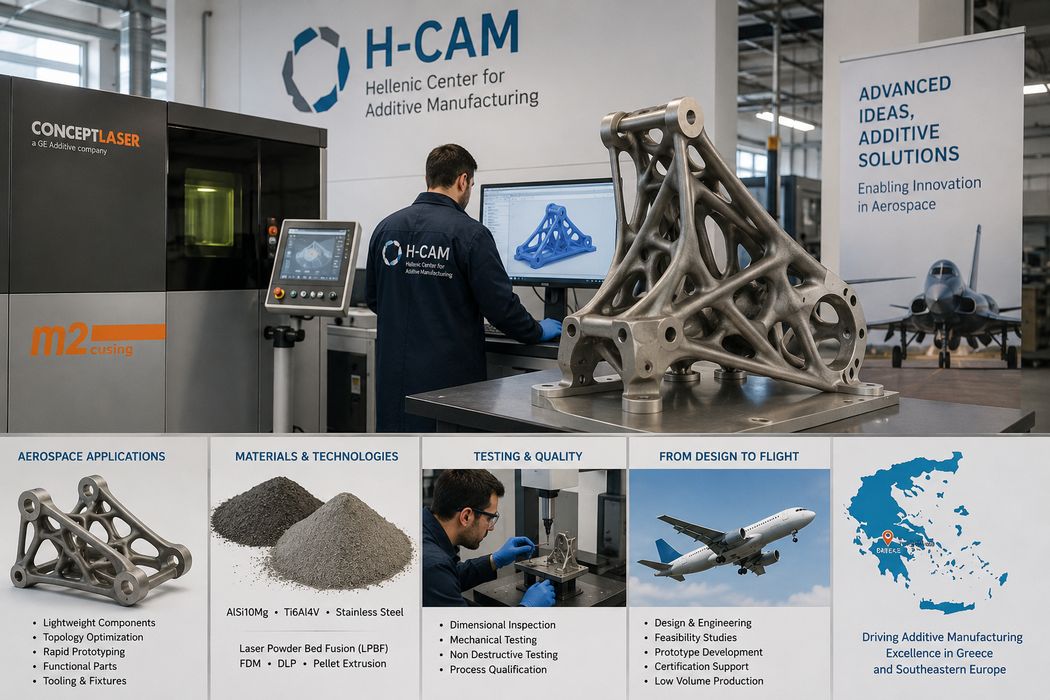
Perhaps the most significant development is the establishment of the Hellenic Center for Additive Manufacturing (H-CAM) in Patras.
Rather than serving as simply another research laboratory, H-CAM was created as a national competence center intended to accelerate the adoption of additive manufacturing throughout Greece and Southeastern Europe. Its mission is ambitious: provide industry with the expertise, equipment, research capability, training, and engineering services necessary to move additive manufacturing from experimentation into production.
The center describes itself as a “one-stop shop” for additive manufacturing services. Companies can access engineering expertise, prototype development, production assistance, testing, certification support, and educational programs under a single organization. This approach is particularly valuable for small and medium-sized manufacturers that may lack the resources to build their own additive manufacturing expertise.
The organization itself is a collaboration between public research organizations and private industry under Greece’s General Secretariat for Research and Innovation. That public-private structure reflects a growing recognition that additive manufacturing succeeds when research can be translated into commercial products rather than remaining confined to academic publications.
More Than Just Printing Parts
One interesting aspect of H-CAM is that its focus extends well beyond operating 3D printers.
Its services include:
- Rapid prototyping
- Design and engineering optimization
- On-demand manufacturing
- Technology development
- Materials testing
- Product certification
- Engineering consulting
In other words, the center addresses the entire product development lifecycle instead of treating additive manufacturing as simply another fabrication process.
This reflects a broader trend across the additive manufacturing industry. Successful deployments increasingly rely on redesigning products specifically for additive manufacturing rather than merely replacing conventional production methods with a 3D printer.
Industrial Research and Development
H-CAM also places considerable emphasis on technology development.
Its engineers conduct feasibility studies to determine whether additive manufacturing is appropriate for specific applications before production begins. They also investigate material modifications, process optimization, manufacturability studies, and pilot production runs.
The center supports multiple additive manufacturing technologies, including FFF/FDM systems, continuous DLP resin printing, and remarkably large-format pellet extrusion systems capable of producing components measuring up to two meters in size. Such equipment opens opportunities for tooling, molds, industrial fixtures, and oversized structural components that extend well beyond consumer-scale 3D printing.
Industries Feeling the Impact
The industries targeted by H-CAM provide an excellent snapshot of where additive manufacturing is finding traction within Greece.
Aerospace and Space
Although Greece does not have a massive aerospace manufacturing sector, it possesses a growing collection of aerospace suppliers, engineering firms, and research organizations. Lightweight components, rapid prototyping, customized tooling, and low-volume production are natural applications for additive manufacturing.
Participation by companies such as OHB Hellas demonstrates how additive manufacturing is becoming integrated into Europe’s broader aerospace supply chain.
Healthcare
Medical applications continue to be one of additive manufacturing’s strongest growth areas.
Customized anatomical models, surgical planning aids, prosthetics, dental devices, and patient-specific medical components all benefit from digital manufacturing workflows.
The COVID-19 pandemic demonstrated how local additive manufacturing capacity could rapidly produce urgently needed medical equipment, an experience cited as one motivation for establishing a dedicated national competence center.
Transportation
Transportation represents another logical market.
Whether producing replacement parts for rail systems, automotive applications, or specialized industrial vehicles, additive manufacturing enables low-volume production without expensive tooling. For countries where replacement components for aging infrastructure may be difficult to source, this capability offers clear economic value.
Maritime
One sector where Greece has a particularly unique opportunity is maritime shipping.
Greece controls one of the world’s largest merchant shipping fleets. Ships operating globally often require replacement parts while far from traditional manufacturing centers. Additive manufacturing could eventually enable localized production of certified spare parts at ports or maintenance facilities, reducing downtime and simplifying logistics.
While this vision is still developing globally, it represents a particularly compelling opportunity for Greece.
Traditional Manufacturing
Perhaps surprisingly, H-CAM explicitly targets traditional manufacturing sectors as well.
Small manufacturers often struggle to justify expensive tooling for limited production runs. Additive manufacturing enables economical production of customized components, production fixtures, replacement machinery parts, and prototype tooling without large upfront investment.
For Greece’s many small and medium-sized manufacturers, this may ultimately become one of additive manufacturing’s greatest advantages.
Education and Workforce Development
Technology adoption depends as much on people as machines.
Recognizing this, H-CAM invests heavily in education and workforce development. The center offers training programs for engineers, researchers, students, and business professionals, helping develop the skills needed to integrate additive manufacturing into industrial operations.
This educational mission is especially important because additive manufacturing requires expertise spanning materials science, mechanical engineering, software, design optimization, quality assurance, and production management.
Building that multidisciplinary workforce may ultimately prove as valuable as installing new printers.
Looking Ahead
Greece’s additive manufacturing ecosystem remains relatively young, but its direction appears well defined.
Rather than attempting to compete on manufacturing scale, Greece is focusing on high-value engineering services, research, specialized industrial applications, and regional technology leadership. Serving Southeastern Europe as an additive manufacturing competence center could provide a valuable niche within Europe’s increasingly interconnected manufacturing landscape.
The country’s strengths in shipping, healthcare, engineering, tourism infrastructure, and advanced research provide multiple opportunities where additive manufacturing can solve practical problems rather than simply demonstrate technological novelty.
The U.S. Research and Development (R&D) Tax Credit
For US-based companies involved in trade and business in Greece, the Research and Development (R&D) tax credit may apply if they have qualifying activities. If their business has integrated 3D printing, that is an excellent indicator of R&D-eligible projects. Again, the R&D credit is for US-based companies and subsidiaries with US-based R&D activities.
The R&D tax credit is available for all for-profit companies with qualifying activities. These activities may include, but are not limited to, designing or development new and/or improved products or processes, or software development/upgrades. R&D Tax Savers has been helping companies navigate the complexities of this tax benefit since the inception of the Research and Development Tax Credit in 1981.
What Would the Ancient Greeks Think?
It’s difficult to write about modern Greece without thinking about the country’s remarkable intellectual heritage.
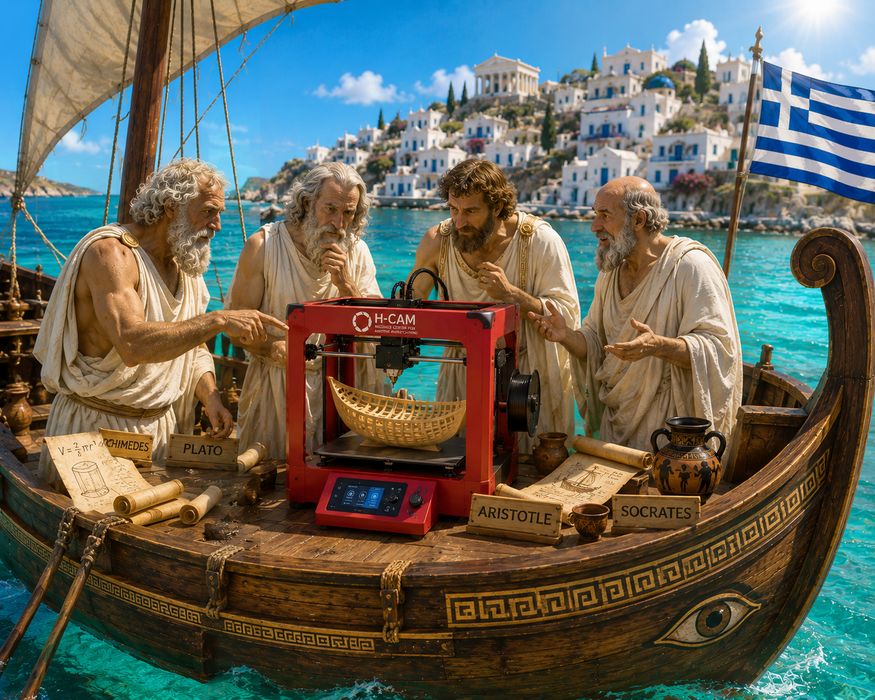
One can’t help imagining Aristotle examining lattice structures and immediately launching into a discussion about form and function. Archimedes would almost certainly be fascinated by topology optimization software. Plato might argue that every CAD model is merely an imperfect representation of the ideal object existing in the realm of Forms.
And then there’s Socrates.
His method of questioning assumptions feels surprisingly appropriate for additive manufacturing. Why machine away material when you can add only what’s needed? Why manufacture thousands of identical parts when every product can be customized? Why accept traditional design constraints if they no longer apply?
One suspects Socrates would have asked uncomfortable questions of conventional manufacturing until everyone in the workshop became thoroughly exasperated.
History tells us that didn’t always end well for Socrates.
Which raises an amusing thought: if Socrates had stood in the Agora some 2,400 years ago enthusiastically describing digital design files, topology optimization, and machines capable of building complex objects layer by layer from nothing more than powdered metal or plastic filament… would the Athenians still have handed him a cup of hemlock?
Or perhaps they would simply have asked him to print them one first.