
Charles G. Goulding explains why the future of robotics may not roll or crawl, but grow, comparing two groundbreaking technologies poised to reshape industrial applications.
Self-Growing Robots Leave the Lab (Through a Sewer Pipe)
“Growing” robots acquire their final dimension on the way to wherever they are going. The body lengthens at the front, allowing the machine to enter a confined space without hauling its entire deployed length behind it. In a pipe network, where every bend adds friction and every junction creates another chance to become stuck, that is more than a difficult terrain to navigate.
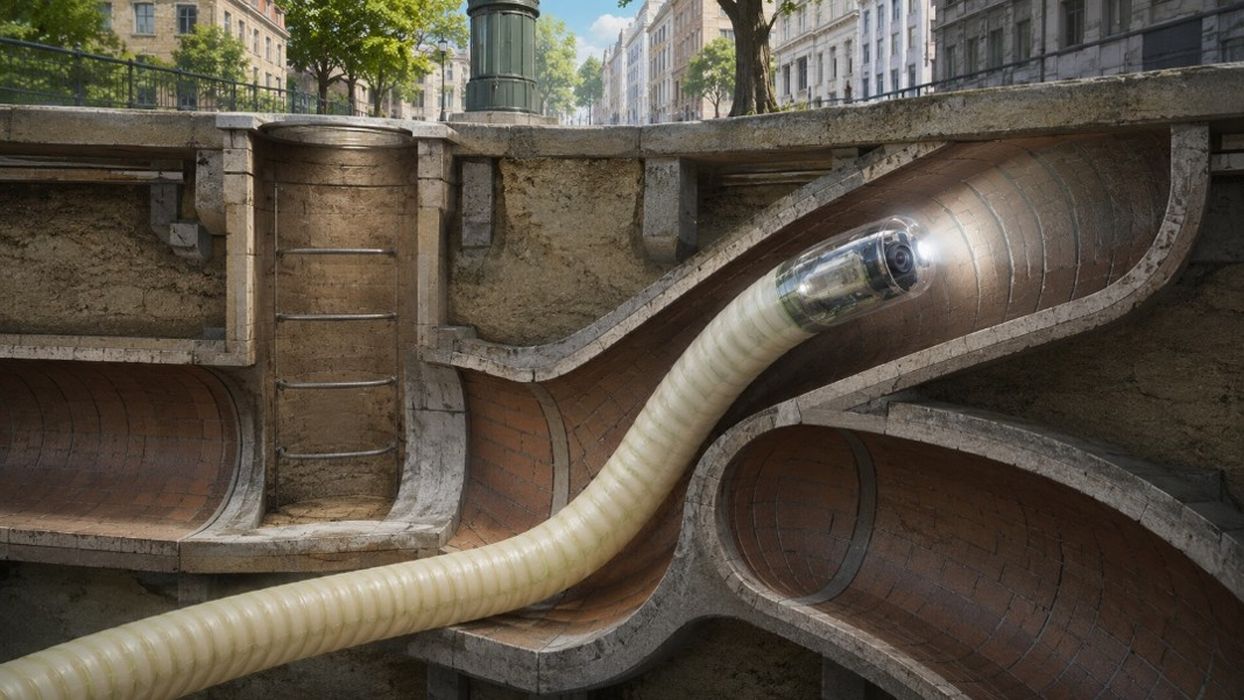
A Stanford team put the idea to work in a wastewater pipe in 2025. The robot carried a camera at the tip of a soft tube that extended through the line without wheels, tracks or articulated legs. As the camera advanced, the tube settled along the route behind it. This was a field test of a growing robot, not simply a conventional camera attached to one.
The growth comes from eversion. Pressurized material stored inside the machine turns outward at the tip, much as the finger of an inverted glove takes shape when pushed outward. The deployed tube barely moves once it is laid down. Only the leading end advances, so the camera does not have to drag the robot’s full length around each bend.
Researchers reported the work in “A Hermetic, Transparent Soft Growing Vine Robot System for Pipe Inspection,” in October 2025. The prototype mapped a real wastewater pipe while its camera remained enclosed inside the body. The test did not produce a market-ready inspection system. It did establish that growth could carry a protected sensor through the conditions of an ordinary industrial job rather than a laboratory obstacle course.
That setting gives the research a sharper point. Growing robots have been proposed for collapsed buildings, forests, disaster zones and other planets. Wastewater is less dramatic and commercially more legible. The infrastructure already exists, access is routinely difficult, and operators already pay to learn what is happening beyond the next bend.
The trial also gives FiloBot, covered by Fabbaloo in January 2024, a useful point of comparison. FiloBot prints a plant-like body as it travels. Stanford’s robot deploys flexible material prepared in advance. They do not grow in the same way, but both discard the assumption that a robot must begin a mission at full length.
Pipe inspection shows what that change can accomplish now. FiloBot suggests what could follow: a machine that not only reaches into an inaccessible route but fabricates the structure it needs to keep going.
First Contact
The difficult part of wastewater inspection is not getting a camera near the pipe. It is keeping the camera useful once it gets there. Moisture, contaminants and abrasive surfaces threaten the lens, lighting, motors, cables and sensors clustered at the front of the machine.
Stanford’s design places that equipment inside a soft, airtight body. The tube is transparent, so the camera can examine the wall without opening the enclosure. A passive mount keeps the sensor package at the advancing tip while body material continues to pass around it.
This protected viewpoint is the central achievement of the recent work. Researchers had already shown that a soft tube could grow. Inspection demands more. The camera has to arrive intact, remain correctly oriented and produce images that can be tied to specific locations. Reaching the far end with a blurred lens or an unknown position would have little operational value.
Following the Body
Every meter of a conventional tethered crawler adds something the machine must pull. As its body moves, its cable follows. At a bend, the cable presses against the wall; after several bends, those contacts accumulate into enough drag to stop the crawler even when its wheels still have traction.
The growing robot leaves that burden in place. Once a section of tube enters a bend, it rests against the pipe while fresh material emerges at the tip. Distance still consumes body material, but it does not create the same moving load. The machine advances by relocating the point of extension rather than towing everything already deployed.
That makes the body both vehicle and connection. Power, data and sensor support remain linked to the front, yet the tip is not asked to haul the full link through the network. The tube can navigate a complicated route while motion remains concentrated at its leading edge.
Challenges and pitfalls abound. The body can tear, snag or obstruct flow, and a route that is easy to enter may be difficult to leave. Debris, sharp fittings and damaged pipe can turn retrieval into the hardest part of the job. Commercial buyers will care about maximum reach, but they will care more about how often the equipment comes back.
Choosing a Branch
Reaching deep into a network solves only half the inspection problem. The robot must enter the correct branch, then give every image an address. Video of corrosion or cracking is of limited use when a maintenance crew cannot tell where it was recorded.
An earlier Stanford study, published in July 2025, tackled both requirements. Researchers equipped a growing robot with an external tip mount that could steer in three dimensions and brace against the pipe wall. It selected branches, moved through networks with radii as small as 2.5 centimeters and reached a maximum steering angle of 51.7 degrees.
Sensors at the tip worked with measurements from the continuous body to provide real-time localization without GPS. The result was not merely a record of what the camera saw. It was a map connecting each observation to the route taken through the network.
Taken together, the two 2025 papers assemble the pieces of an inspection system. Steering chooses the asset. Localization then identifies the defect. The hermetic transparent body keeps the sensing package alive long enough to record it. Remove any one of those capabilities and the usefulness of the others declines sharply.
This combination also identifies the likely first market. Growing robots do not need to replace crawlers in straight, accessible lines. Their advantage lies in more awkward courses and pathways: tight turns, branching routes, changing diameters and distances at which tether drag becomes the limiting factor.
Printing a Different Body
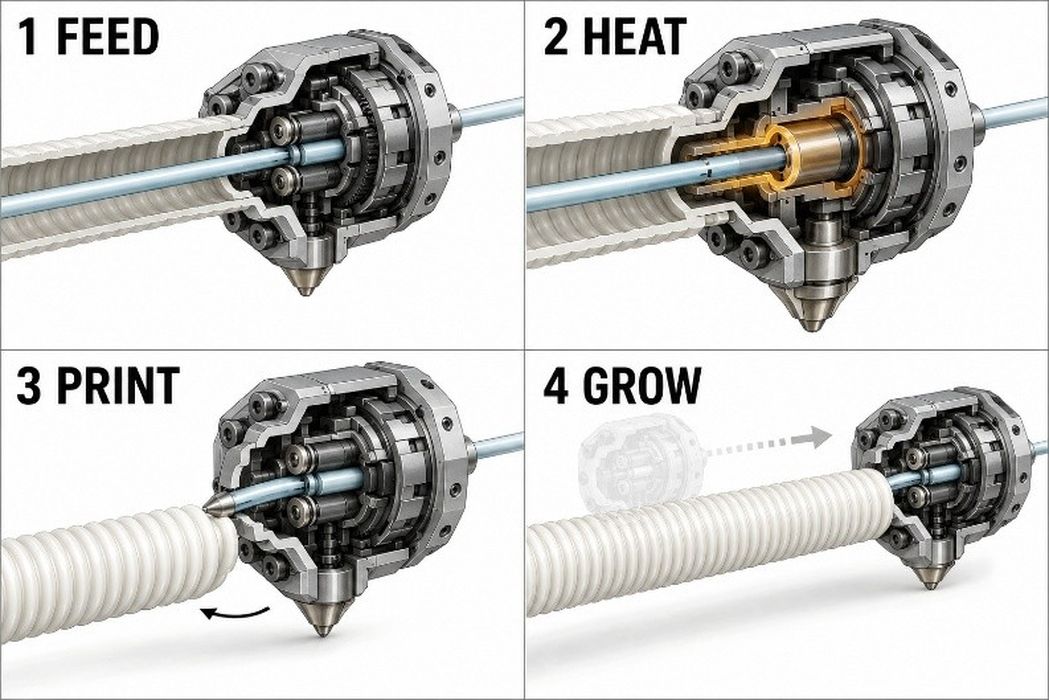
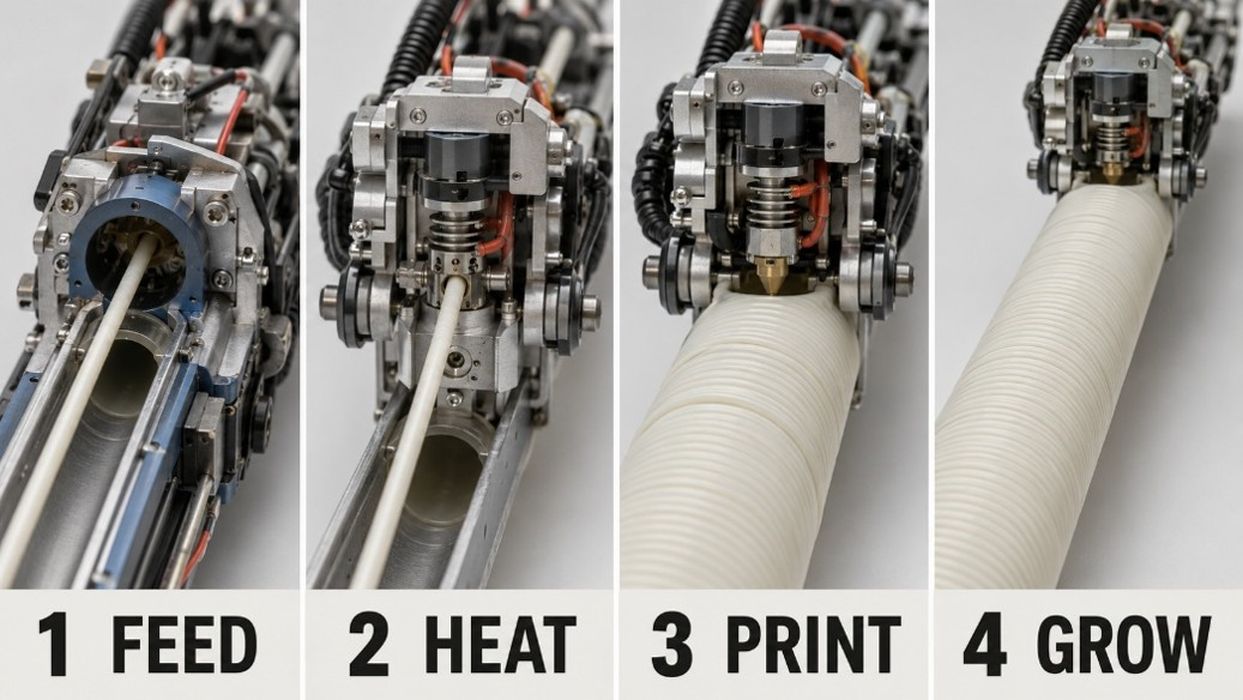
FiloBot grows by leaving a structure behind. Thermoplastic filament travels from a supply at the base, passes through the hollow stem and reaches an extruder in the head. As the head rotates, a heated nozzle deposits a continuous coil. The material cools behind the tip and becomes the route the robot has built.
Its sensors respond to gravity and light in ways modeled on plant growth. The printing process can also respond to local support. A section resting on another surface needs less material; an unsupported span can be printed more heavily. Direction and structure are decided together as the body forms.
This is a different bargain from eversion. Stanford’s robot carries finished flexible body material and releases it under pressure. FiloBot carries feedstock and manufactures a rigid stem. Eversion supports relatively fast, soft extension and offers the possibility of retraction. Printing proceeds more slowly but can leave behind a structure tailored to the route.
For inspection alone, that permanent structure is mostly a liability. FiloBot grows at millimeters per minute, requires heat at the head and leaves plastic in place unless someone removes it. A utility has little incentive to accept a new plastic tube simply to collect video that an eversion robot could obtain with less residue and greater speed.
Printing earns its place when the body itself becomes part of the job. The stem could serve as conduit, structural support or a carrier for sensors positioned along the route. Material could be concentrated across unsupported gaps and reduced where the existing pipe supplies support. A future machine might inspect on entry, then convert its path into a distributed monitoring installation.
Monitoring That Stays Put
FiloBot becomes more convincing when movement is not the end of the assignment. A camera passing through a site produces a record. A printed stem can remain there, turning the route into part of the sensing system.
A machine that can cross uneven ground and print a strong section before spanning a void could carry instruments into terrain that is difficult to traverse repeatedly. Landslide slopes, avalanche zones, eroded embankments and contaminated sites are plausible examples; each rewards slow installation more than fast travel.
The printed body could support a sequence of sensors rather than a single payload at the tip. Moisture probes across a slope could track how water moves before a failure. Strain or displacement sensors could record gradual deformation. Gas and particulate sensors could sample conditions around an industrial release or a polluted site. A camera might guide placement, but the lasting value would come from measurements gathered after growth stops.
That changes the economic comparison. FiloBot would not compete with a drone on the speed of an initial survey. It would compete with the equipment and site disturbance required to install a monitoring line. A drone can photograph a dangerous slope in minutes; it cannot wrap a sensor support around a tree, cross a gap and leave the resulting structure connected to a base station.
The plant-inspired behavior has practical relevance here. “Twining” transfers load to existing supports and reduces the amount of printed material required. FiloBot can adjust its printing parameters to produce lighter sections when supported and tougher sections when it must hold itself up or cross open space. The route and the structure are negotiated together instead of being fully designed in advance.
Building the Connection
Many difficult sites do not simply need to be observed; they need a line carried through them. That line might provide power, data, communications or physical support. FiloBot’s body offers the beginnings of a route that can be fabricated in place rather than pulled through afterward.
In a damaged building, a self-printing robot might extend a communications link or sensor line through a void that is unsafe for responders. In a tunnel, by contrast, it could place environmental sensors beyond a blocked passage.
Or consider self-growing infrastructure. A printed stem could become a support for wiring or a scaffold for devices installed at intervals. Its geometry would emerge from the route that’s actually available, while the amount of material could change with local loads. A supported run might be thin and quick to print. A crossing between supports could be reinforced as it forms.
This would not require printing a conventional pipe, cable tray or structural member by another method. FiloBot’s advantage would be the ability to establish a modest connection where conventional installation is disproportionately difficult. The useful scale may be closer to instrumentation and temporary services than to major construction.
Removal deserves equal attention. A system designed to print its way into a site can leave behind an awkward waste stream when the project ends. Recyclable feedstock would make the difference between deployable infrastructure and abandoned plastic. In some applications, biodegradation may be desirable. In others, predictable long-term stability will matter more. No single material will satisfy both.
The Research and Development (R&D) Tax Credit
For companies adopting advanced technologies such as automation, AI-enabled design, improved materials, and 3D printing, those developments may create strong opportunities for IRC §41 R&D tax credits when the company is not merely buying equipment but using it to solve technical uncertainty. Under IRC §41(d), qualified research generally must seek technological information, relate to a new or improved business component, and involve a process of experimentation focused on function, performance, reliability, or quality
For example, a for-profit company using 3D printing to test lighter parts, improve product durability, reduce failure rates, or refine production methods may have qualifying activities if employees are evaluating alternative designs, materials, build settings, or prototypes through trial and error. The credit can potentially include employee wages for qualified research, supplies consumed in testing, certain cloud or computer-use costs, and 65% of eligible contract research expenses under IRC §41(b).
The key is documentation: companies should track the technical problem, alternatives tested, prototype results, failed attempts, and employee time. Routine production, market research, cosmetic changes, quality control after production, and funded research generally do not qualify under IRC §41(d)(4).
R&D Tax Savers has been helping companies navigate the complexities of the R&D credit since its inception in 1981.
Commercial Threshold
The first credible FiloBot applications are likely to share three features: 1) the route is hard to survey or preplan. 2) Existing supports are available but irregularly placed. 3) Leaving behind a lightweight structure is useful or at least acceptable.
The Stanford wastewater test draws the boundary clearly. Its eversion robot carried a protected camera through a real pipe, completed the inspection and justified the trip. FiloBot faces a different standard. Because it fabricates its route as it moves, the route itself has to have a purpose.
To that end, FiloBot can reinforce a gap, print lightly around an existing support and place material according to conditions encountered along the way. Its path can become infrastructure instead of residue. The commercial test is straightforward: when the printed structure is more valuable than the time, material and equipment used to create it, FiloBot has moved beyond an ingenious experiment.
Charles G. Goulding is a practicing attorney.