
A newly published research study suggests that MXene coated PEEK composite powders may require far less fibre laser energy during polymer powder bed fusion.
That claim comes from a paper titled Conformal MXene surface engineering enables ultra-low-energy fibre-laser powder bed fusion of PEEK composites. The idea is to alter the outside of each powder particle so the laser interaction improves before the polymer melts.
PEEK is among the most desirable polymers in AM. It offers high temperature performance, chemical resistance, and applications in aerospace, medical, and industrial components. It is also a very demanding material. High processing temperatures, tight thermal control, crystallinity management, and required costly hardware have kept PEEK powder bed fusion far away from the ease of typical SLS systems.
Fibre lasers add another complication. Their near infrared wavelength is common in metal powder bed fusion, but many polymers do not absorb that wavelength efficiently enough for proper processing. A 3D printer might compensate with more energy, but that risks overheating, part degradation, an far-too-big melt zone, or lousy dimensional control.
Changing The Powder Instead of The Laser
MXenes are a family of two dimensional transition metal carbides and nitrides. Researchers have been examining them for conductivity, electromagnetic shielding, sensing, and photothermal behavior. Their strong light absorption also makes them an intriguing additive for AM powders.
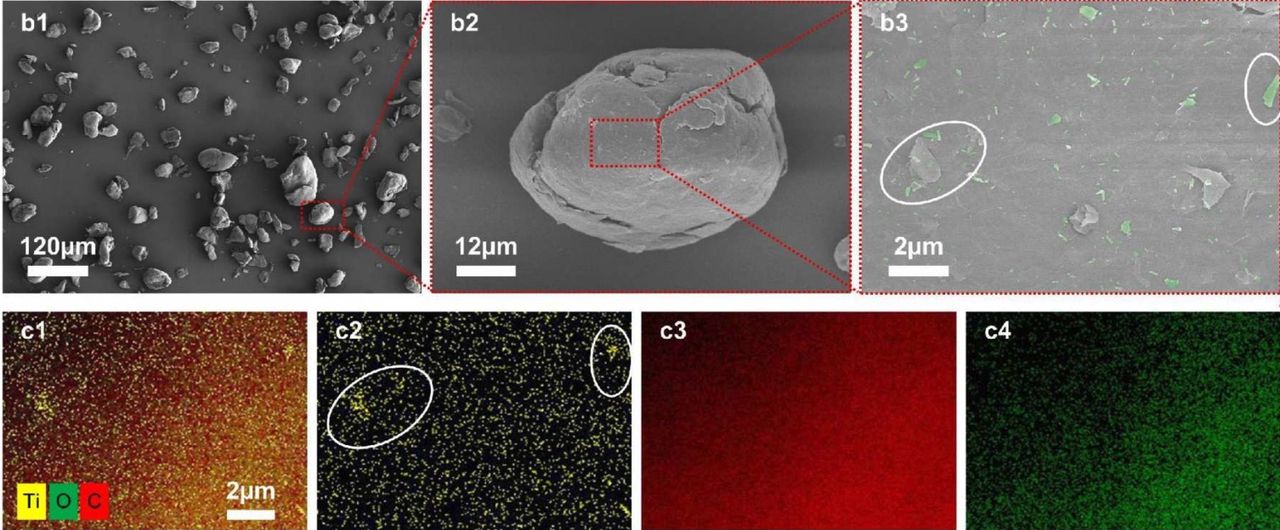
A “conformal treatment” implies that the MXene is placed over the surfaces of the PEEK composite particles, instead of just mixing them unevenly with the powder.
That could make the powder surface act as a laser absorbing layer. The coating captures more fibre laser energy, converts it into local heat, and helps initiate fusion in the underlying polymer. In other words, the researchers are trying to tune the optical behavior of the material rather than trying to make a standard laser and a tricky polymer work together.
Lower required energy can be more useful than just a power saving. A smaller energy requirement may widen the usable processing window, reduce heat accumulation, and make fibre laser architectures more possible for polymers that normally require carbon dioxide laser sintering. It may also help retain finer features if heat does not spread as quickly through the powder bed.
This is a very interesting idea. Much of the polymer AM progress focuses on new machines, hotter build chambers, or more powerful thermal systems. This engineered powder suggests that there is a completely different way to tackle the issues.
This idea could give material suppliers another idea for new types of powder products, which I am sure some will investigate.