
Prusa takes an interesting step into higher-temperature materials.
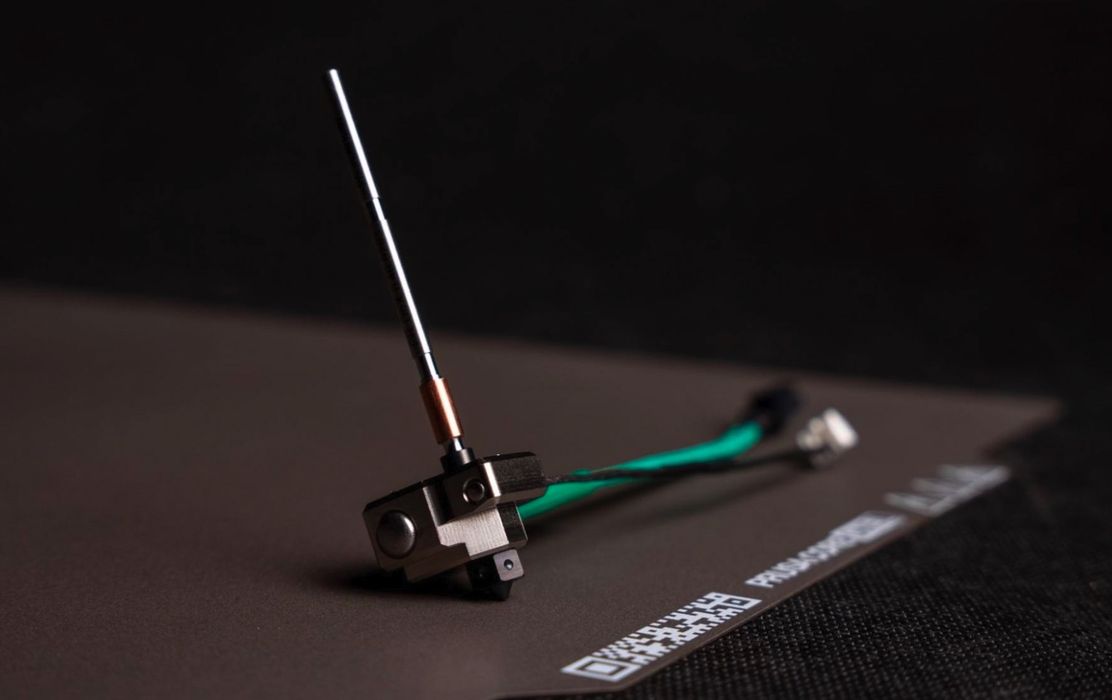
Last week, the company announced the availability of a series of products that enable their existing CORE One+ and CORE One L+ systems to print higher-temperature materials. The list of new products includes:
- The HT Hot End upgrade
- High-temperature print sheets
- High-temperature materials
Let’s look at each.
High Temperature Hot End
The US$205 hot end upgrade, which can be installed by the operator, raises the nozzle temperature from 300C to 400C. This “unlocks,” as Prusa Research explains, several higher-temperature materials that would otherwise be impossible to print on the equipment.
In addition, the higher temperature should also provide better print results for particular materials that are printable on older equipment. Specifically, they said that certain PA11, PC and ASA materials would have far better layer adhesion when printed at higher temperatures.
The print sheets are intended specifically for high-temperature materials and are optimized for printing PEI, PEEK, PEKK, PPSU and PPS. You don’t want to print PEI on a PEI-coated sheet! These new sheets are also said to be poor for “normal” materials, so they are only for high-temperature use.
Three New Materials
The three new high-temperature materials are:
- PPS-CF
- PPS-GF
- PPA-CF Core
All of these offer hugely upgraded engineering properties over standard materials, making them suitable for a wide range of applications.
This is a terrific step for Prusa Research, as it effectively gives their CORE One system some new superpowers. High-temperature 3D printing has been around for a while now but has always been available only at extreme cost. This upgrade could allow operators to print high-temp materials at a lower cost.
What About the HT90?
But then I wondered about Prusa Research’s other product: the HT90. This is a delta-style 3D printer that is capable of printing high-temperature materials. Could Prusa Research be taking market share away from that machine?
Possibly, but it turns out there is a difference between the two.
The HT90 has a 500C nozzle, so it’s a bit hotter. It also has a build chamber that can be heated to 90C, and that’s the major difference. High-temperature materials are notorious for warping, and to counteract that, you need a very hot print surface and an actively heated chamber. The CORE One+’s chamber heats to only 55C.
This means that you’ll be more successful printing high-temp materials on the HT90 than on the upgraded CORE One+. It may be that once CORE One+ operators experience high-temp materials, they just might be a bit more inclined to upgrade to an HT90. However, the HT90 costs far more, starting at US$11,500. That’s 10X the cost of the CORE One+.
But that again shows the cost advantage of this upgrade: high-temperature 3D printing at a far lower cost.
Via Prusa Research