
Could the aging software barrier be broken in 3D printing?
You’ve probably been in this scenario: you have a device that works very well, and you’ve been using it for years. Then, you upgrade your operating system or servers and suddenly find that the software that ran the device no longer works. Even worse, there is no replacement software, meaning the hardware device is now effectively dead because no official software is available.
That scenario occurs all the time in 3D printing, where older devices become obsolete. We don’t notice it as much because the newer 3D printers are so much more powerful than the old ones: you’re better off running the new equipment anyway.
But that rapid growth is going to level off soon, because machines are reaching a point where they basically do everything someone would require. Then the software trap becomes a lot more likely.
But someone found a way around it, at least for one machine.
3D printer operator Niklas Barning happens to have an ancient (~2017ish) XYZprinting da Vinci Nano 3D printer. At this point, XYZprinting is no longer in the business — if you hit their website, you’ll find a Vietnamese sports betting site. Of course, this means their software is no longer supported, and Barning is deep into the software trap.
He found a solution, using vibe coding:
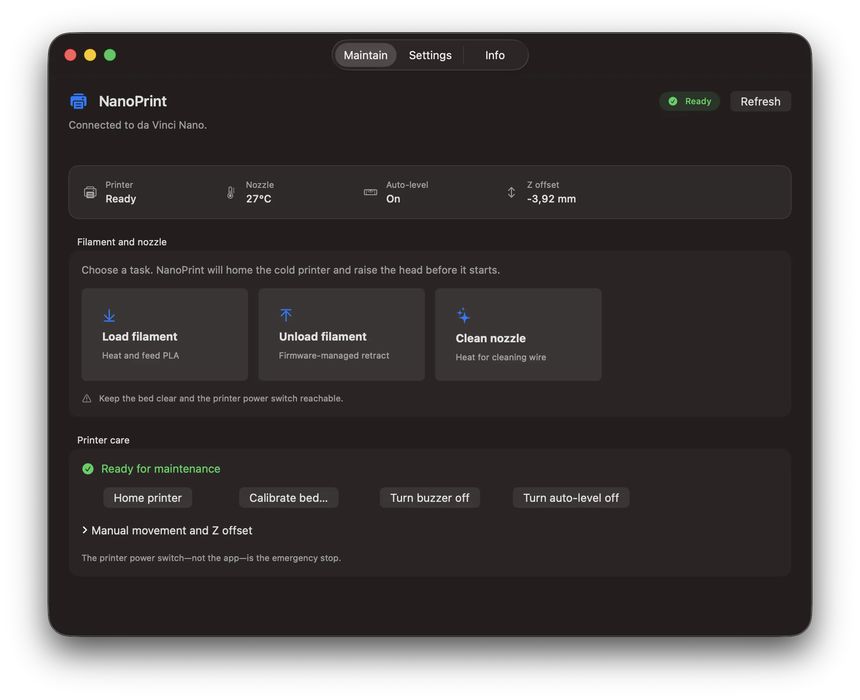
“So I spent some time with Codex, USB traffic, and quite a lot of trial and error. The result is NanoPrint: a small native Mac app for calibration, movement, filament changes, nozzle cleaning, and other maintenance tasks.”
If this could be done for the da Vinci Nano, it can be done for many other machines that might otherwise end up in the bin. It would also be possible to create an app that performs more functions, as well, such as integrating with current slicing software.
It may be that end of life for a desktop 3D printer means something a little different in the future than what it did two years ago.
This is the world we are beginning to enter: with the new AI-based code generation tools, it is slowly becoming possible for almost anyone to create their own software, just like Barning did.
If software isn’t available for something, just make it.
Via Niklas Barning
