
Here’s an interesting way to 3D print with ice: don’t make the room colder. Make the pressure lower.
Living in a cold climate, I’ve always wondered about the possibility of printing ice structures using water. Water is liquid at room temperatures, but solidifies when sufficiently cold. That’s the same pattern we see with FFF materials, so why can’t we do the same with water and ice?
It seems that some research has been done on actual ice printing. Researchers at the University of Amsterdam published a paper describing a modified commercial 3D printer that prints water inside a vacuum chamber. The water exits as a fine jet, rapidly cools through evaporation, and freezes when it lands.
Most ice printing approaches depend on cold plates, refrigerated chambers, or other cryogenic hardware. This one uses the same trick that makes sweat cool your skin, but pushed way harder: let some of the water evaporate quickly, and the remaining water loses heat.
The result is a printer that can build temporary ice structures without putting the machine in a freezer or leaving it outside in the deep winter.
The team placed a ROOK MK1 3D printer inside a transparent acrylic vacuum chamber and replaced the normal thermoplastic extrusion system with a fine water jet. Water is fed through capillary tubing by an HPLC pump, then ejected through a 16 micrometer nozzle.
Inside the chamber, the pressure is around 2-3 mbar. At that pressure, water evaporates very quickly. Evaporation pulls heat from the remaining water, dropping it below 0C. When the droplets hit the build surface or the growing part, they freeze in about half a second.
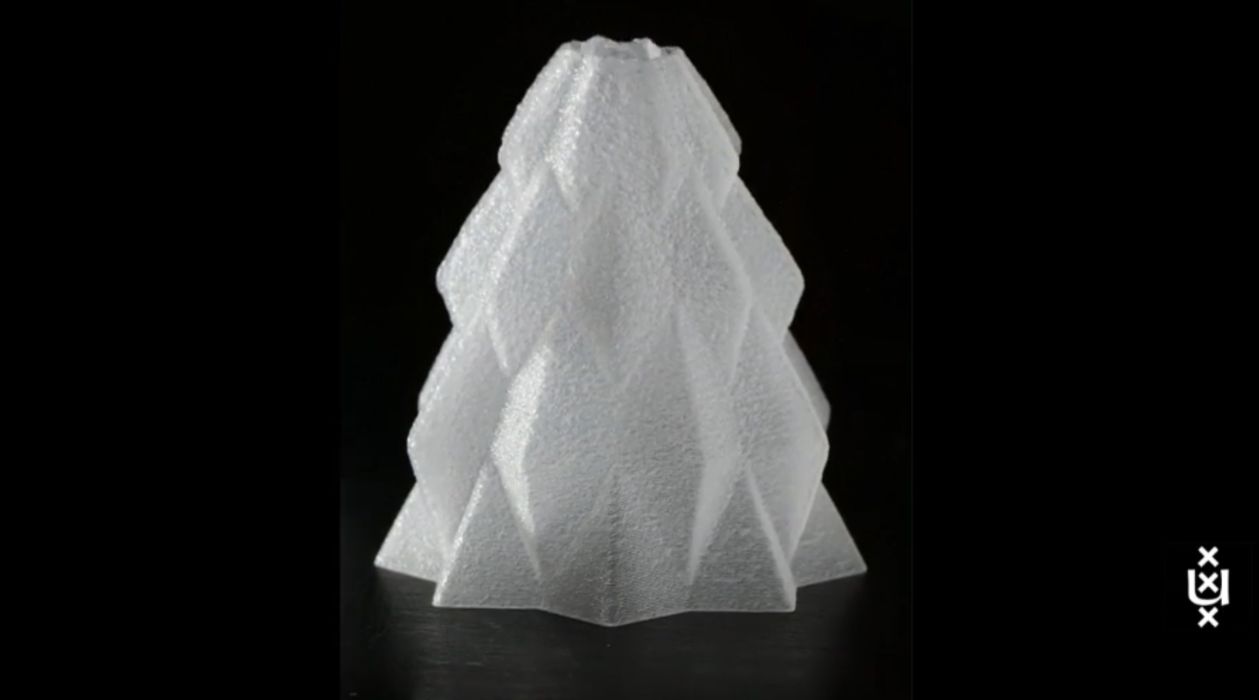
The researchers were able to print an ice Christmas tree about 8cm tall and 6cm wide at the base, which took 26 minutes. They also printed a cone, vertical pillars, zigzag shapes, and unsupported ice struts.
By adjusting print speed, the printer can grow ice into angled forms rather than simply stacking neat horizontal lines. In one demonstration connected to the work, the system produced a profile of a human face, including features that extended downward at shallow angles.
Why does that matter? Because it suggests the process is not limited to ordinary layer by layer ice stacking. The ice can be grown in ways that resemble drawing in midair, provided the droplets freeze quickly enough and the geometry behaves. I guess we are looking at nonplanar ice printing here?
Of course, ice is probably not a material you really want to print objects. Why? Because it melts, and you end up with a puddle.
The potential value here is that it can disappear cleanly. Print an ice structure, form another material around it, and then melt the ice. What remains is an internal channel, void, or porous structure. This is similar to how soluble support material is used.
That is where applications such as microfluidics, tissue scaffolds, and ice templating come in. Small internal channels are often awkward to make, especially when they need to be clean and connected. Sacrificial supports can leave residue, require solvents, or involve messy removal procedures. Ice has a really simple removal method: just let it melt.
You could imagine printing a branching ice network, surrounding it with another material, and then clearing it out with heat or by venting the chamber. The leftover part would contain the negative shape of the ice.
The researchers also mention potential space applications, including Mars, where low pressure and water ice are part of the environment.
There are some catches, of course. The paper reports wall thicknesses around 600 micrometers and a layer height around 200 micrometers, even though the jet itself is only 16 micrometers. The droplets move much faster than the printhead, so they pile up before freezing.
This is a unique take on ice printing, but it remains to be seen whether this technology will actually make it to the commercialization stage.
