
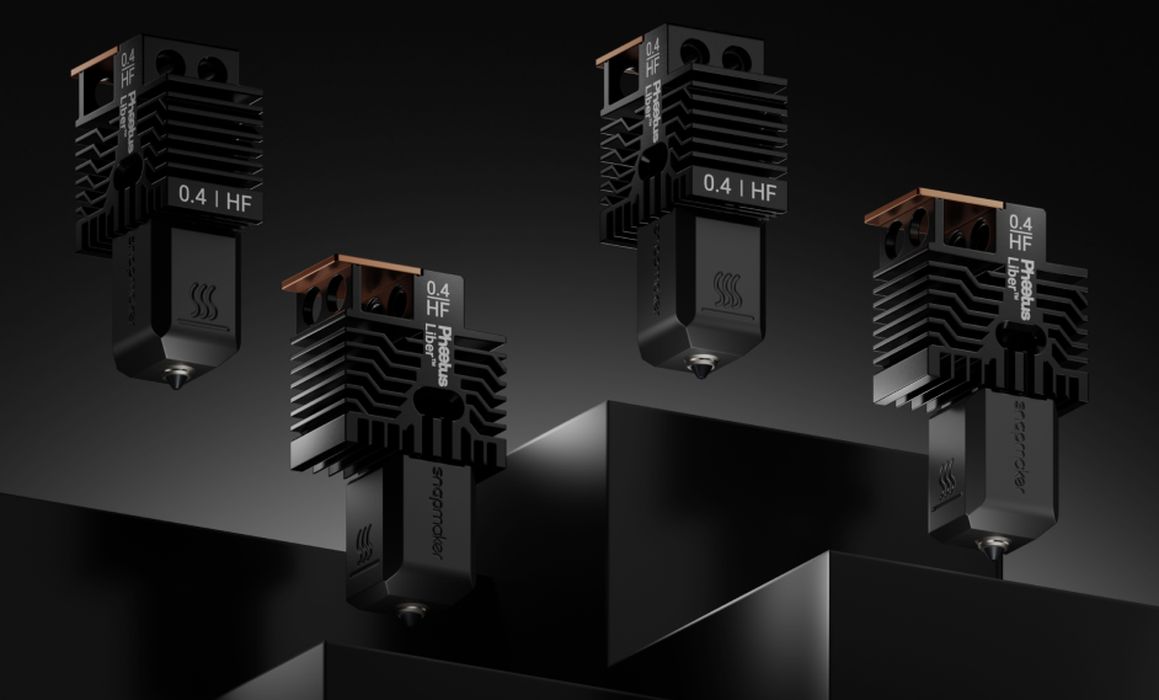
Snapmaker announced an intriguing new hot end for their U1 series: the Liber.
The Liber is a collaboration between Snapmaker and Phaetus, a ten-year-old manufacturer of core 3D printer components, including hot ends. The two companies combined skills to develop the Liber, a high-flow hot end.
What’s a high-end hot end? It’s all about speed. A normal hot end offers a single path for filament. That path initially is cold, but then heats up rapidly to soften the material. At the bottom of the hot end, the nozzle focuses the extrusion to the correct diameter.
The problem is that such a system has a maximum amount of material that can be deposited per second. Typical hot ends have a capacity of around 20-30 cubic mm per second.
If you attempt to print at higher speeds, you may exceed the capacity of the hot end to deliver material. That’s why high-flow hot ends are of interest: you can print faster because more material is available.
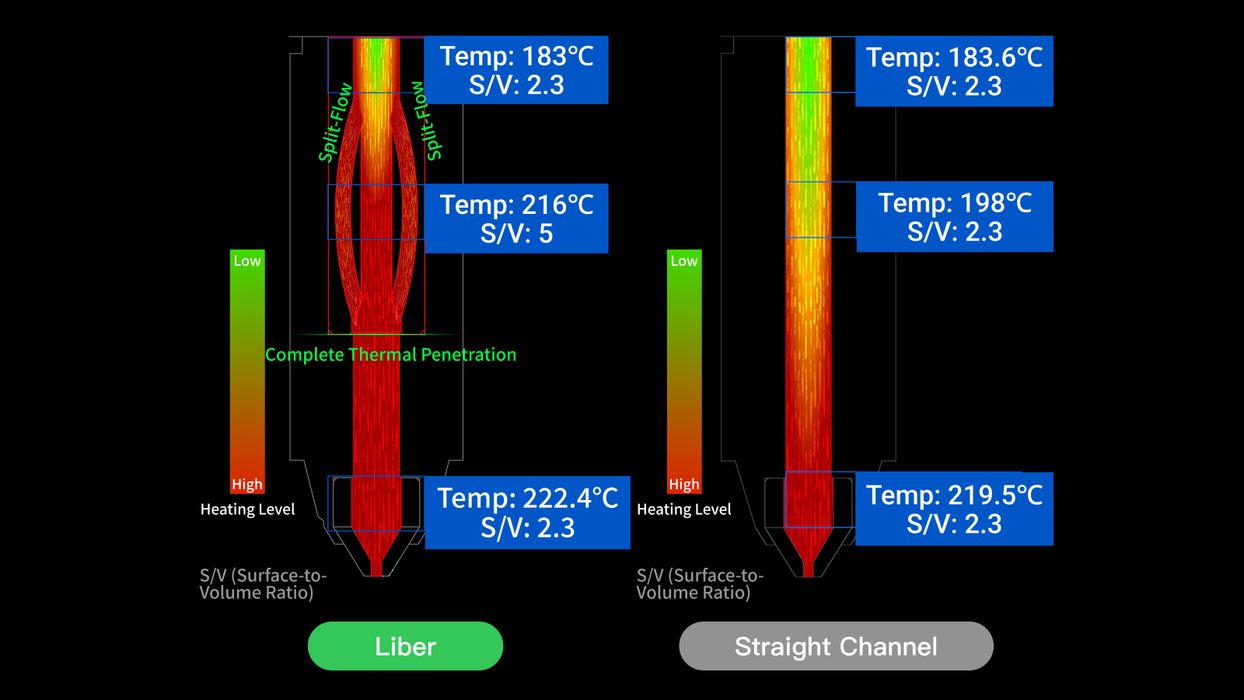
High-flow hot ends are more complex because they aren’t a straight-through path for the material. In the Snapmaker diagram above, you can see how their high-flow design compares with a standard straight hot end.
The idea is to split the flow, which allows more hot metal surface area to contact the material as it passes. This transfers heat more rapidly, allowing the flow to increase.
The Liber is designed for use in Snapmaker’s popular U1 desktop 3D printer, and it is priced at US$35 per hot end. Note, the U1 has FOUR hot ends; if you’re interested in upgrading all of them.
How much is the increased flow? According to Snapmaker, it varies by material:
- ABS: +87%
- PLA: +66%
- PETG: +43%
Does this mean you can increase your print speeds by up to 87%? No, it does not. It simply means that the machine is more capable of running faster, but not the specific speed. We will have to leave this up to Snapmaker to publish suitable high-speed profiles that make use of this new capability.
Snapmaker said the new Liber hot end should enable better consistency when printing long extrusions. For example, a really long perimeter extrusion for a helmet would be more reliable and possibly faster.
Another benefit is generally improved quality due to the flow headroom. You will be far less likely to run into a situation where the flow is insufficient.
Finally, the Liber is also made to last: it is made from hardened steel, but also has a “wear-resistant DLC coating”. That should help considerably to lower the number of clogs when operating the system.
The Liber should be available today.
