
A carbon dot filled PLA filament has shown a potentially useful combination of better mechanical behavior and steadier dielectric performance in FFF printed test parts.
The work, led by researchers at Sharda University and several Indian partner institutions, examines how to make a printable structural polymer do something electrical without turning it into a mess.
PLA is easy to print and widely available, but it is normally an electrical insulator with basically no functional role beyond the part’s shape. Carbon black, graphene, and carbon nanotubes can add conductivity or piezoresistive behavior, but too much filler can clump, obstruct extrusion, or weaken layer bonding.
The team instead used “carbon dots”, which are nanoscale carbon particles with oxygen containing surface groups. Those groups are intended to interact with PLA’s ester chemistry, helping the filler disperse and transfer load through the polymer matrix. Carbon dots also have optical characteristics, although this study concentrated on tensile and dielectric tests rather than fluorescence testing.
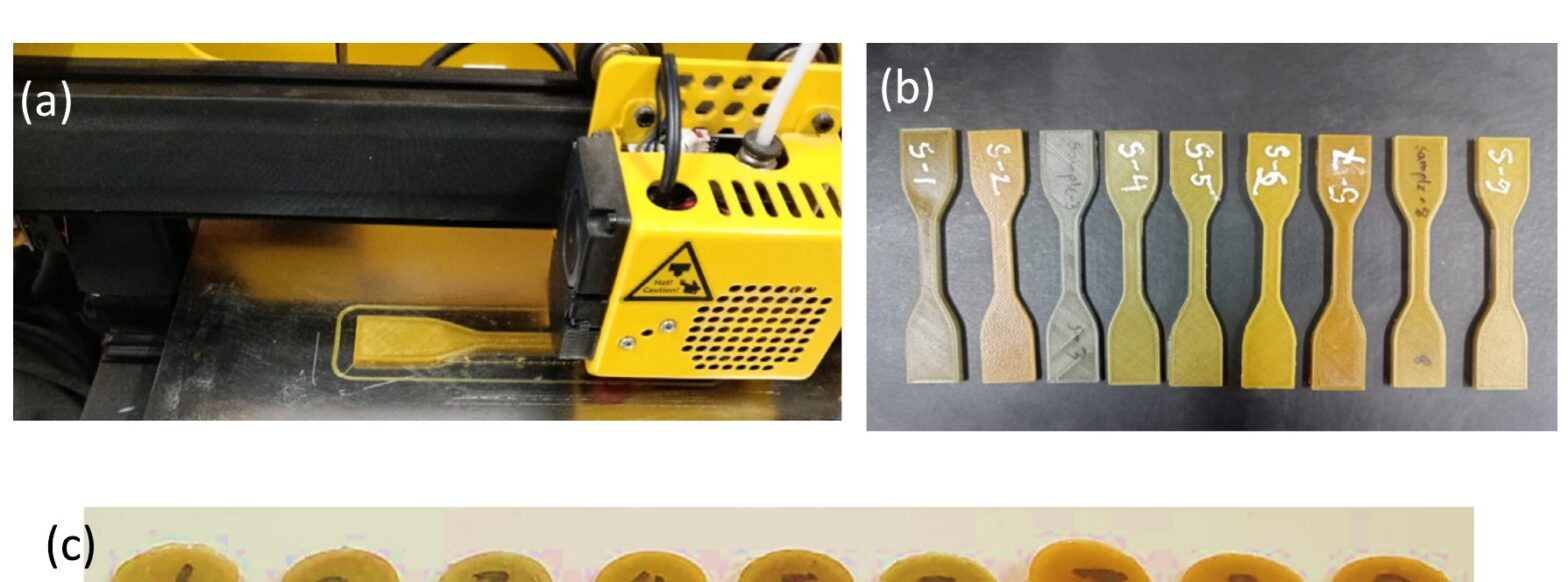
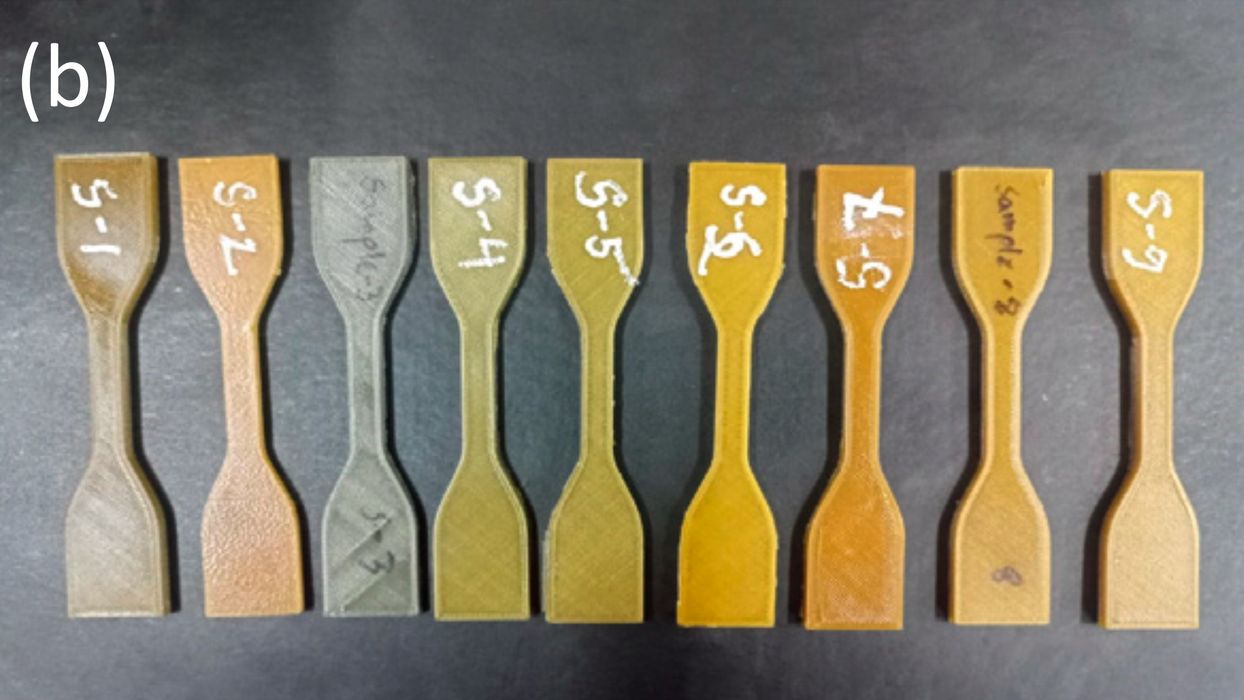
The researchers produced PLA filament containing 0.5, 2.0, and 3.5 % weight of carbon dots. They dried the PLA, dispersed the dots in ethanol with ultrasonication, blended the materials, and melt extruded them on a single screw FELL EVO system. The resulting 1.75mm filament was then printed into fully filled tensile bars and dielectric discs.
The best of the nine experimental combinations used 3.5 wt.% carbon dots, a 170C extrusion temperature, and a screw speed of four rpm. Against the paper’s pure PLA reference, they found the composite material had approximately a doubling of peak stress, stiffness, and toughness.
Why did that particular recipe work? The research believe that 165C did not melt the PLA sufficiently for strong interfaces, whereas 175C increased the risk of thermal degradation and voids. Lower screw speed also gave the material more residence time for mixing. In other words, adding the dots alone was not the trick; the extrusion settings determined whether the dots reinforced the filament or led to defects.
The optimized composite also showed lower dielectric loss and reduced low frequency polarization from 100 Hz to 7 MHz compared with the reference PLA. For a printed insulating component near electrodes, that may mean less energy dissipation and a more predictable electrical response. The paper attributes it to stronger filler matrix interfaces that restrict charge buildup and polymer chain motion.
While definitely not anything close to a commercial product, the research suggests a potential approach to introduce conductive properties in regular PLA 3D print material.
