
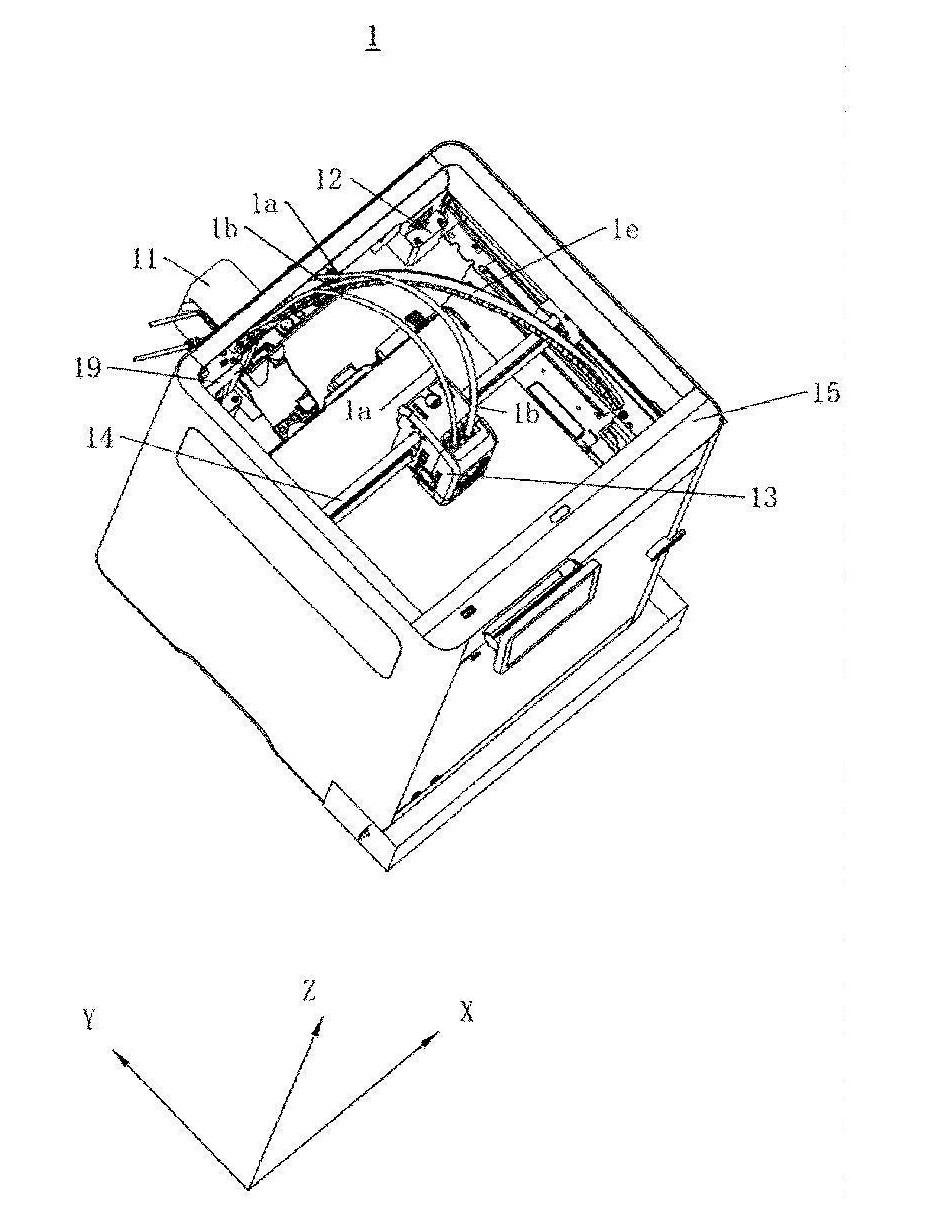
Bambu Lab has patented an unusual extrusion arrangement that seems particularly good for printing soft materials like TPU in FFF systems.
The patent, CN122766526A, describes a 3D printer with two separate hot ends and two completely different ways of getting filament to them.
One extruder rides directly on the printhead, just as you would expect on most modern desktop 3D printers.
The other doesn’t.
Instead, the second extrusion mechanism is located away from the moving printhead and pushes filament remotely to its hot end.
If that sounds familiar, it should. Bambu Lab appears to be combining the basic ideas behind direct-drive and Bowden extrusion in the same dual-material printhead.
Why would you do that?
The answer is weight.
Direct-drive extrusion has become extremely common because placing the drive gears close to the hot end provides excellent control over the filament. That’s especially important when printing softer materials that can bend, compress or buckle inside longer feed paths.
But every extruder placed on the printhead adds mass.
That’s not such a big problem with a single extruder, but things become more complicated when designing a dual-nozzle system. Two complete direct-drive extrusion systems means two sets of motors, gears and associated hardware flying around with the toolhead.
Bambu Lab’s patent takes a different approach.
Only one extrusion mechanism travels with the printhead. The other remains elsewhere in the machine, reducing both the size and weight of the moving assembly.
The patent specifically says this reduces the load on the motion system and should allow the printhead to move faster.
That’s obviously useful, but there’s another interesting possibility here.
TPU has traditionally been very challenging to impossible in Bowden-style systems. Because the filament is flexible, pushing it through a long path can be considerably more difficult than feeding rigid PLA or PETG. Imagine trying to push wet spaghetti up a tube. A short direct-drive path is way friendlier for flexible material like TPU.
That means this proposed configuration could potentially divide the work according to filament type.
A conventional rigid filament could use the remote (Bowden-like) extruder, where the longer path isn’t much of a problem. Meanwhile, TPU or another difficult-to-feed material could use the direct-drive side of the toolhead.
It’s important to point out that the patent doesn’t actually say that’s the intention. TPU isn’t identified as the reason for the arrangement.
But mechanically, it makes quite a bit of sense.
Desktop manufacturers have been trying to find new ways to make flexible materials work with increasingly sophisticated multi-material FFF systems. The difficulty is that the mechanisms used to automatically route and change rigid filament don’t work properly with soft filaments.
Bambu Lab’s idea seems to sidestep at least part of that problem.
Instead of insisting that both materials travel through identical extrusion systems, give one filament a lightweight remote feed and give the other a tightly controlled direct-drive path.
The interesting part is that Bambu Lab has not invented a new type of extruder. Instead, they’ve taken two very old extrusion concepts and combined them.
And that might be exactly what’s required to make a fast, inexpensive dual-material desktop machine that can comfortably handle TPU. We should watch carefully to see if they launch a machine with this concept.
Via Espacenet
