
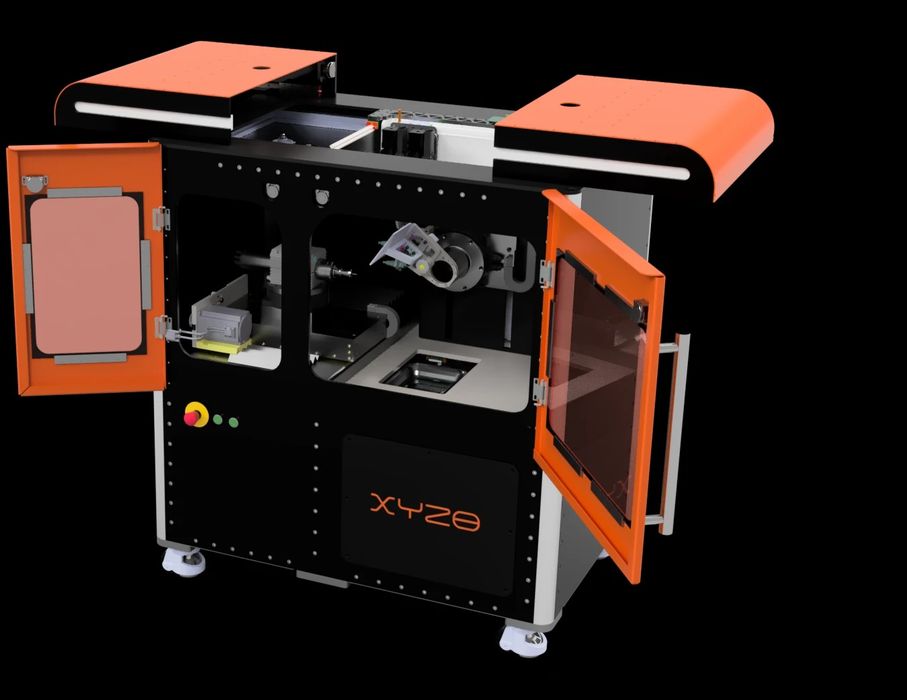
A new UK-based startup is to launch a hybrid machine that includes not only resin and FFF 3D printing, but also post-processing, CNC milling, and more.
That company is XYZO, not to be confused with the now-defunct XYZprinting from Taiwan. This new company is focusing directly on the traditional manufacturing problem with additive manufacturing: it’s a standalone process.
While factories today might be highly integrated operations where parts travel from one end to the other without human intervention, many of today’s industrial 3D printers are outliers: they sit on the sidelines and require a human to put things in and out of them. Those manual steps have long hampered wider use of additive manufacturing in industry.
XYZO, which seems to have been formed only two years ago, has an answer: just put all the steps inside one box.
Their seemingly unnamed platform can perform a number of manufacturing tasks automatically, and is able to move parts in progress between stations. However, it appears to be all in a single frame. Other attempts to solve the problem involve multiple units, some with robotic conveyors toting parts between.
Their promo shows something like a flowchart, where the different processes can be tied together. For example, you might have: resin print, then wash & cure. The more interesting part is that you could then take the completed resin part and, for example, CNC mill it to have perfectly smooth faces. Subsequent steps might involve FFF (which they call FDM, a Stratasys trademarked term) printing on top of the part, or deposition of conductive traces. They also mention the possibility of part inspection, which would make sense if you are manufacturing production parts.
None of these features is new; it’s just that they are all pasted into the same box here. That’s the proposed value equation.
There’s not a lot of specific information here, and we don’t know when they are to launch the unnamed system, nor any costs. We don’t know of any specifications or capabilities. Perhaps they will reveal more at Formnext?
Somehow I am a bit skeptical about this approach.
The flowchart approach would seem pretty interesting, until you think about it more deeply. Why, for example, would you need to link Wash & Cure to resin printing? Don’t you want to ALWAYS do that? Would you ever do them in the other order?
It seems to me that the number of practical sequences is actually quite constrained. Yes, there are possibilities, just not enough for me to justify needing a full flowchart setup.
For many manufacturers, I don’t believe they would need the flexibility to change these sequences often. I suspect that most would typically set up the machine in the way they need and let it run, meaning the flowchart capability might really be just for experimental labs trying out different ideas.
Their machine renderings seem to show a machine that includes a resin printing system with automation to do wash and cure, which is good. But where do you put all the other functions? Are they squeezed in somehow? Are there separate modular cabinets that get pasted together? How does all that work? Would a customer order a combination of frames that are built together — and that basically dictates how the flowchart is going to work?
I’m also a bit suspicious of the business case here. The implied proposition is that by integrating functions you would be able to reduce your labour costs, since no one is required to move parts between workstations. But how much are you actually saving? Does that offset the cost of the XYZO machine? We can’t know because a) labour efforts are always different, and b) XYZO has not shown the costs of their system options.
Manufacturers make decisions based on the business case, and that’s something that XYZO will have to get right if they are to succeed.
Via XYZO
