
After the announcement of the Bambu Lab / Stratasys patent infringement case, there are some implications.
As a recap, Stratasys took Bambu Lab to court in the US, alleging infringement of a number of Stratasys’ 3D printing patents. After a lengthy trial, the decision was that, yes, Bambu Lab did infringe on several, but not all of the patents listed by Stratasys. As a result, Stratasys was awarded US$26.7M for past infringements.
Bambu Lab intends on appealing the decision, so it can’t be considered final. But there are certainly going to be some ramifications as a result of the decision.
Here are some possibilities that come to mind relating to Bambu Lab’s operations:
Bambu Lab may negotiate a royalty payment to Stratasys for each printer sold in the future. The judgement was for past infringements, not future infringements. Given that the decision was made for the past, it implies the same decision would happen for future infringements. Therefore, Bambu Lab may have to negotiate with Stratasys on a payment schedule. This could in turn raise the price of Bambu Lab equipment sold in the US.
One of the patents deals with the use of “prime towers”. It is possible that Bambu Lab may change their software to avoid using prime towers at all, and instead use some alternative approach for purging materials. This may be the case for any of the methods in the listed patents.
For other 3D printer manufacturers, there may be some implications:
The verdict could effectively cause a “patent tax” on desktop FFF. Stratasys now has a jury verdict supporting several patents and actual dollar awards attached to them. The awards for those patents in the case aren’t automatically royalty rates for someone else, but instead they give Stratasys considerably more leverage in private licensing discussions. Other manufacturers might prefer paying something quietly to spending millions litigating.
Design-around engineering could suddenly become a product requirement. Force/contact probing could migrate toward optical, inductive, or other sensing approaches. Slicing algorithms could be rewritten.
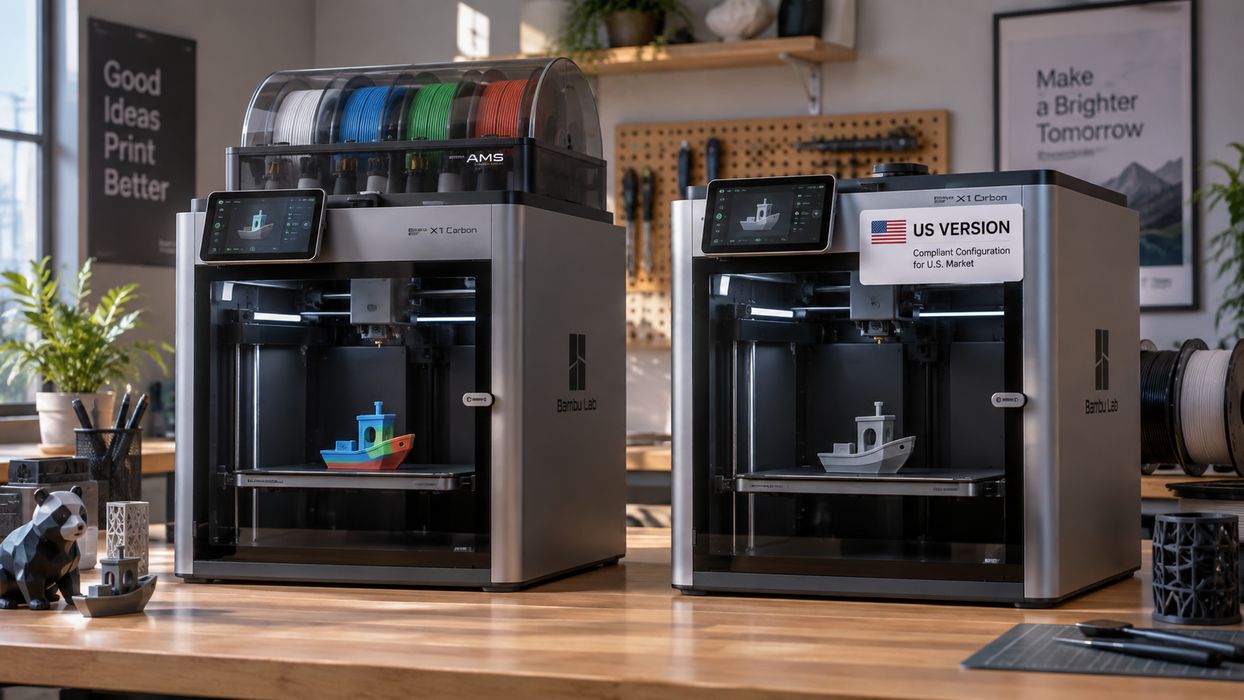
Software may split into US/non-US printer versions. We might see one hardware platform with a US firmware, US slicer build, or geographically controlled feature flags. A US Bambu Studio, for example, might generate G-code differently while an overseas version retains the existing algorithm.
That could produce a bizarre situation where US printers are purposely less capable. A function might disappear not because the manufacturer can’t implement it, but because it can’t legally implement it in that particular market.
Open-source slicers could become an especially messy area. Manufacturers using open source as a basis for their software tools (e.g. all of them) will no doubt examine whether algorithms in their slicers resemble what the jury found infringing. But if code is open source, removing a function from an official US build doesn’t necessarily make it disappear: forks can restore it. That could create some peculiar situations where what the manufacturer distributes and what owners can independently install could be quite different.
Product development for desktop printers could slow down. Until now, many inexpensive FFF manufacturers have implemented features that appear to be generic industry techniques: probing the bed, generating extrusion paths, purging material, identifying spools, networking printers, etc. After this verdict, product development teams may be told, “Before we add this, check the patents!” That slows development and adds costs even if no lawsuit ever occurs.
Smaller manufacturers might be affected more than Bambu. Bambu is large enough to litigate, redesign, and potentially license the patent features from Stratasys. A much smaller Asian manufacturer contemplating US distribution might decide that a US patent court battle isn’t economically viable. So while I also doubt Bambu leaves the US, ironically, the verdict could discourage smaller competitors from entering the US market at all. And that reduces competition and would raise prices.
US distributors and resellers may start asking hard questions. US patent law covers making, using, selling, offering for sale, and importing an infringing invention. They therefore have an incentive to demand IP indemnification from manufacturers. Large retailers might become unwilling to carry questionable products without contractual protection. That’s another way these patents could influence products without Stratasys directly suing every manufacturer.
Existing commercial customers could start asking for indemnities too. An enterprise purchasing hundreds of printers doesn’t want to become entangled in somebody else’s patent dispute. Larger buyers could start making IP warranties and indemnification part of their buying process, which again favors bigger manufacturers capable of providing them.
The verdict could trigger a patent-arms-race scenario. Bambu, Creality, Prusa, and other major manufacturers have increasingly substantial IP portfolios of their own. The rational defence against a company holding hundreds or thousands of relevant patents is often not merely invalidating those patents; it’s accumulating enough patents of your own to enable cross-licensing. That could make patent portfolios strategically much more valuable in desktop 3D printing. Up to now, we’ve seen most companies seek patents in their home country. Imagine if Bambu Lab decided to start patenting many new things in the US, and then imagine them suing Stratasys for infringing them.
Stratasys may not need to sue competitors at all. I had thought that Stratasys would not bother with companies that were not impinging on their own customer base, but after this verdict, Stratasys also has another option: send letters and negotiate licences. A credible threat backed by a US$27.6M jury result can accomplish quite a lot without another courtroom battle. It could be an easy way for Stratasys to scoop up some cash from popular 3D printer manufacturers. And also raise the price of the equipment at the same time.
Patent expiration dates suggest different tactical decisions. One extrusion-path patent is currently listed as expiring in March 2027. A manufacturer might tolerate a temporary US workaround for that one rather than negotiate a long licence. By contrast, the purge-tower patent is listed through 2034, while the two force-detection patents extend into roughly 2034 and 2036. Those are long enough that permanent redesign or licensing makes much more sense.
There’s something else: there is a second Stratasys lawsuit brought against Bambu Lab for patent infringement. This one involves different patents that relate to AMS operation. They talk about reading data from tagged RFID filament spools, machine vision print inspection, automatic printer configuration, and remote operation. All of which are features you’d find on any Bambu Lab machine, or indeed on many other brands.
Should Stratasys win that case, or portions thereof, then they have rather strong leverage over not only Bambu Lab but any 3D printer manufacturer that uses an AMS-like multimaterial system. Which is basically all of them.
We don’t know how far Stratasys would push their patent power, as for this moment, it is only directed against Bambu Lab. But should they press other manufacturers, it could have serious effects on 3D printing in the US.
We could see withdrawal of models from the US market, fewer product options, higher prices, and more. It is also possible that some operations with larger farms may even consider locating their operations outside of the US to avoid these complications.
