
Charles R. Goulding and Aaron Rofe take a look at how additive manufacturing is moving from the ski workshop to the slopes, reshaping everything from boot fit to ski construction.
Skiing has always been an equipment-heavy sport, and for decades that equipment came from a small number of manufacturers running molds, autoclaves, and lamination presses. Additive manufacturing is starting to chip away at that model from both ends: hobbyists are printing their own binding jigs and ski racks at home, while manufacturers and startups are exploring 3D printed skis, boots, and even carbon fiber composite structures that could eventually replace traditional layup. The result is a surprisingly wide spectrum of activity, from a garage tinkerer’s MakerBot to a US$1.2 billion global ski equipment market being reconsidered around additive processes.
For gear-obsessed skiers who already own a desktop FDM printer, the appear isn’t necessarily printing a full ski – it’s solving the dozens of small, annoying problems that come with owning and maintaining ski gear. Binding mounting is a good example. Rather than paying a shop US$60 or more every time they want to test a new pair of skis, hobbyists with a printer can produce their own binding mount templates and toe/heel offset jigs, letting them remount bindings at home without a drill press.
Beyond mounting, there’s a long tail of small, printable accessories that make ski ownership easier: wall-mounted ski racks and displays, center-finding tools, skin tail clips, ski vises for base work, and even boot dryers. This DIY layer reflects a broader pattern in consumer 3D printing: the technology only became genuinely useful for this kind of work once print quality and affordability crossed a threshold. Early consumer machines from the early 2010s were inconsistent enough that many hobbyists concluded the category needed several more years to mature. By the later part of that decade, cost and quality had both improved enough that owning multiple printers for everyday projects – ski-related and otherwise – became practical for a serious hobbyist.
While hobbyists were printing accessories, larger manufacturers started asking a more ambitious question: could you print the ski itself? Stratasys answered that in 2014 with what’s generally regarded as the first functional 3D printed downhill ski, built on an industrial-grade F900 printer using Ultem 9085 resin, paired with a polyethylene base and metal edges for rigidity. The design and testing process took considerable iteration to meet the safety demands of a product that has to survive real mountain forces, and each pair took roughly three days to print. Stratasys followed that project with a 3D printed snowboard, again relying on Ultem 9085 for the main body but combining it with ABS, nylon, and polycarbonate for bindings, straps, and base components – a build that took closer to a week per board.
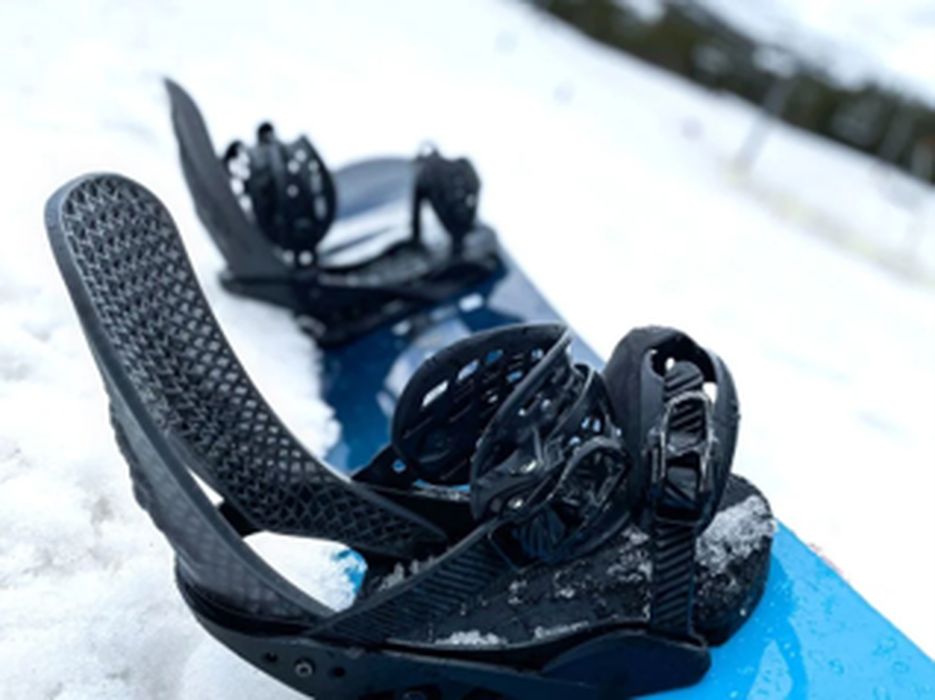
These projects were never meant to be commercial products; they were proofs of concept demonstrating that additive manufacturing could meet the structural demands of snow sports equipment. But they mattered because they showed printed skis weren’t a novelty limited to small toy-like objects — with the right industrial hardware and materials, a printer could produce something that actually holds up on snow.
On the hobbyist end of that same spectrum, smaller-scale projects have shown that even a basic desktop printer can produce something ski-adjacent. One maker designed a pair of compact “shoe skis” short ski-like attachments that clip onto regular shoes — printable on an ordinary 220mm-bed consumer printer in about a day using standard PLA filament. It’s a far cry from a resort-ready ski, but it illustrates how low the barrier to entry has become for experimenting with the concept.
If there’s one category where 3D printing has moved furthest toward practical, sellable products, it’s ski boots. Boot fir is a chronic pain point in skiing – stock shells rarely match the exact shape of a skier’s foot and lower leg, which is why boot-fitting is its own specialized trade. Several companies have used 3D scanning and printing to attack that problem directly.
Switzerland-based Tailored Fits scans a customer’s foot and uses that data to design a custom inner liner that slides into an outer shell, eliminating the pressure points created by traditional buckles and straps and improving how power transfers from leg to ski. A similar approach from Austria’s Sport Egger, marketed as EasyStand, uses SLS printing and a carbon-fiber-reinforced polyamide material to produce boots with interchangeable insoles for a more precise heel position, aiming to reduce joint strain from ill-fitting boots. Materialise has taken a hybrid approach with its own custom boot program, 3D printing a flexible liner while leaving the outer shell to conventional molding.
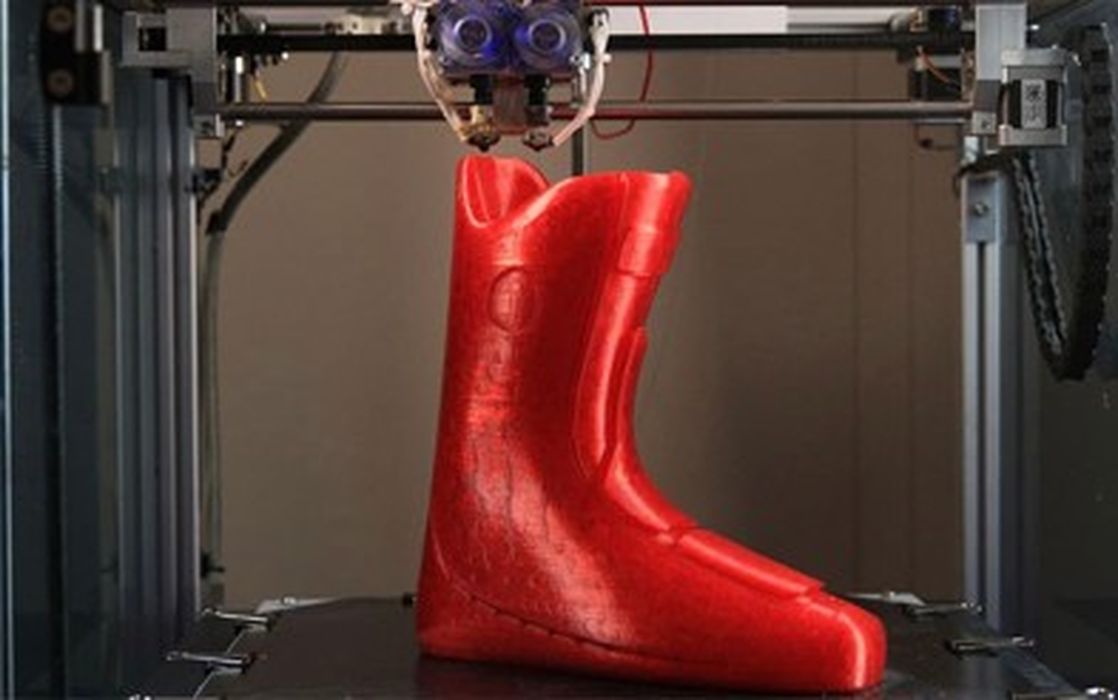
What makes boots a better near-term fit for 3D printing than full skis is the nature of the problem being solved. A ski has to survive enormous, repeated mechanical loads across its entire length; a boot liner mainly needs to match a complex, individual shape precisely and comfortably. That’s exactly the kind of geometry problem additive manufacturing is good at solving, which is likely why custom 3D printed boots have reached actual retail availability while printed skis remain largely experimental.
The more recent development is the emergence of continuous carbon fiber 3D printing, which changes the calculus for printing structural ski components rather than just prototypes or accessories. Systems capable of laying continuous carbon fiber during the print process can now reach fiber volume fractions in the 35-40% range, closing in on the 45-50% typical of traditional hand-laid prepreg composites used in premium skis. That matters because it starts to make additive manufacturing viable for parts that need real stiffness-to-weight performance, not just a rigid outer shape.
The appeal isn’t only performance-it’s flexibility in design. Traditional ski construction relies on laminate schedules that are expensive and slow to change, which is part of why new ski designs typically take months and multiple prototype rounds to refine. Because a 3D printer can vary fiber orientation and internal lattice density continuously along the length of a print, it’s theoretically possible to tune a ski’s flex pattern-softer tip, stiffer waist, controlled torsional rigidity – without the tooling changes that traditional manufacturing would require. Advocates of this approach also point to sustainability advantages: conventional ski manufacturing generates meaningful trim waste and relies on materials, like epoxy prepreg and polyurethane cores, that are difficult to recycle at end of life, whereas thermoplastic-based printed structures use only the material that ends up in the final part.
None of this is without real hurdles. Cold-weather durability is a serious open question, since the polymer matrices used in fiber-reinforced printing behave differently at resort temperatures than they do at room temperature, and any manufacturer pursuing this route would need extensive field testing before matching the multi-season durability skiers expect from mid-range or premium skis today. It’s also a capital-intensive path: producing full-length ski parts requires industrial-grade continuous-fiber printers that cost tens of thousands of dollars, well beyond desktop hobbyist equipment.
The Research and Development (R&D) Tax Credit
3D printing may help ski-industry companies identify and document activities that fit the federal R&D tax credit framework. Under IRC § 41(d), qualified research generally must involve domestic R&E expenditures, seek technological information, support development of a new or improved business component, and include a process of experimentation. The article’s examples-printed skis, snowboards, boot liners, structural parts, and prototype tools-point to work that may involve engineering-based uncertainty about materials, fit, strength, flexibility, durability, and manufacturability.
The strongest credit connection is not simply “using a 3D printer.” It is using 3D printing to test alternatives and solve technical problems. For example, the article describes opportunities to vary fiber orientation and internal lattice density to tune flex patterns and torsional rigidity, which relates to improved performance, reliability, or quality-permitted purposes under IRC § 41(d)(3). The article also notes that cold-weather durability remains an open question, which could support technological uncertainty if available information does not establish the proper design or method.
Companies should focus on documenting prototype iterations, failed and successful material trials, design alternatives, engineering tests, and employee time spent evaluating results. General novelty, customer customization, routine quality checks, and post-production tweaks are not enough under IRC § 41(d)(4).
R&D Tax Savers has been helping companies navigate the complexities of the R&D tax credit since it was introduced into law in 1981.
Conclusion
Right now, 3D printing’s footprint in skiing looks less like a single technology story and more like three separate ones happening in parallel. At the hobbyist level, printers have become a genuinely useful workshop tool for solving small, practical problems around gear maintenance and setup. At the boot level, custom printing has already found a real commercial niche by solving a fit problem that traditional manufacturing struggles with. And at the ski level itself, the technology is still mostly in the prototype and proof-of-concept stage, with continuous carbon fiber printing representing the most credible path toward printed skis that could eventually compete with- rather than just imitate-traditional construction. Whether that last piece becomes a mainstream product category or stays a niche for well-funded, technically sophisticated shops will likely come down to how well printed composites hold up to a few hundred real days on snow