
SPONSORED CONTENT

One object, six ways to scan it.
One of the frustrations of 3D scanning is figuring out whether your scanner can handle that object in your hand. A scanner that works perfectly on a small mechanical part might have big troubles with a large sculpture, a shiny metal surface, or a deep niche.
Revopoint is handling this problem with its new MIRACO 2, an all-in-one handheld 3D scanner launching on Kickstarter on November 18, 2026.
The most interesting feature of the MIRACO 2 is its six different scanning modes, each designed to deal with particular scanning situations. This is quite unusual because many 3D scanners have only a single mode.
Three modes use blue laser technology. The 34-Line Blue Cross Laser mode rapidly captures larger surface areas, while the 15-Line Parallel Laser mode concentrates on fine details. A Single-Line Deep-Hole Laser mode is specifically intended to reach into tricky niches and other challenging geometries.
The remaining three modes provide different capabilities. Full-Field HD offers detailed surface capture, VCSEL Rapid is intended for quickly scanning larger subjects, and Hybrid HD combines detailed capture with dependable tracking. Hybrid HD mode can capture up to ten million points per second.
Why so many modes?
Let’s consider an operator attempting to capture a complicated mechanical assembly. It might include shiny metal components, black plastic housings, narrow openings, and wide surfaces. These are all very different scanning challenges and usually require different scanning equipment or setups.
With MIRACO 2, the operator can select whichever scanning mode best suits each situation. Revopoint says the system can handle reflecting or shiny metals, dark objects, intricate geometries, and even human bodies.
Instead of wondering whether you have the right scanner for a particular object, you can focus on choosing the appropriate scanning mode. It won’t eliminate every scanning difficulty, but it should widen the range of objects that this single device can deal with.
There’s quite a bit of flexibility in object size, too. Revopoint recommends a minimum scan volume of only 10 × 10 × 10 mm, sugar cube size. At the other extreme, an optional Photogrammetric Metrology Kit extends the maximum scanning volume to 5 × 5 × 5 m.
In Multi-Line Laser mode, the MIRACO 2 specs list single-frame accuracy as up to 0.02 mm.
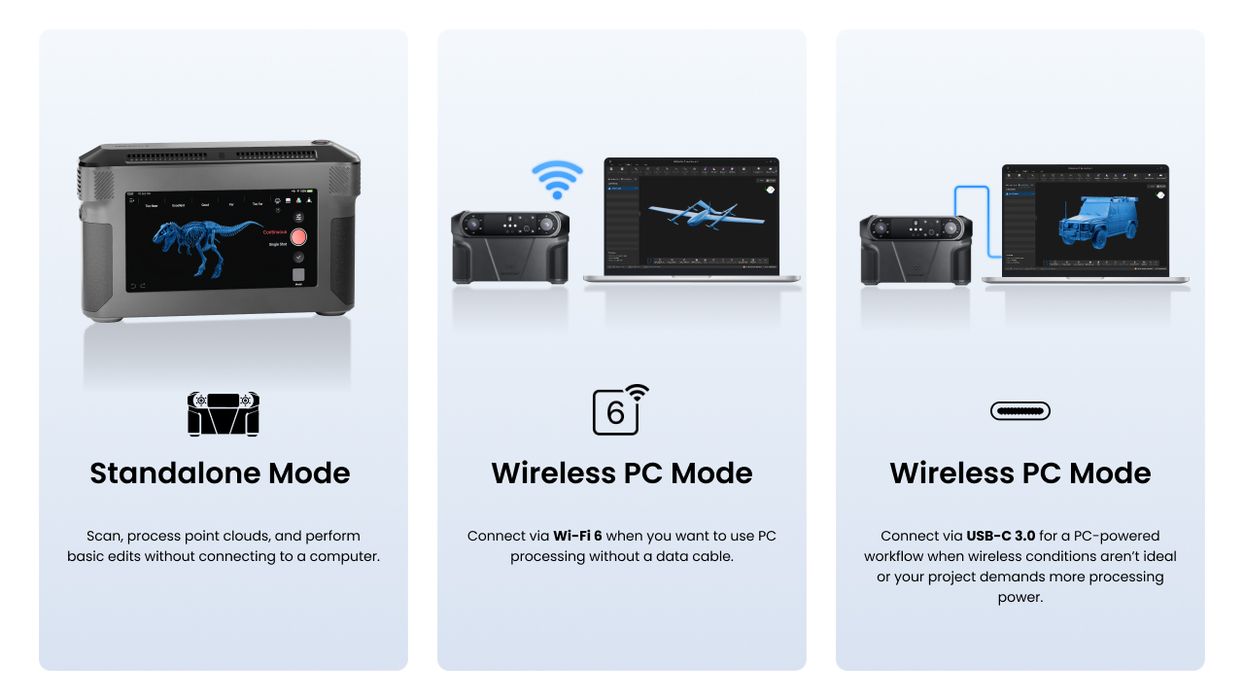
Another very handy feature is the MIRACO 2’s standalone capability. Weighing 960 g, the device incorporates an eight-core CPU, six-core neural processing unit, and a six-inch 2K AMOLED touchscreen. Operators can scan, preview, process point clouds, and perform basic edits without carrying a laptop.
For more complex scanning work, the scanner can connect to a PC using WiFi 6 or USB-C 3.0. With a suitable GPU-powered computer, Multi-Line Laser scanning can reach 120 frames per second.
The device also includes dual RGB cameras, providing 2 MP near-field and 50 MP far-field color capture. Its 10,000 mAh battery offers approximately three hours of operation, and the system supports outdoor lighting conditions up to 100,000 lux.
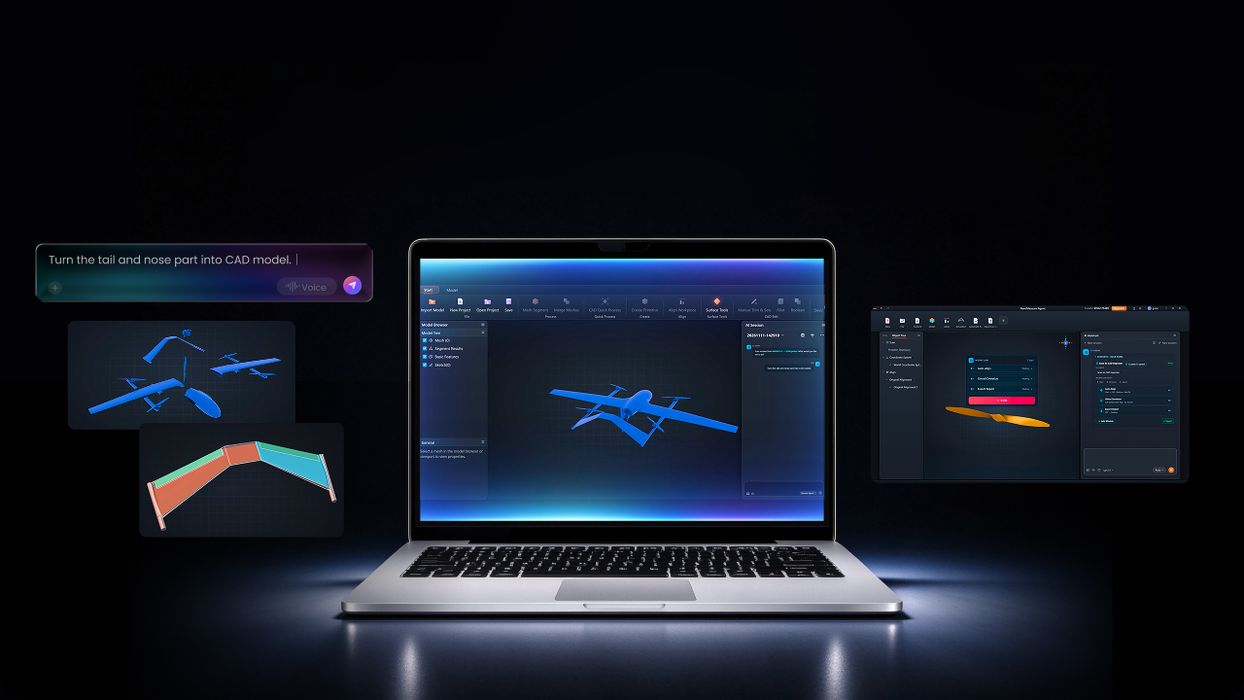
There’s another interesting component to this launch: Revo Agents.
This is Revopoint’s new AI-powered software environment, intended to automate tasks that usually require a lot of manual processing. Using plain natural language instructions, operators can request point cloud fusion, Scan-to-CAD conversion, or dimensional inspection against specified tolerances.
For 3D printing operators, that’s a particularly interesting feature. Capturing an existing object is often only the beginning. The real objective might be to develop a replacement component or modify an existing design. Reducing the work between scanning and CAD could make these workflows far simpler — and shorter.
Revopoint is launching MIRACO 2 on Kickstarter, with limited Super Early Bird offers starting at US$1,425, with discounts of up to 38%.
The combination of six scanning modes, standalone operation, and AI-assisted processing is pretty compelling. The possibility of approaching almost any object with one scanner and then moving directly into an engineering workflow could make 3D scanning considerably more accessible.
Via Revopoint and Kickstarter