
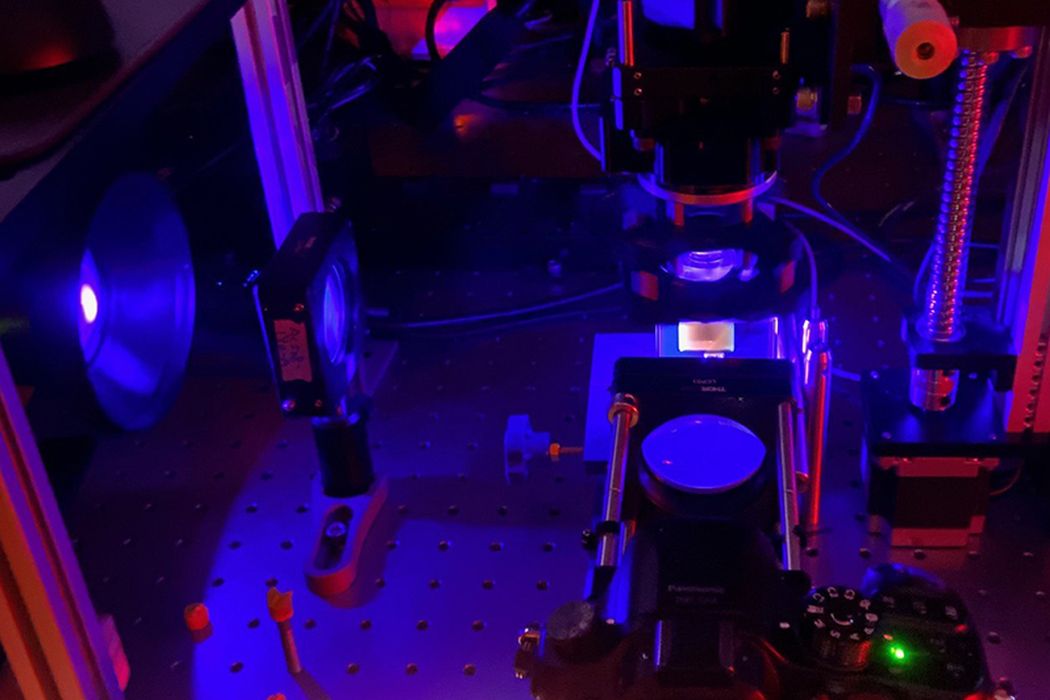
Volumetric 3D printing has a heat problem, and researchers may have found a way around it.
The work comes from a joint team from the University of Nottingham in the UK and the University of California, Berkeley. They’re working with volumetric additive manufacturing, or VAM, a resin process quite different from the SLA and DLP systems most readers will know.
Instead of curing one layer at a time, VAM projects patterns of light into a volume of liquid resin. The combined exposure causes a complete 3D object to form within the resin, potentially in only seconds. It’s like doing a CT scan, except in reverse.
That eliminates layers entirely, opening up some unusual geometry possibilities and avoiding layer delamination. It also makes VAM extremely fast. Some methods can print whole objects in mere minutes or even seconds.
Unfortunately, curing that much resin at once creates another problem: heat.
Polymerization is an exothermic reaction, meaning it releases heat as it occurs. In VAM, enough material can react simultaneously that temperatures reportedly rise by more than 60C.
That can become a feedback problem. Higher temperatures accelerate the reaction, which creates more heat, which accelerates things further in a kind of heat spiral. The result can be over curing, distorted geometry and lost detail: a print failure.
It also puts limits on what you can print.
A larger object contains more resin that reacts. Several objects packed closely together can create similar heat problems because all those reactions are occurring within a relatively small volume.
The researchers found a solution to this by changing the polymer chemistry rather than trying to bolt a larger cooling system onto the printer.
They used “reversible addition fragmentation chain transfer polymerization”, normally shortened to RAFT.
In regular polymerization, reactive sites can rapidly continue adding monomers until the reaction terminates. That rapid activity generates considerable heat.
RAFT introduces a control agent that spends much of its time attached to the end of the growing polymer chain. Occasionally the bond releases, allowing the chain to grow for a short period. The RAFT agent then reconnects, effectively putting that chain back to sleep.
Repeat this process across the resin and fewer chains are furiously reacting at the same moment.
The polymerization still happens, but the activity is spread out, reducing localized temperature spikes. Apparently that makes a measurable difference when printing.
The team reports being able to produce large and small parts together in the same VAM build, as well as position multiple objects closer to one another without the over curing and inconsistent quality normally caused by concentrated heat generation.
They adjusted both the type and amount of RAFT agent to find a balance between slowing the reaction enough to control temperature and keeping the VAM process fast.
There’s another interesting bit. The researchers specifically considered compatibility with acrylates and methacrylates already commonly used in resin 3D printing. They also chose RAFT chemistry partly because many potential VAM applications are medical, making some alternative approaches that involve metals less interesting.
This doesn’t mean your desktop resin 3D printer operator will order bottles of resin marked “RAFT”.
The RAFT materials is just for volumetric systems, where much more resin can react simultaneously than in a conventional layer based machine. That’s exactly why thermal control becomes such a significant issue.
What I find interesting is the direction of the solution. Scaling a 3D printer often means larger motion systems, more powerful light sources or better cooling hardware. Here, some of the scaling problem could instead be solved by just changing the material.
The Berkeley team is now designing larger VAM systems to see whether the approach keeps working at industrial scales.
