
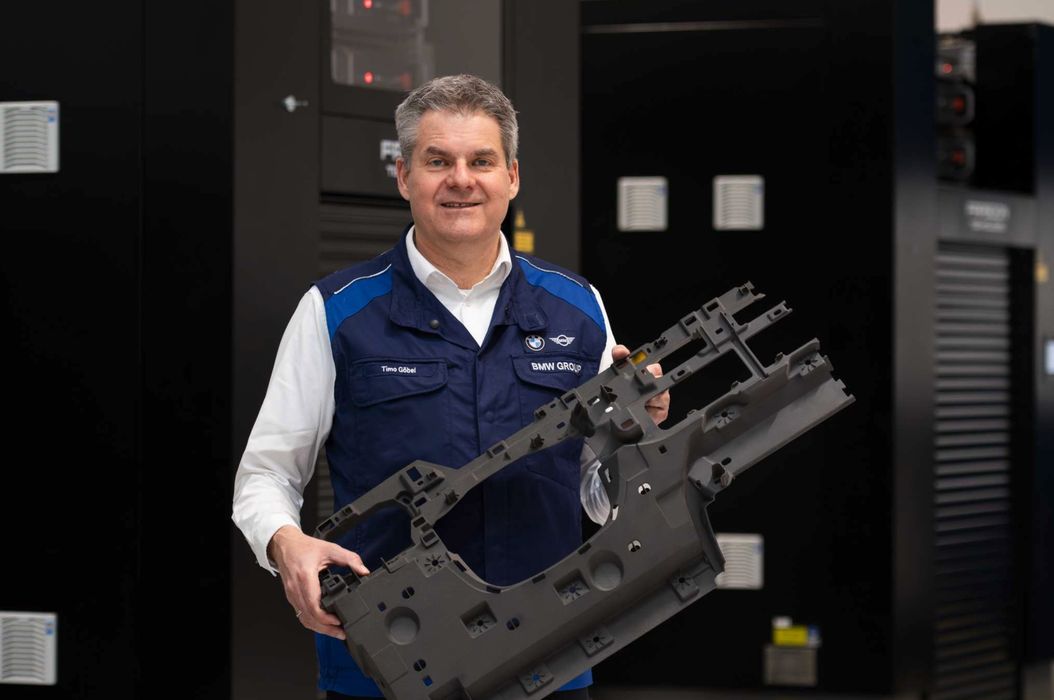
BMW is investing further in additive manufacturing, and that seems like a normal thing to do.
But WHY is it a normal thing to do?
In a recent press release, the company says additive manufacturing is now embedded across its entire vehicle life cycle, covering concept work, prototypes, production, after-sales, and even equipment used inside its factories. 3D printed production parts can be found across BMW, MINI, Rolls-Royce, and BMW Motorrad, and BMW said the technology is present at every one of its plants worldwide.
That sounds incredibly different from the way industrial 3D printing was talked about a couple of decades ago.
Back then, the question was usually whether 3D printing would eventually become a “real” manufacturing technology. I literally heard engineers describing the technology as a “fad” in those days. There were also endless discussions about replacing conventional manufacturing, printing entire products, and factories somehow turning into collections of 3D printers.
That isn’t quite what happened.
Instead, 3D printing seems to have soaked slowly into manufacturing over many years, finding a role where it makes sense, then finding more later.
BMW provides a particularly good example because they have been doing this for a very long time.
The company began investigating additive manufacturing around 1990 and produced its first stereolithography prototype parts in 1991. That was primarily prototype territory, which is in fact where almost everyone started with the technology, because the materials and technology used then were not good enough for production parts.
Then things began creeping toward production.
In 2012, BMW began producing polymer brackets for Rolls-Royce Phantom vehicles. In 2017, the BMW i8 Roadster introduced series-produced metal components, while MINI Yours Customized applied additive manufacturing to individualized customer parts.
BMW opened its dedicated Additive Manufacturing Campus in 2020. By that point, the company had produced more than 300,000 additively manufactured parts during 2019 alone. In 2022, it established automated and digitally networked metal 3D printing lines, and in 2024, began developing WAAM for large vehicle structural components.
Now comes the latest step.
BMW is expanding the Campus with more automated equipment, larger build volumes, open-material systems, and open interfaces intended to fit additive equipment more easily into existing factory infrastructure.
Their goal is increasingly to make the equipment behave like regular factory equipment: connected, automated, dependable, and able to work within the existing production systems.
Even materials are part of this. Open-material systems reduce dependence on proprietary material setups and presumably make it easier for BMW to qualify materials according to its own requirements.
Meanwhile, their production keeps expanding. BMW says more than 1.6 million components have been produced at its Additive Manufacturing Campus since it opened, with another 100,000-plus components made annually at vehicle plants elsewhere. WAAM parts are already undergoing vehicle testing, with the first series production applications planned for 2027.
Look at the dates again.
- Prototype parts: 1991.
- First polymer series applications: 2012.
- Metal series parts: 2017.
- Dedicated industrial campus: 2020.
- Automated production lines: 2022.
- Large structural components heading toward production: 2027.
That’s about 35 years.
I think this is a much more realistic picture of how a new manufacturing technology becomes established in an industry. It just can’t replace everything all at once. Engineers try it somewhere useful. Then somewhere else. Equipment improves. Materials improve. Standards, software, and workflows appear. People inside the company learn how to design for it. Eventually, it stops being “the 3D printing project” and becomes another “normal” manufacturing method.
BMW appears to be getting quite close to that point.
Perhaps the biggest success industrial 3D printing could achieve is becoming so “normal” that announcements like this one don’t make sense anymore. That day is coming.
Via BMW Group
