
Carbon fiber filled filament sounds like an easy upgrade, but the reality is considerably messier.
A new research review by Lorenzo De Noni and Hengxi Chen examines research on carbon fiber reinforced FFF materials, including both chopped and continuous fiber systems. The researchers looked beyond basic tensile strength to examine fracture behavior, wear, friction and the many printing defects that can prevent the fibers from doing their job in a 3D print.
They found that adding carbon fiber isn’t enough. The 3D printer also has to arrange those fibers correctly and successfully bond everything together.
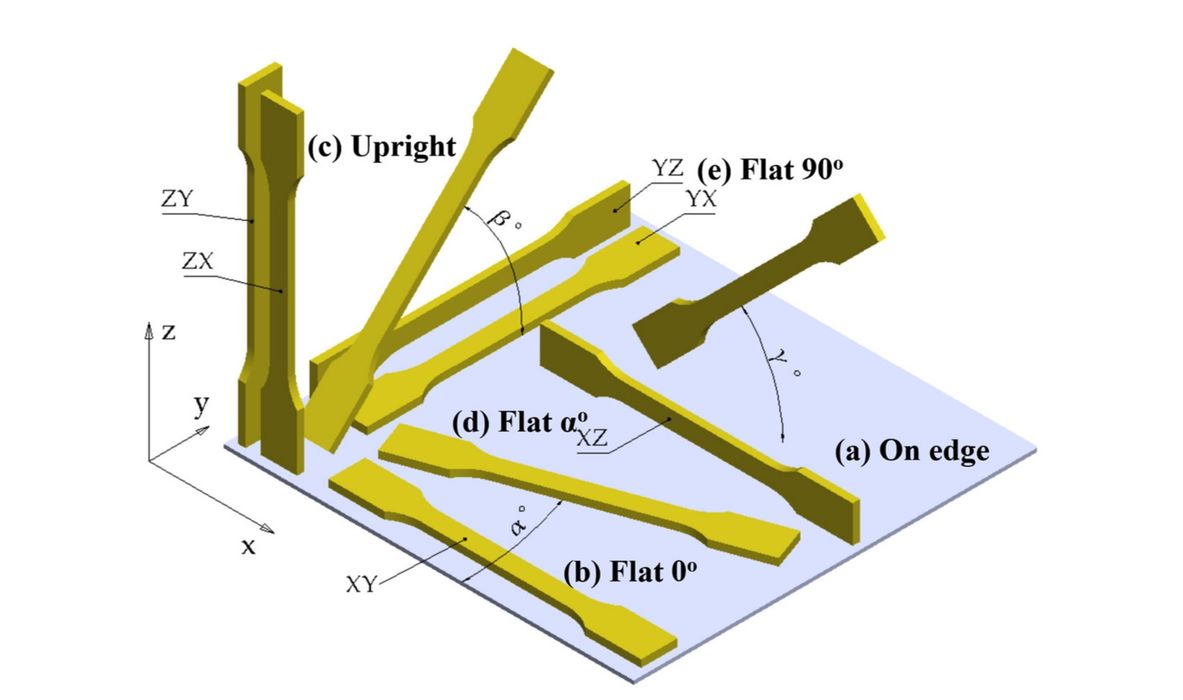
Chopped carbon fibers tend to align with the extrusion direction as material passes through the nozzle. That can produce considerably stronger parts when the print path lines up with the expected load, emphasis on “when”.
One study reviewed by the authors found carbon fiber increased tensile strength at the favorable 0 degree orientation by 33.2% for ABS, 14% for PLA and 48.2% for PETG.
Turn the deposited lines away from the load direction and much of that advantage immediately disappears. Instead of pulling along strong carbon fibers, the load increasingly works against comparatively weak bonds between adjacent extrusion lines and layers.
There are other problems. Fibers can break during extrusion, particularly when continuous reinforcement has to negotiate curves. Chopped fibers can become misaligned inside the nozzle and contribute to clogging. Carbon fiber is also abrasive, creating additional wear on printer components, most notably the nozzle.
Then there are voids.
FFF already produces small gaps between adjacent extrusion lines. Carbon fiber composites can introduce additional voids between the fibers and polymer matrix. These reduce the amount of material actually carrying a load and create places for cracks to start.
This helps explain why real carbon fiber FFF parts often perform below what calculations based purely on the fiber and polymer properties would predict.
The fracture results are particularly interesting. Carbon fiber can actually make a material either tougher or more brittle.
With good bonding, fibers can bridge a developing crack and force it to consume more energy as it propagates. Continuous fiber polyamide prints have demonstrated Mode I fracture behavior comparable with some conventionally manufactured composites.
With poor bonding, however, short fibers can behave more like defects. Fibers pull out of the polymer instead of transferring loads, potentially reducing fracture toughness compared with the unfilled material.
In other words, that carbon fiber label on the spool doesn’t guarantee tougher parts.
The review also examines something about carbon fiber FFF materials that doesn’t get enough attention: wear.
During dry sliding, exposed carbon fibers can generate a thin carbon rich transfer layer on the opposing surface. This reduces direct polymer contact and can substantially lower friction. Carbon fiber parts can be slippery!
Reported examples include nylon dropping from a coefficient of friction of about 0.70 to 0.40 after carbon fiber reinforcement, while PLA dropped from about 0.70 to 0.45 in another study.
Even here, printing quality interferes. Porosity, infill density, layer orientation and printing temperature can significantly change wear behavior. One study found increasing infill in a polypropylene carbon fiber material from 60% to 100% reduced its specific wear rate by around 41%.
The review points toward several ways to squeeze more performance from these materials. Thermal annealing can reduce voids and improve consolidation, while researchers are experimenting with chemical treatments, ultrasonic processing and hybrid systems combining short and continuous fibers.
Perhaps the most interesting conclusion is this: carbon fiber FFF is increasingly becoming a manufacturing process problem rather than just a material problem.
Via Polymers
