
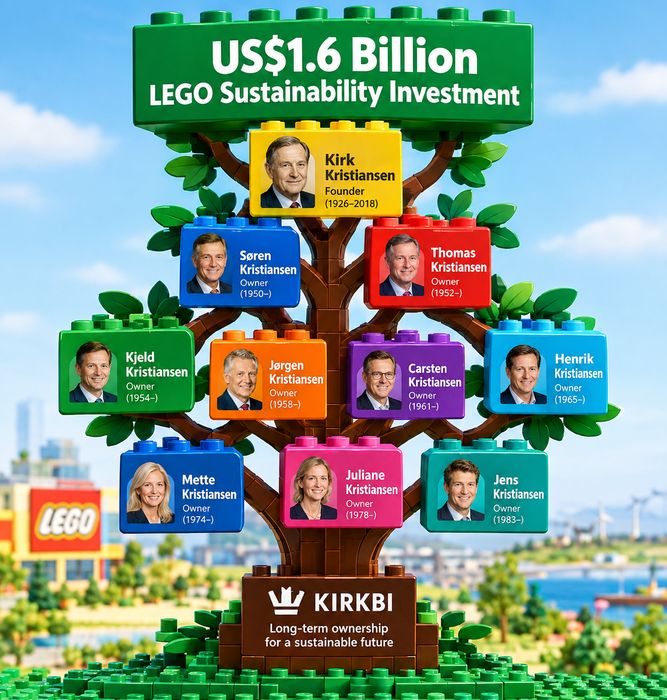
Charles R. Goulding and Preeti Sulibhavi look inside the Kirk Kristiansen family’s US$1.6 billion climate investment strategy and explain why solving LEGO’s notoriously difficult plastic-recycling challenge could have implications far beyond the toy industry.
For generations, LEGO has been one of the world’s most recognizable toys—and one of the most enduring. But the same characteristics that make a LEGO brick so satisfying to build with also make it unusually difficult to make sustainably.
The bricks must be extraordinarily precise, durable, colorful, safe for children and capable of connecting with LEGO pieces manufactured decades ago. That is a formidable materials-engineering challenge.
Now, the billionaire family behind LEGO is putting significantly more money behind solving the broader plastics problem. KIRKBI A/S, the investment company controlled by the Kirk Kristiansen family, plans to double its approximately US$1.6 billion climate investment portfolio over the next five years, with plastics recycling expected to be a major area of investment. KIRKBI Climate CEO Anupam Bhargava said plastics recycling is an area where the organization plans to invest heavily.
For the 3D printing industry, the development is particularly interesting because additive manufacturing can serve as an important laboratory for testing new materials, geometries and manufacturing processes before those materials are committed to high-volume production.
Why LEGO Plastic Is So Difficult to Recycle
LEGO’s famous bricks have traditionally relied heavily on acrylonitrile butadiene styrene, or ABS. ABS is an engineering plastic prized for strength, dimensional stability, surface finish and impact resistance.
Those characteristics are precisely why it works so well for LEGO.
A LEGO brick has to be manufactured to extremely tight tolerances. Its studs and internal tubes must produce the familiar “clutch power” that allows one brick to connect securely to another while still being separable by a child. The material also has to survive repeated assembly and disassembly without significant deformation.
LEGO says ABS accounts for approximately 85% of the resin used in its bricks. The company has been testing recycled and renewable alternatives, but finding materials that meet its demanding quality, safety and durability requirements has proven difficult.
The company learned this lesson particularly clearly with recycled PET.
LEGO spent more than two years developing a prototype brick using recycled polyethylene terephthalate from discarded plastic bottles. Ultimately, the company abandoned the project because the additional processing, energy requirements and manufacturing changes would have produced a higher overall carbon footprint.
That is an important lesson for the entire manufacturing industry: a material is not automatically sustainable simply because it is recycled.
LEGO Has Already Been Experimenting with Circular Materials
LEGO’s sustainability program is therefore becoming more sophisticated. Instead of looking for one “magic” replacement for ABS, the company is experimenting with multiple materials and technologies.
One of the most interesting examples is a new material used for LEGO tires.
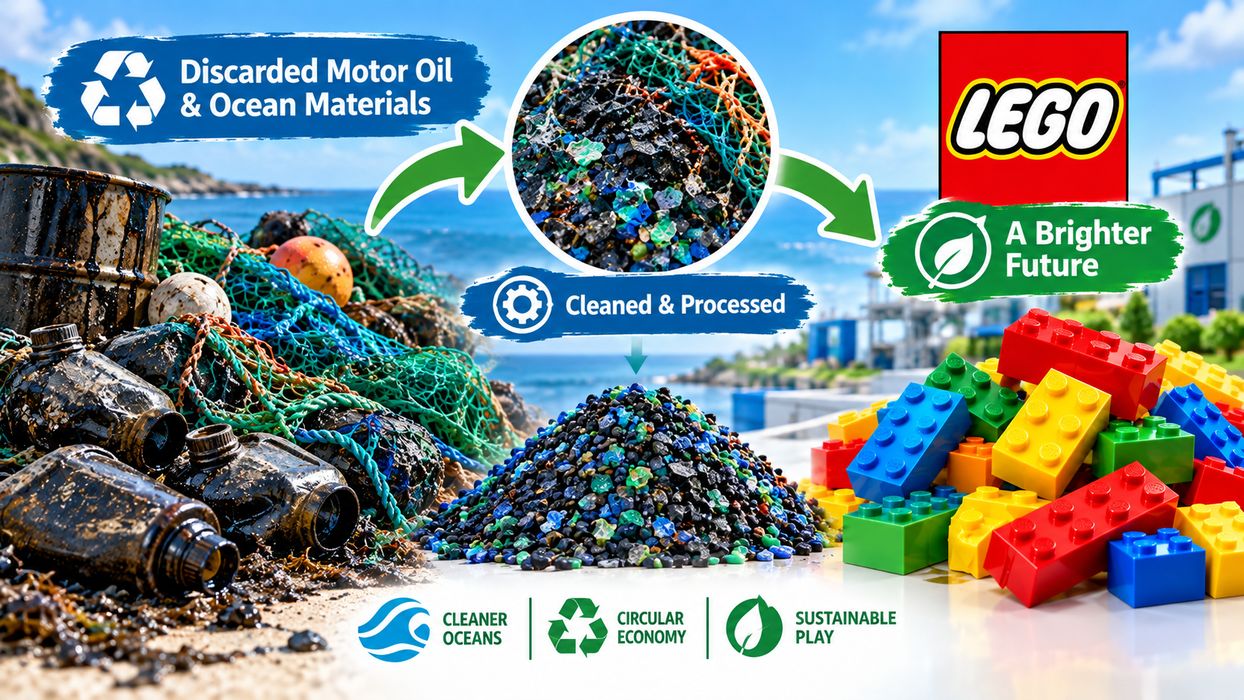
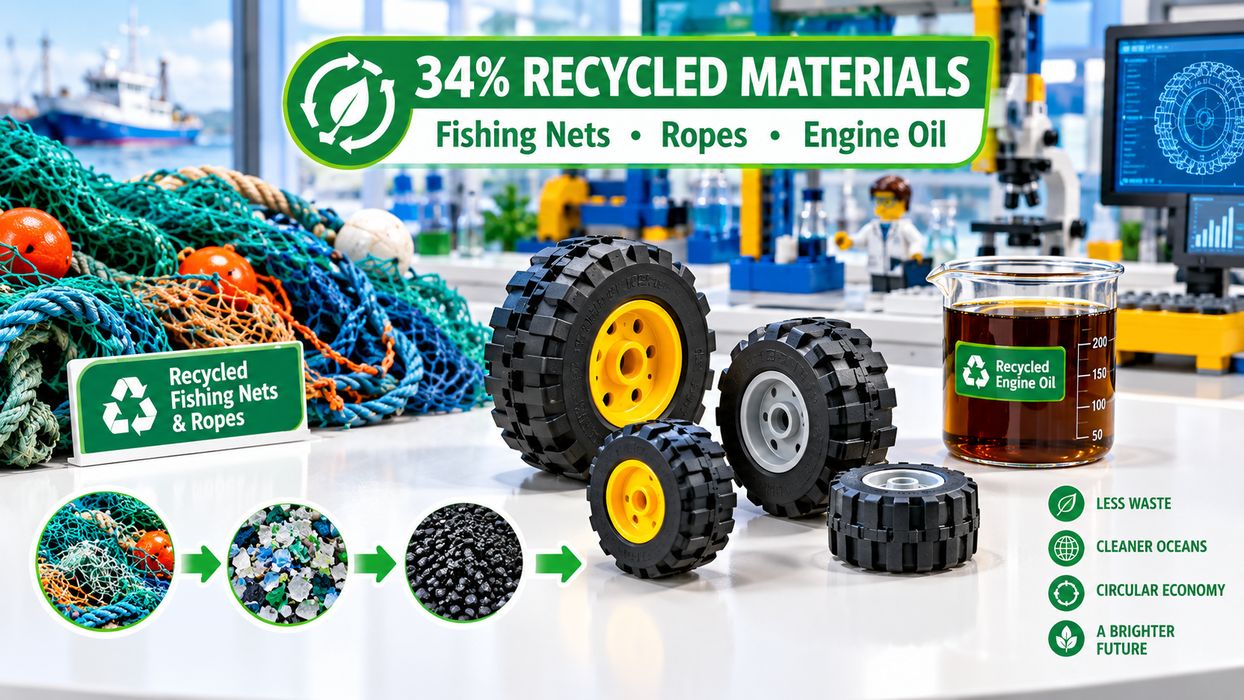
In 2025, LEGO introduced tires containing at least 30% recycled content derived from discarded fishing nets, ropes and recycled engine oil. The company calls the material rSEBS, referring to recycled components combined with styrene-ethylene-butylene-styrene, a thermoplastic elastomer. LEGO says the material was developed and tested for approximately five years before entering production.
The concept is fascinating because it combines two waste streams that seem unlikely to belong in the same product.
Discarded fishing nets and ropes can become difficult-to-manage ocean waste. Meanwhile, used engine oil is a complex waste material requiring significant chemical processing to recover useful components and remove contaminants.
We at R&D Tax Savers have a client that uses cutting-edge technology to recycle used motor oil waste.
Likewise, LEGO’s approach demonstrates the potential of combining different waste streams to produce a material with useful performance characteristics.
The result is not merely an environmentally themed product. The new LEGO tires have to function like conventional LEGO tires, with the same appearance, feel and durability. LEGO has said the new material is indistinguishable from the existing tires, and the company planned to expand its use across approximately 120 sets.
Where 3D Printing Enters the Picture
This is where the LEGO sustainability story intersects directly with additive manufacturing.
3D printing provides manufacturers with a relatively fast way to experiment with materials before committing to expensive production tooling.
LEGO already uses 3D printing extensively in product development. In our 2024 Fabbaloo article, Dreamzzz by LEGO: Toy Making with 3D Printing, we discussed how LEGO used 3D printers to develop new shapes and detailed elements for its Dreamzzz product line. LEGO also uses additive manufacturing alongside injection molding, with 3D printing particularly valuable for prototyping and producing smaller quantities of specialized elements.
Our earlier LEGO: Many Exciting Developments & 3D Printing article examined LEGO’s environmental-materials research alongside its increasing use of 3D printing. At the time, we noted that additive manufacturing could facilitate experimentation with new materials and manufacturing processes.
That prediction remains relevant today.
Our 2021 article, Lego Leadership, Innovation and Sustainability, specifically examined the challenge of developing materials that could simultaneously provide the precision, durability, color and safety required by LEGO while reducing environmental impact. We also suggested that 3D printing could help facilitate experimentation with sustainable materials.
The emergence of rSEBS demonstrates why that concept remains important.
While LEGO has not announced that it is 3D printing these recycled tires, additive manufacturing could potentially become a valuable development tool for future recycled thermoplastic formulations. Researchers could test new blends, examine mechanical properties, optimize extrusion parameters and evaluate geometries without immediately producing expensive injection molds.
For the 3D printing industry, the bigger opportunity may therefore be upstream: additive manufacturing can help materials companies determine whether a recycled or bio-derived polymer can actually perform before mass production begins.
KIRKBI Is Betting on the Recycling Infrastructure
The new LEGO tire material is only one piece of a much larger strategy.
KIRKBI Climate currently manages approximately DKK 10 billion, or about US$1.6 billion, across energy transition, circular plastics and land sustainability. The organization says it plans to deploy up to another DKK 10 billion by 2030. Its circular-plastics portfolio includes investments involving advanced recycling, textile recycling, plastics supply chains and bio-based materials.
That is significant because the economics of recycling have historically been challenging. Virgin plastic can often be cheaper and easier to process than recycled material. Recycling infrastructure also requires substantial capital investment.
KIRKBI’s strategy recognizes that solving the plastics problem requires more than changing the material in one LEGO product. It requires investment in collection, sorting, chemical and mechanical recycling, processing infrastructure and companies capable of scaling these technologies.
The family’s approach is therefore less about making a “green LEGO brick” and more about helping build an ecosystem in which recycled materials become commercially viable.
Meet the Family Behind the Strategy
KIRKBI is the holding company of the Kirk Kristiansen family, which founded LEGO in 1932. The family’s long-term ownership structure gives it an unusual ability to think across generations rather than quarterly earnings cycles. KIRKBI describes its purpose as building a better future for children and reinvesting proceeds from LEGO and other holdings into LEGO, education and climate initiatives.
The family consists of fourth-generation owners Thomas Kirk Kristiansen, Agnete Kirk Thinggaard and Sofie Kirk Kristiansen, together with their father, third-generation owner Kjeld Kirk Kristiansen.
Current wealth estimates vary by methodology and market valuation. Forbes recently estimated Kjeld Kirk Kristiansen’s fortune at approximately US$7.3 billion, while Thomas, Agnete and Sofie were each estimated at roughly US$8.2 billion. Bloomberg’s estimates are higher, illustrating how valuations of private LEGO-related holdings can vary substantially.
Thomas Kirk Kristiansen serves as chairman of KIRKBI and represents the fourth generation of the owner family. KIRKBI’s structure reflects a long-term philosophy: preserve the family’s ownership while using the financial resources generated by the LEGO business to invest in areas that can influence future generations.
The motivation is therefore both philosophical and strategic. The family explicitly links its ownership vision to children, learning and climate. KIRKBI says its investments are intended to create lasting impact for children and the planet.
The Research and Development (R&D) Tax Credit
The developments described provide a strong business-development story for evaluating federal R&D credits for LEGO’s U.S.-based subsidiaries and U.S.-performed activities. LEGO and KIRKBI are increasing investment in climate and plastics recycling, including advanced recycling, plastics supply chains, bio-based materials, collection, sorting, and processing infrastructure. These initiatives align with the type of engineering, materials science, and manufacturing-process work that may qualify when performed domestically and connected to new or improved products or processes.
Under IRC §41, qualified research must generally involve domestic R&E expenditures, technological information, a new or improved business component, and a process of experimentation for improved function, performance, reliability, or quality. LEGO’s testing of alternatives to ABS, which remains approximately 85% of brick resin, and its abandoned recycled PET prototype after carbon-footprint and manufacturing-change issues, illustrate technological uncertainty and iterative experimentation. Likewise, rSEBS recycled-content tires, developed and tested for about five years, show sustained product and material development.
LEGO’s use of 3D printing for prototypes, new shapes, specialized elements, smaller production runs, and testing materials, mechanical properties, extrusion parameters, and geometries may also generate qualified wages, supplies, computer-use costs, and eligible contract research expenses. We at R&D Tax Savers covered The Rodon Group, a domestic construction toy manufacturer, in a previously published August 2025 Fabbaloo article. It’s not all fun and games with toy manufacturing; a lot of R&D goes into developing new and/or improved product lines.
R&D Tax Savers has been helping companies navigate the complexities of the R&D credit since it was introduced into law in 1981.
Old-Fashioned Play Gets a New Environmental Mission
There is something particularly fitting about this strategy.
Today’s children have smartphones loaded with apps and online games. Digital entertainment competes intensely for their attention. LEGO, by comparison, is an old-fashioned physical toy: small plastic pieces that children hold, manipulate, connect and take apart.
That physical interaction matters. Building with LEGO develops spatial reasoning, creativity, problem-solving and tactile skills.
Now, the same toy can also become an example of circular manufacturing.
The lesson extends beyond LEGO. Manufacturers of everything from automotive components to medical devices are confronting the same challenge: how can recycled materials achieve the precision and performance demanded by modern products?
KIRKBI’s decision to double its climate portfolio suggests that the answer will require serious capital, advanced chemistry and manufacturing innovation.
And that is where 3D printing fits naturally into the story.
Before tomorrow’s sustainable products can be manufactured by the millions, somebody has to experiment with the materials, test them, fail with them, improve them and try again.
For LEGO, that process is already underway. The next generation of bricks, tires and other elements may look almost exactly like the ones children have been playing with for decades.
The difference could be what is inside them—and the sophisticated combination of chemistry, recycling technology and additive manufacturing that helped make them possible.