
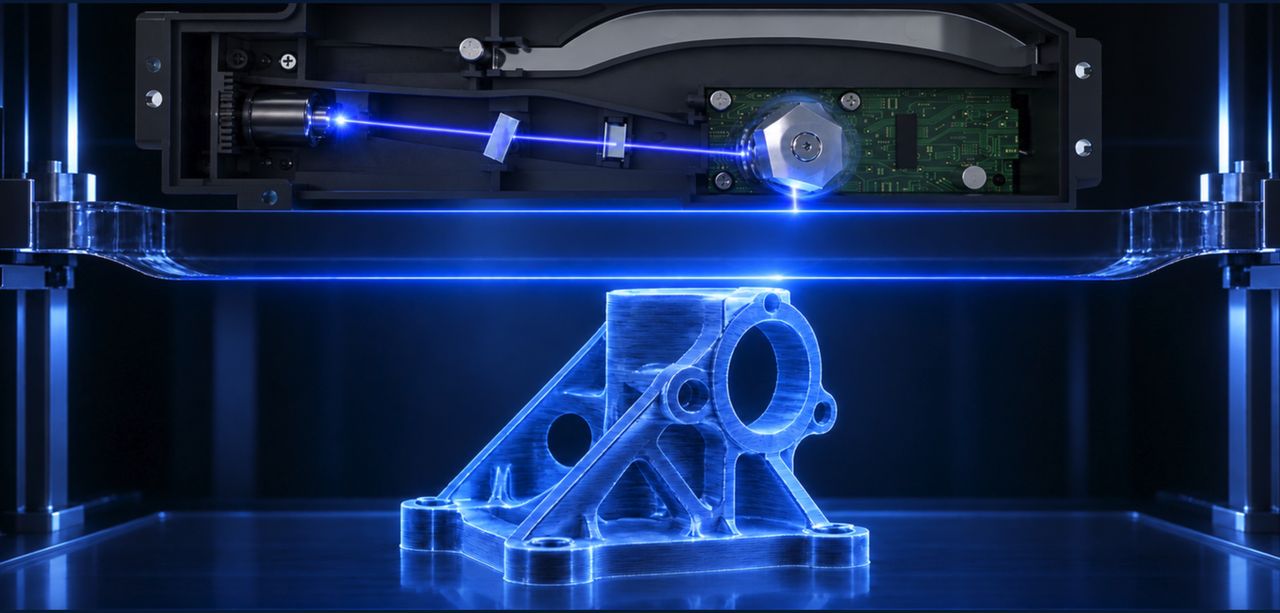
An entirely new full-color 3D printing process is about to launch.
The new process is called “LMS”, or “Layered Membrane Stereolithography”, from a new Chinese startup known as Lynxel. It is likely this is a brand name of Ningbo Baishida Electronic Technology Co.
It’s not entirely clear how LMS works, but based on the product images and knowledge of similar systems, it could be something like this:
- A transparent membrane (like FEP film) is coated with a liquid resin in the toolhead.
- The membrane is positioned at the top of the build (or first layer)
- A laser fires through the membrane, curing the wet resin on the other side, and bonding it to the build (or first layer to the plate)
- Rollers quickly peel off the membrane.
- The process repeats until done.
So there is no resin vat in this approach, which would certainly be less messy. The other big advantage is that you can print with very viscous (e.g. strong) resins because there is no need to wait for resin to flow as is required on MSLA systems.
This is somewhat reminiscent of the Admatec systems that used a circulating roll of membrane to deliver fresh resin for printing.
LMS should be able to build very strong parts at quite high resolution. Lynxel states resolution at 600 dpi, or about 0.04mm per dot. That would be able to produce extremely fine detail on a 3D print.

There’s another really interesting feature: full color!
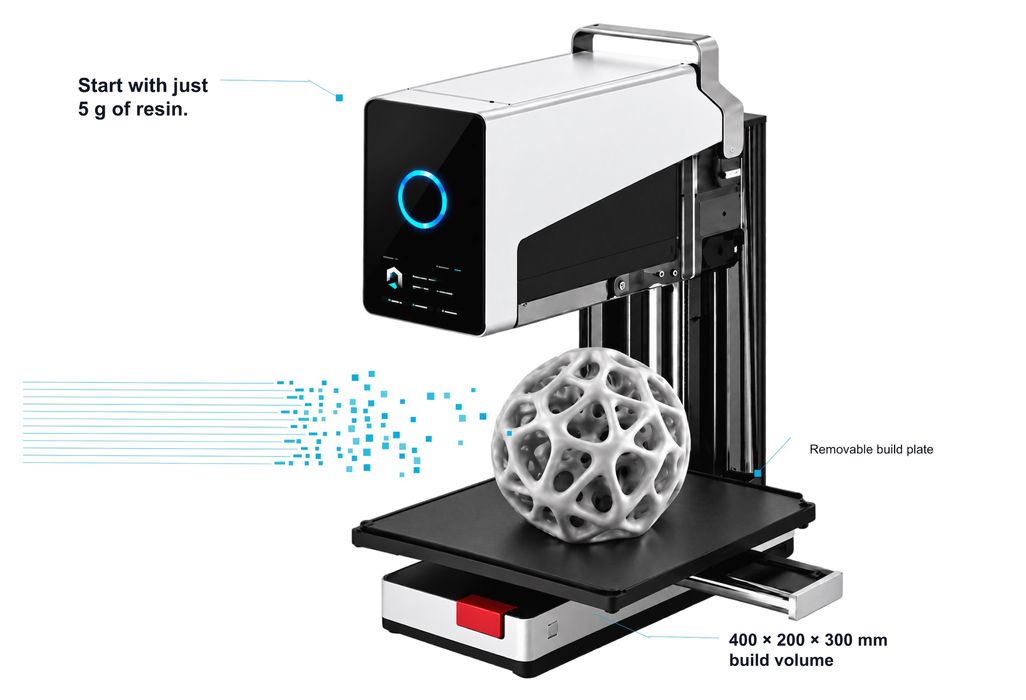
There are two initial models from Lynxel: the LynBeam LB1, which prints in monocolor as described above, and the LynChrom LC1, which can print in full, textured color. Not spot color as you’d see in a FFF filament swapper, but full color shades and gradients, like a photograph.
This appears to be done by adding an “inkjet on resin color module”. Evidently this module would pass over the fresh layer and introduce the color shades required, just like an inkjet 2D printer would do. Here, it’s doing it on each layer.
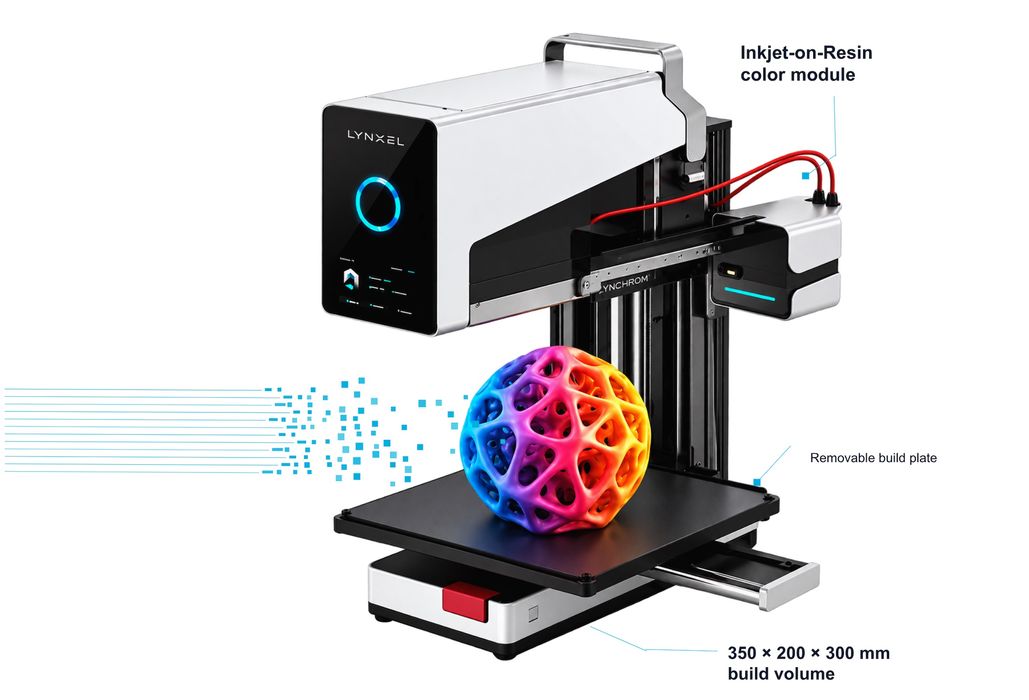
Again, this is not explained by Lynxel, but my suspicion is that the color might be introduced after the resin is cured. This provides a stable surface for the color inkjet droplets. If they were dropped into the liquid resin, they would disperse and mix. Lynxel claims 10M colors can be produced with the system.
The result would be a system that can build a very strong object that has full color textures. That is something we have never seen in 3D printing before.
What else do we know? The build volume of the LynChrom LC1 is quite large: 350 x 200 x 300 mm. That’s enough to print all kinds of color objects. The LB1 has an even larger build volume: 400 x 200 x 300 mm. It seems that the color module takes away a bit of the volume.
Another point of interest is that these machines are not enclosed. They are open gantries, similar to early FFF systems — yet they are resin machines. This demonstrates that the resin is far more under control in the Lynxel LMS concept than you’d see in any MSLA system.
While Lynxel is a startup company, they do have considerable backing, having recently received a huge investment from Jingshu Lake VC, which had previously helped launch Polymaker, and before that another investment from Gaoling Capital, which had backed Snapmaker and ELEGOO. In other words, there is very serious investment backing for this company, even though they are brand new.
Can you buy an LB1? Nope, they are going to launch via Kickstarter at some point in the near future.
We don’t know the price of the systems, but my guess would be perhaps something around US$5,000 for the full color LC1 system, and a bit less for the LB1? If that is the case, they will certainly gain a huge number of backers when they launch.
Via Lynxel
