
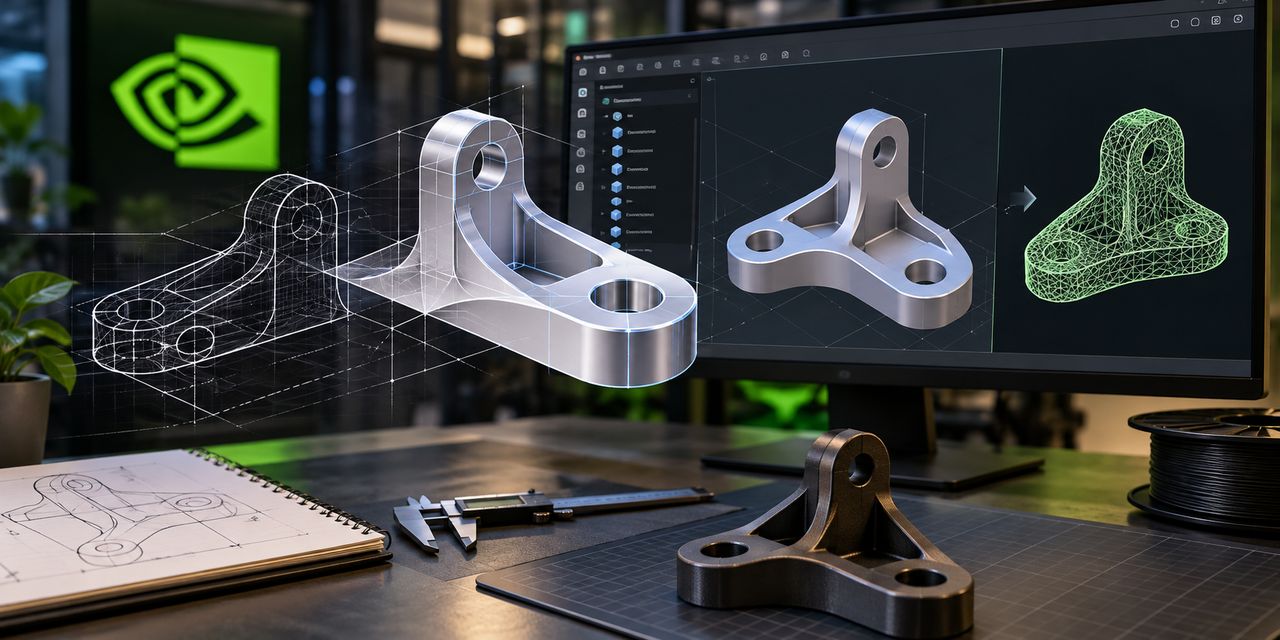
The hardest part of building a CAD application might have just become lot easier.
NVIDIA has open sourced USD BRep, a software library that includes SMLib, a geometry kernel for creating and editing precise solid models. The source is available under the Apache 2.0 license, which allows commercial use.
A CAD kernel is the key software engine underneath the buttons and menus in any 3D tool. It performs the most difficult geometric operations: joining or cutting solids, making fillets, and defining curved surfaces, etc. SMLib can represent those surfaces mathematically, rather than as the flat triangles used in a typical STL mesh.
This means that a CAD tool can work with the geometry of a face or edge as a defined surface, instead of trying to judge it from thousands of adjacent triangles. The open source library also includes Python bindings, which should make it easier to experiment with scripted modeling and automated design workflows.
This is where the release could have an effect on 3D printing. A developer could build a tool that generates a custom bracket from a few measurements, edits a design using a text prompt, checks geometry against manufacturing rules, or converts a solid into a mesh for slicing.
The kernel does not do all of that by itself. It is not a complete CAD application, a sketching tool, a fancy user interface, or even a 3D print slicer. A software developer would still have to build those pieces and more, and then make sure it all works properly.
The commercial impact of this release by NVIDIA may be the biggest for new and smaller software projects. A software company making a 3D tool no longer has to buy a kernel software license before it can start building a new CAD tool. After building a full and complete 3D tool for users, the company could then sell subscriptions, support, manufacturing services, or other specialized tools all built on top of the free geometry engine from NVIDIA.
Large CAD companies are in a rather different position. Their existing kernels are deeply tied into design history, file handling, and other engineering software. Replacing their kernel would be a major project, without much benefit: they’d end up with the same functions.
Lightweight 3D tools could have more room to experiment. Tinkercad-like tools, for example, are simple browser-based 3D design tools. It’s easy to imagine a new browser CAD application using SMLib to offer more precise geometry and better editing. But even there, the kernel would be one part of the work required to build an actual product.
FreeCAD, an open source CAD tool, already uses Open CASCADE, an open-source CAD kernel. So SMLib doesn’t suddenly give FreeCAD access to free geometry software — it already has one. But it gives developers another kernel to evaluate. Replacing Open CASCADE inside FreeCAD would be a big deal, but using SMLib for a new feature or experimental workbench might be more feasible.
There may also be a strategic angle here for NVIDIA. USD BRep connects solid modeling to OpenUSD, NVIDIA’s preferred framework for moving 3D data between applications and simulation workflows. Making the kernel freely available could encourage more developers to build tools that work with that ecosystem.
One complication: NVIDIA says the project is not currently accepting outside code contributions. Developers can USE the code under its license, but they may have to maintain their own changes. That could slow adoption by companies that need long-term support. But who knows, perhaps that policy will change in the future.
The geometry engine is now available. What applications will be built around it?
Via GitHub