
What if the printing head never had to reach the place where the object is being made?
That is the seemingly crazy idea in US20260306236A1, a patent application from Muthukuman Packirisamy, Mohsen Habibi, and Shervin Foroughi. The filing describes remote distance printing, using focused acoustic waves to solidify material hidden behind an opaque barrier.
Most of today’s photopolymer processes have a limitation: light has to reach the resin. If the material is opaque, or if something solid sits between the light source and the target region, curing stops. The patent proposes replacing light with ultrasound.
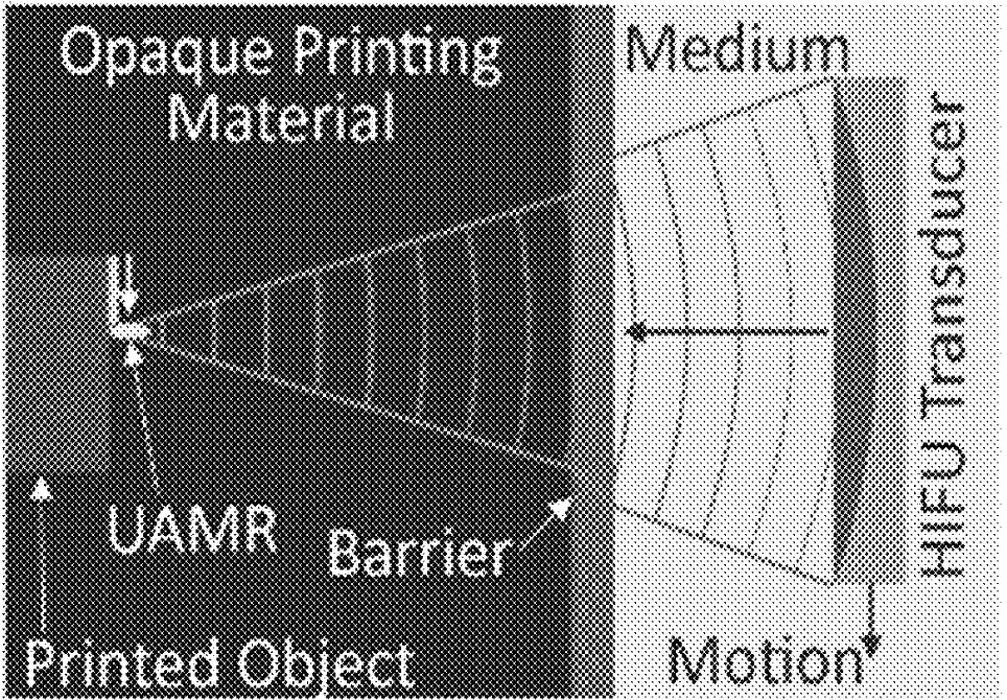
Their mechanism appears to use a high-intensity focused ultrasound transducer, or HIFU transducer. Acoustic energy travels through a medium and is focused inside the printing material. At that focal region, the pressure and energy conditions create a chemically active zone where the polymer can solidify.
Move the focal point, and the solidified regions can be placed in different locations. Move it repeatedly and a three-dimensional object can be created without exposing the entire material volume to the energy source.
The drawings show an opaque printing material with the desired object buried inside it. In one setup, a conventional light source is blocked by the material. In another, the HIFU transducer sits outside the barrier and sends focused energy through it. The barrier can be a solid shell, which is the part that caught my attention.
That could allow an object to be formed inside a container without opening the container first! It might also allow printing beneath a surface that cannot be removed easily.
The application goes further than an printing inside industrial boxes. Its abstract describes bio-printing inside the body without open surgery. One diagram places the transducer outside tissue and shows acoustic energy focused through skin, fat, and muscle toward a printing region.
That is a very remarkable proposed use, but of course it also makes their engineering questions more challenging. The system would need accurate imaging, precise positioning, careful control of acoustic energy, and a material that can remain where it is placed until the intended regions are solidified. And there’s certainly the toxicity of the resin to be considered.
One diagram shows the control arrangement: an imaging system and computer guide a three-axis manipulator carrying the printing head. Material is injected into the target region, while imaging information appears to guide the acoustic printing process.
The patent discusses heat-curing polymers and polymer composites, along with materials intended for biological applications. It also reports experimental printed shapes, including small patterned objects and structures formed through barriers. The images suggest the applicants are showing that acoustic exposure can actually produce localized printing.
If the entire container heats up or cures, this doesn’t work at all. The value is in creating small active regions deep inside an uncured volume.
I can also see a problem here. A normal printer operator can check out a nozzle or resin surface directly. Here, the printing action happens out of sight. Imaging and calibration become part of the machine, and any mismatch between the intended focal point and the actual material could produce a misplaced or incomplete object. Did the job actually succeed? Or not?
For industrial use, this concept could be useful for manufacturing inside sealed or opaque structures. For medical applications, the possible payoff is way larger, but so are the safety and regulatory challenges.
The patent propose a truly different way to think about printing: the tool does not enter the workspace. Just the energy does.
Via Espacenet