

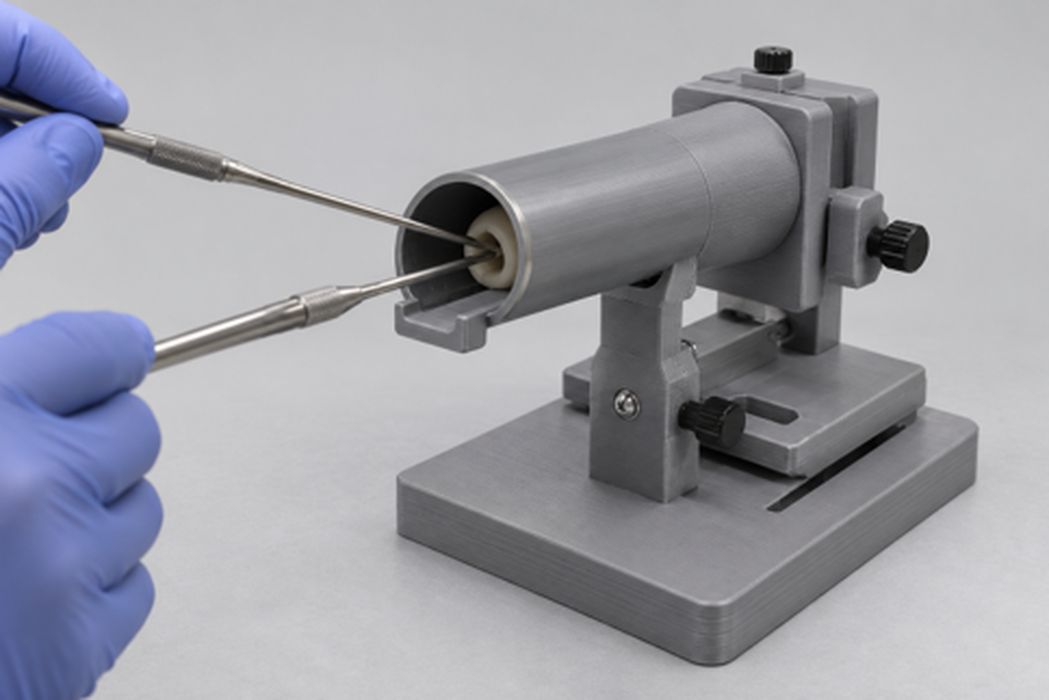
Charles G. Goulding highlights an innovative Georgetown-developed 3D printed surgical trainer that brings vocal-cord surgery practice out of the operating room and onto an affordable tabletop platform.
Your voice begins with two small folds of tissue inside your throat. They vibrate as air passes between them, producing the sound that becomes speech or song. When a growth interferes with that movement, a surgeon may need to remove it while protecting the delicate tissue around it. A 3D printed tabletop trainer gives surgeons a place to rehearse that careful work.
Two Folds That Make Your Voice
The vocal cords, also called vocal folds, sit inside the voice box, or larynx. This structure lies below the tongue and directly above the windpipe leading to the lungs. The folds face each other across the airway. When you breathe quietly, they move apart so air can pass through.
Speaking changes their position. The folds come close together, and air pushed upward from the lungs sets them vibrating. Their surfaces repeatedly meet and separate, creating sound. Your throat and mouth then help shape that sound into the voice other people recognize. The National Institute on Deafness and Other Communication Disorders explains this connection between airflow, vibration, and voice.
For that movement to work well, the tissue needs to remain flexible. A small growth called a polyp can interfere with normal vibration and make the voice sound hoarse. Removing the growth requires care because the surrounding tissue still has to vibrate afterward. Johns Hopkins describes preserving that healthy tissue as a central goal of vocal-cord surgery.
Surgery Through the Mouth
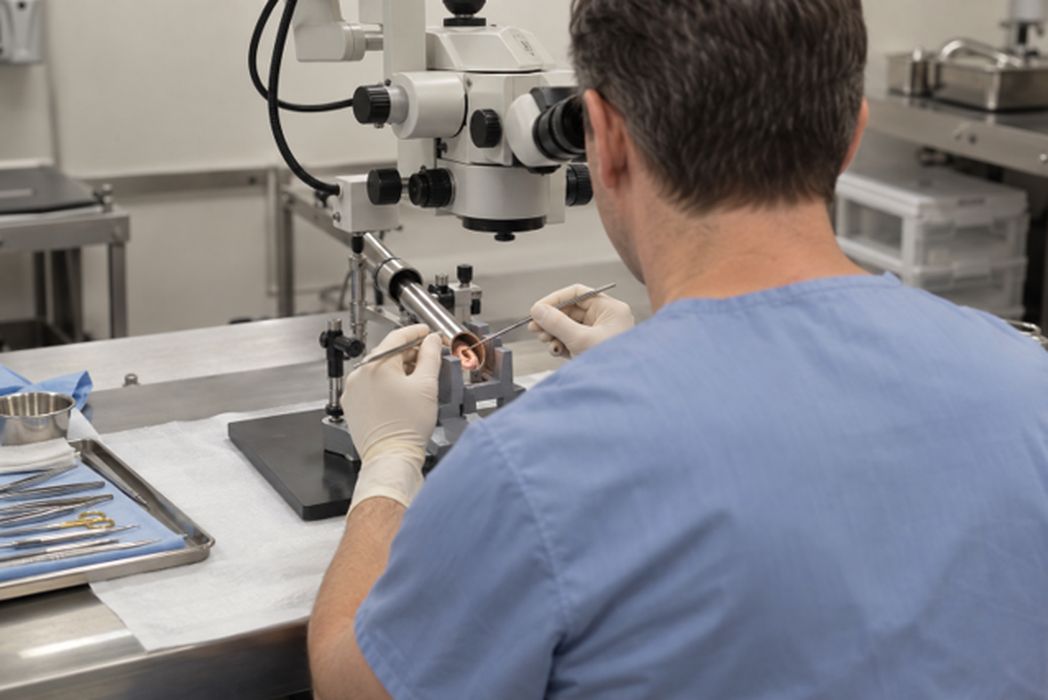
To reach the vocal folds, the surgeon can approach them through the patient’s mouth. During an operation called microlaryngoscopy, the patient is asleep under general anesthesia. A hollow instrument called a laryngoscope passes through the mouth toward the voice box, providing a narrow passage through which the surgeon can examine and treat the folds. A microscope supplies a brightly lit, magnified view.
Long, slender instruments pass down that same passage. Their handles remain outside the mouth, while tiny gripping or cutting tips reach the tissue farther inside. The surgeon watches those tips through magnification and controls them with movements made at the other end of the instruments. Both hands may be working within the same small space.
The task depends on the growth being treated. In a microflap procedure, the surgeon carefully lifts a thin layer of surface tissue to reach the abnormal tissue beneath it. The growth is separated from the healthy tissue, with the aim of preserving as much of the vocal fold’s delicate covering as possible. The reader can picture a small flap being lifted, worked beneath, and laid back into place.
That explains why simply practicing a cut on an open tabletop would leave out so much. During surgery, the target lies at the end of a narrow passage. The surgeon must reach it, keep the instrument tips in view, and handle a thin tissue layer without pulling or cutting more than intended. Each part of that sequence takes practice.
The Operation Moves to a Table
A surgical trainer recreates selected parts of that arrangement outside the body. A small target sits inside a housing on a stand, beyond an opening through which the trainee introduces instruments. The learner’s hands stay outside the apparatus, just as they stay outside the patient’s mouth during surgery. The practice target occupies the position where the tissue would be.
The Georgetown team’s open-source printed design includes a tube-like housing and supports that hold it at a usable height. Its printed laryngoscope also contains a separate channel for a flexible viewing scope, which sends images to a monitor. Together, those parts arrange the instrument passage and the view around the same target.
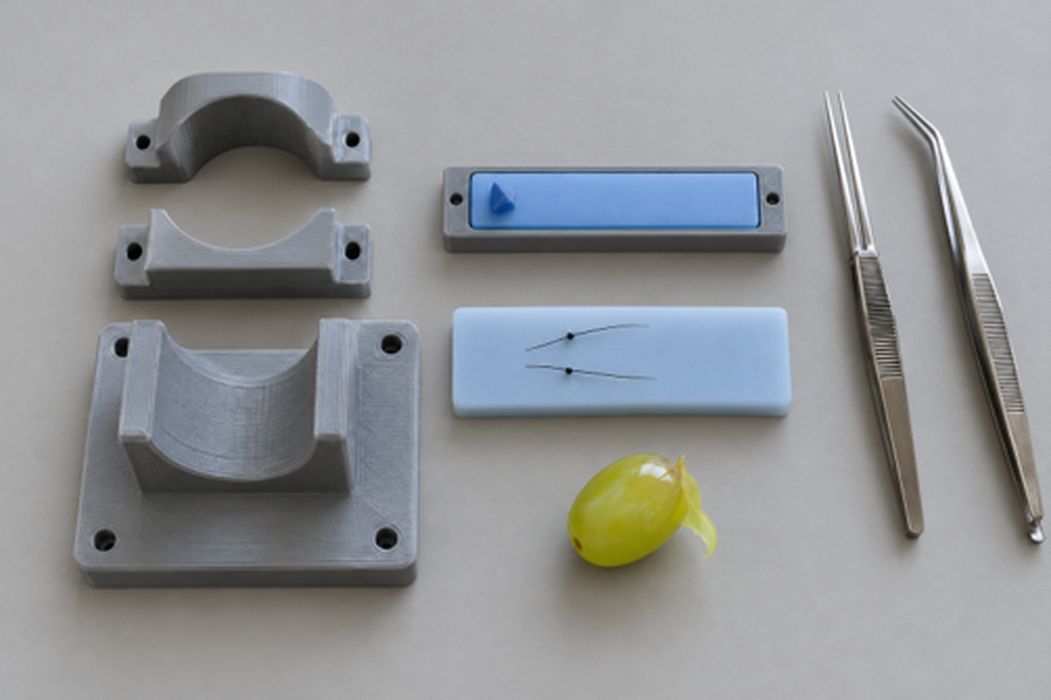
The target can then be changed to suit the movement being practiced. A thread supplies something small to grasp and remove. Silicone supplies a substitute growth to cut away. Once the lesson turns to lifting a delicate surface layer, grape skin has a clear purpose too. The fruit gives the trainee a thin covering to separate from softer material beneath it, while the printed apparatus makes the trainee approach it through a restricted opening.
Grape Skin and Silicone Polyps
Once the trainer recreates the narrow passage toward the voice box, it needs something for the learner to operate on. That is where the grapes come in. Their thin skin can be carefully lifted away from the flesh beneath, giving the trainee a simple substitute for separating a delicate layer of tissue. In the Georgetown study published in March 2025, ten ear, nose, and throat residents practiced with grape skin, sutures, and simulated polyps made from silicone.
Each material gives the instruments a different job. Removing a suture requires finding and grasping a fine thread. A silicone polyp represents a small growth that must be removed while preserving the surrounding material. The grape exercise asks the learner to lift a fragile surface without tearing through it. Together, these tasks introduce the careful grasping, cutting, and separating movements used in vocal-fold surgery.
The restricted opening makes those familiar materials much harder to handle. The learner must reach down the passage, keep the instrument tips in view, and approach the target at a workable angle. A grape sitting openly on a plate would allow the hands to come in from almost any direction; inside the trainer, that freedom disappears. The ordinary material enables this delicate task, while the printed structure supplies the awkward route that tests a surgeon’s dexterity.
The Feel of Real Tissue
Peeling grape skin gives the learner a thin layer to lift. Working on a voice box adds the actual tissue the surgeon needs to understand. The instrument must take hold of that tissue and gently separate one layer from another. The learner can feel how it responds while watching what happens at the tip.
A University of Colorado team built a reusable printed trainer for practicing with voice-box specimens. In their study, participants worked on voice boxes taken from pigs. They practiced lifting a small flap from a vocal fold, the same type of careful separation introduced by the grape exercise.
The printed holder keeps the specimen steady while the trainee reaches it through a surgical laryngoscope. The holder supplies the working position, and the specimen supplies the tissue being handled. After the exercise, the holder remains available for another session with a fresh specimen.
Practice Makes a Difference
Once someone has tried the exercise, an instructor needs a way to judge the attempt. Completing the task is one part of the picture. Watching how the learner handles the tissue gives the instructor more to work with, especially when a movement happens too quickly to discuss as it occurs.
The Colorado researchers recorded the procedures so a reviewer could assess them afterward. Experienced surgeons performed significantly better than beginners. That result suggests the exercise captured differences in surgical skill. The same apparatus gave people with different levels of experience a task on which those differences became visible.
Participants also reported feeling more confident after practice. That adds the learner’s perspective to the recorded performance. Confidence describes how prepared someone feels, while reviewing the procedure allows an instructor to examine what they actually did. Together, the two measures give a fuller picture of the training experience.
Julie Andrews & When a Voice Is a Livelihood
For Julie Andrews, the stakes of vocal-cord surgery became painfully clear. The star of Mary Poppins and The Sound of Music underwent throat surgery in 1997 and later said it had left her unable to sing professionally. She brought a malpractice lawsuit against her doctors and the hospital, which settled in 2000 on confidential terms. A voice familiar to millions had changed, with consequences that reached far beyond the operating room.
The underlying concern applies to all speaking voices. Vocal folds need to remain supple enough to vibrate. Scar tissue can make them stiffer, changing the sound or making speaking more difficult. Surgery therefore involves protecting the tissue that will keep producing the voice after the growth is gone. For a teacher leading a classroom or someone whose job requires constant conversation, that function is part of earning a living.
Yet opportunities to rehearse these delicate movements have been uneven. In a national survey published online in 2019, only one-third of responding ear, nose, and throat residency programs reported offering a hands-on course in this type of surgery. A tabletop trainer addresses a concrete part of that gap. It provides somewhere to practice reaching, grasping, and lifting delicate material before performing those movements during a patient’s operation.
An aging world adds another reason to pay attention to voice care. The World Health Organization projects that one in six people worldwide will be 60 or older by 2030. Vocal folds can lose muscle bulk with age, leaving a gap when they should come together to produce sound. Speaking may become breathier or require more effort. Voice therapy can help, and some patients receive injections that add bulk to the folds and improve their closure. These treatments bring voice specialists into the everyday work of helping older adults remain comfortably heard.
The way that care is delivered is changing, too. A study of U.S. Medicare data found that vocal-fold injection procedures increased by 52.3% between 2012 and 2022, while the share performed in an office rose from 20% to 28%. Some patients can receive these injections under local anesthesia during a clinic visit. This is a different procedure from lifting a delicate flap during microsurgery, but it illustrates how widely voice treatment now extends beyond the traditional operating room. Training must keep pace with that range of procedures, each requiring its own combination of visibility, instrument control, and careful tissue handling.
Surgical Training Moves Beyond the Operating Room
Surgery involves very carefully calibrated movements. Knowing where to place a stitch is one skill; guiding the needle accurately with both hands is a separate one. The American College of Surgeons and the Association of Program Directors in Surgery have developed a simulation curriculum that progresses from tying knots to rehearsing operations and managing emergencies as a team. A learner can work on an individual skill before combining it with the many other demands of an operation.
That approach has become an established part of training. In a U.S. survey published in 2020, 83 of the 87 responding surgery department chairs reported a formal simulation curriculum. Ninety percent said their residents had protected time for simulation—time specifically set aside for practice. For a doctor learning a difficult procedure, that creates an opportunity to repeat a troublesome step, receive feedback and try again.
The practical question is how to provide enough equipment and opportunities for that repetition. Small printed trainers offer one economical approach. The Georgetown vocal-cord simulator’s authors reported using roughly US$15–20 of printing filament for its reusable structure, with practice-task supplies costing about US$0.50 per participant. Instruments, viewing equipment and teaching time add to the expense, but the printed apparatus itself is inexpensive to reproduce. That’s critical since a specialized movement needs repeated practice.
The Research & Development Tax Credit
The now permanent Research and Development (R&D) Tax Credit is available for companies developing new or improved products, processes and/or software.
3D printing can help boost a company’s R&D Tax Credits. Wages for technical employees creating, testing and revising 3D printed prototypes are typically eligible expenses toward the R&D Tax Credit. Similarly, when used as a method of improving a process, time spent integrating 3D printing hardware and software can also be an eligible R&D expense. Lastly, when used for modeling and preproduction, the costs of filaments consumed during the development process may also be recovered.
Whether it is used for creating and testing prototypes or for final production, 3D printing is a great indicator that R&D Credit-eligible activities are taking place. Companies implementing this technology at any point should consider taking advantage of R&D Tax Credits.
Room for Another Attempt
The tabletop trainer gives a difficult movement somewhere to be practiced, critiqued, and tried again. Printed structures provide a working space that resembles the restricted approach of surgery.
Charles G. Goulding is a practicing attorney.