
Charles G. Goulding examines how AI-powered hearing aids and 3D printed ear components are changing the way researchers approach hearing loss and surgical repair.
The “cocktail party problem” is familiar to the world of hearing loss. You’re at a party, for instance, and a friend is telling a story, somebody behind you is laughing, and glasses are clinking near the kitchen. You can hear plenty. Following your friend’s sentence, however, is the hard part. Solving it means picking a voice out of the crowd, a feat that gets harder when hearing starts to slip.
Happily, hearing loss has seen unusual improvement in recent years. AI is getting better at sorting speech from noise. Meanwhile, 3D printing is helping researchers build custom parts and practice ears for repairing the tiny structures that carry sound.
AI Has Been Especially Helpful for Hearing Loss
The hearing aid is becoming much more capable. Small wearable computers can process sound, settings can adapt automatically, and access is expanding. These advances are arriving together, giving people more options for situations that in the past, used to defeat their devices. Restoring natural hearing remains a much bigger challenge, but better assistance can still help. The goal is to help the hearing impaired follow a story without working hard to catch every word.
AI is particularly well suited to one task. Researchers can train software with examples of speech mixed with unwanted noise, then teach it to recognize patterns that help separate the two. Instead of simply turning up the whole party, a hearing aid can make speech stand out. Phonak’s description of its AI hearing technology shows how dedicated chips bring that processing into a device small enough to wear behind an ear. These devices can do the work quickly while living on a tiny battery. Clarity, rather than volume alone, has consequently become a specific target.
Progress also comes from making help easier to get. The FDA’s 2024 authorization of hearing aid software allowed compatible Apple AirPods Pro to serve as over-the-counter hearing aids for adults with perceived mild to moderate hearing loss.
The Structural Chain Behind Hearing
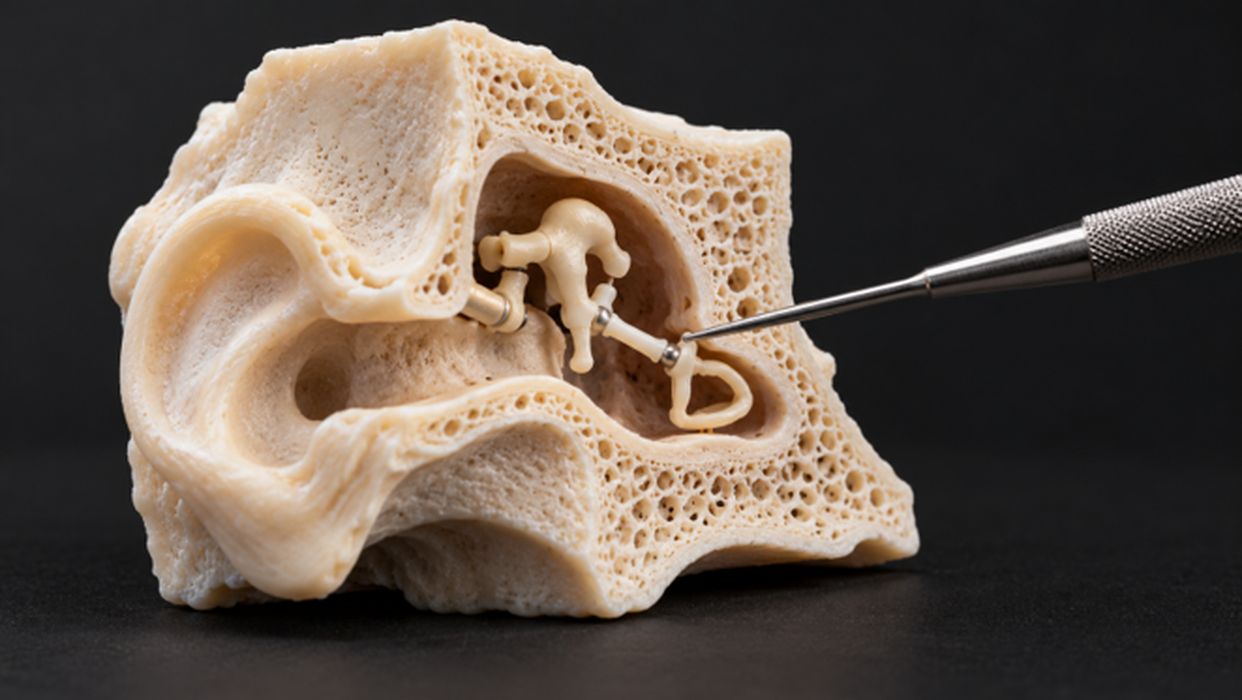
Sound travels down the ear canal and makes the eardrum vibrate. Behind it, three tiny bones pass that movement along. Their names are the hammer, anvil, and stirrup. This structural chain carries vibrations toward the fluid-filled cochlea in the inner ear. There, sensory cells help turn movement into signals the brain can interpret.
Problems can develop at different stops on that journey. Many age-related hearing problems involve changes in the inner ear. A middle-ear repair addresses another situation, where the physical connection has been damaged or cannot move properly. Chronic infection can harm the small bones, and an injury can disrupt them. A growth of misplaced skin cells, called a cholesteatoma, can also damage nearby bone.
For some patients, treatment includes rebuilding that connection with a small replacement part. First, the team needs to understand the damage and deal with disease in the ear. Then comes the delicate fitting job. A replacement must touch the right structures and let them move together. Fabbaloo’s 2019 coverage of printed middle-ear replacements introduced this possibility. Newer research asks what happens after a part is made. Does it actually carry sound well enough to do its job?
Small Parts That Must Fit Perfectly
An ear is an awkward place to put a standard-size gadget. Its curves and narrow spaces make fit a big part of comfort, which helps explain why 3D printing already has a foothold in hearing care. Phonak’s printed titanium hearing aid shells follow the shape of an individual ear. Farther inside, researchers are applying that same custom approach to the tiny parts that carry vibrations.
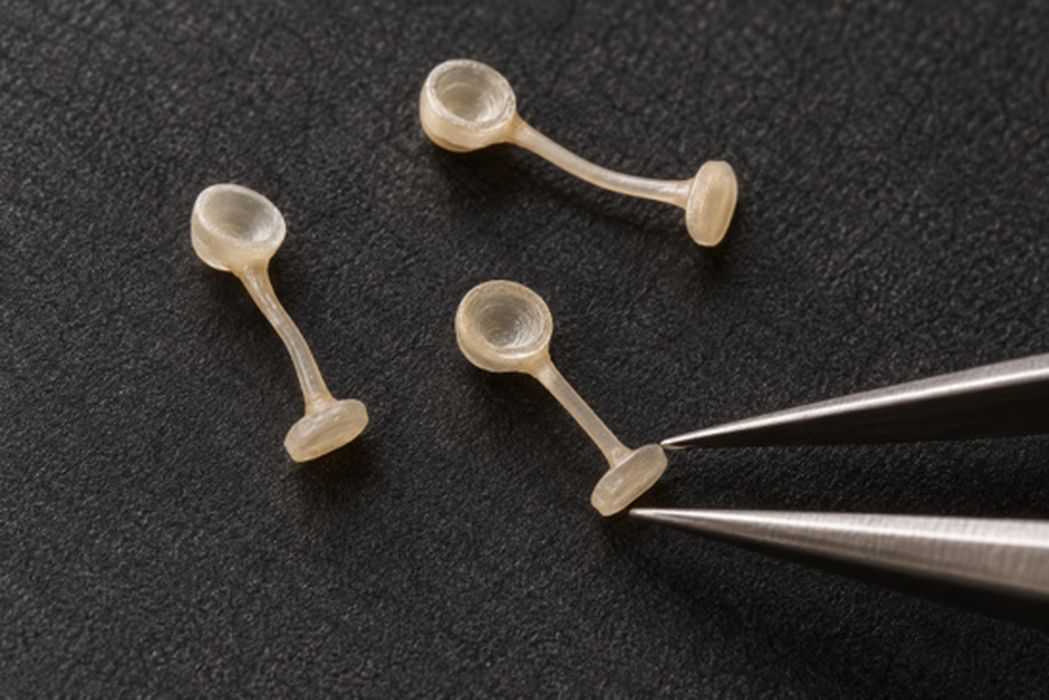
A 2017 University of Maryland experiment printed those tiny parts. Researchers removed the anvil bone from three donated ear specimens, scanned the remaining structures, and printed a replacement for each ear. Then four surgeons had to work out which part belonged where, without being given the answers. Every surgeon matched every part correctly. The experiment did not establish how well a patient would hear, but it showed that a printer could capture differences small enough to fit behind an eardrum – and distinctive enough for surgeons to recognize.
The next challenge was getting those tiny ear parts to carry sound. In a 2023 Helsinki and Aalto study, printed replacements just a few millimeters long performed similarly to a commercial titanium part in donated specimens. Printing also makes it easier to explore another shape or length. Researchers can now turn a proposed adjustment into a physical part and find out what happens when sound passes through it.
These are some of the companies supplying tools or products in that wider effort.
| Company | Product | 3D Printing Work |
| Formlabs | Makes resin printers and materials. | Its Form 2 printer made the Maryland study’s custom middle-ear prototypes. |
| Materialise | Makes medical imaging and design software. | Researchers used Mimics software to design those parts from scans. |
| Phonak | Makes hearing aids. | Its Virto B-Titanium shell demonstrated commercial use of 3D printing for a custom hearing aid housing. |
Testing Ears, Once More with Printing
Some tiny ear parts look quite intricately designed but do not function particularly well. To test them, researchers play sound into an ear specimen or model and track movement farther along the chain. The motion is too small to judge by eye, so a laser detects it without touching the delicate structures. Changing the pitch reveals whether a repair behaves differently with low and high sounds. All that elaborate equipment tests how much of the incoming sound makes it through.
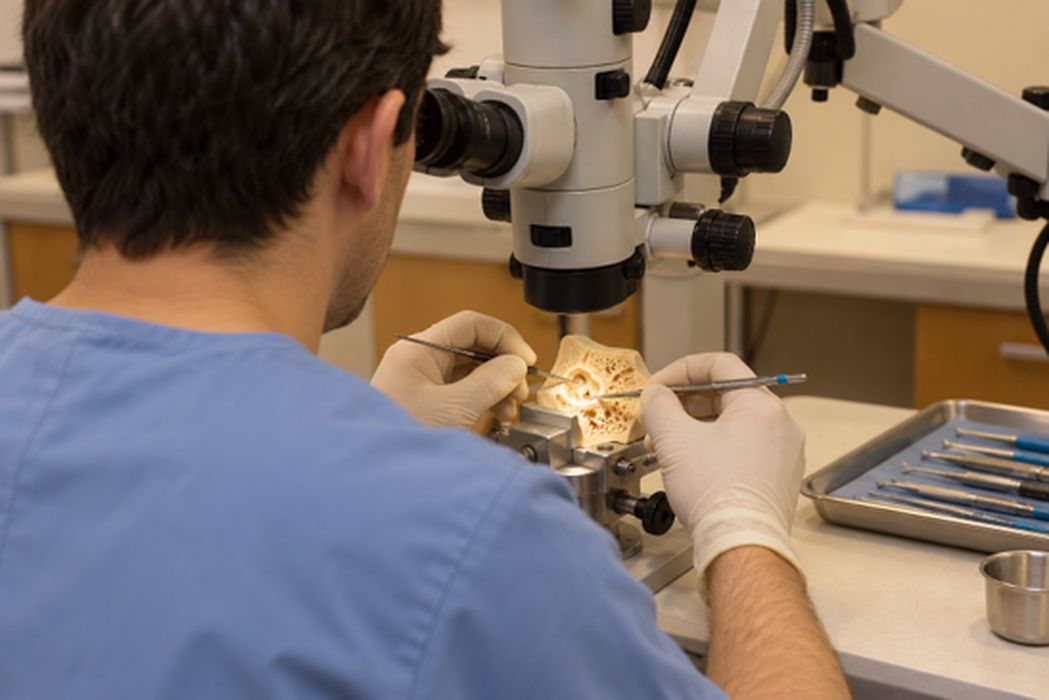
An artificial, printed ear offers a repeatable starting point for trying a replacement. Researchers can work on the same setup over and over while changing a part or its position, making it easier to investigate what affects the result. An April 2026 Helsinki study built a printed middle-ear model that could conduct these kinds of tests. Hard printed parts and softer connections reproduced enough of the ear’s behavior to produce sound-transfer measurements comparable with donated human specimens.
Building the model begins with detailed X-ray scans of a real ear. Those scans give researchers a digital map of structures normally hidden inside the skull. The printer then uses light to harden liquid resin, building the rigid pieces layer by layer. Softer components are added during assembly. The result is a miniature working mechanism, with individual parts that must move together when sound arrives. Getting the shape right is only part of building an ear that behaves like one.
Some of the most interesting ingredients are surprisingly ordinary. The Helsinki researchers used silicone and hot-melt glue to recreate soft structures, including the eardrum and the connections supporting the bones. Those connections need enough give to let the bones vibrate. The team made three versions with different ligament stiffness, and the most flexible behaved most like the donated human ears. That makes softness a design choice worth testing alongside the shape of a printed bone. A beautifully detailed model can still need a little more give.
The Baby Boomer Audience
The audience for better hearing care is growing older. By 2030, all baby boomers will be at least 65, a milestone highlighted by the U.S. Census Bureau. For the generation that helped fill concert arenas and build the market for home stereos, hearing is becoming a more pressing health concern. The setting may be a family celebration rather than a stadium, but there is still a lot worth listening to.
About one in three Americans aged 65 to 74 has hearing loss, and nearly half of those older than 75 have difficulty hearing. Gradual change can make the problem easy to overlook. Someone may still manage a quiet conversation while struggling in a group, missing a warning, or finding a medical appointment harder to follow. The consequences can go well beyond an occasional request to repeat a sentence.
That creates a broad test for the next wave of technology. Can people afford it, manage its controls, and get help when it needs adjustment? Can it make the places people actually go easier to navigate? A laboratory result has to answer each of these everyday questions.
Paul Simon
Paul Simon has become a spokesman for hearing loss in recent years. The songwriter behind The Boxer and Bridge Over Troubled Water lost hearing in his left ear while making the record Seven Psalms. In a 2023 conversation with poet Paul Muldoon, he described singing what felt like the right pitch, then hearing on playback that he was slightly flat. Decades of experience suddenly led to questions on the feedback he had relied on throughout his career.
His later collaboration with the Stanford Initiative to Cure Hearing Loss helped adapt his stage setup and supported a return to touring. Changing the listening conditions helped him perform with the remaining hearing he had. His experience shows how adapting the surroundings can make an immediate difference while work on future treatments continues.
The Research & Development Tax Credit
The now permanent Research and Development (R&D) Tax Credit is available for companies developing new or improved products, processes and/or software.
3D printing can help boost a company’s R&D Tax Credits. Wages for technical employees creating, testing and revising 3D printed prototypes are typically eligible expenses toward the R&D Tax Credit. Similarly, when used as a method of improving a process, time spent integrating 3D printing hardware and software can also be an eligible R&D expense. Lastly, when used for modeling and preproduction, the costs of filaments consumed during the development process may also be recovered.
Whether it is used for creating and testing prototypes or for final production, 3D printing is a great indicator that R&D Credit-eligible activities are taking place. Companies implementing this technology at any point should consider taking advantage of R&D Tax Credits.
R&D Tax Savers has been helping companies navigate the complexities of the R&D tax credit since it was introduced into law in 1981.
Looking Ahead
The next step for AI hearing aids is to make listening easier as conversations change. At dinner, attention moves from one person to another, voices overlap, and someone asks a question from across the table. Better devices will need to follow those changes while preserving the sound of familiar voices. Longer studies of everyday use should help show which features make a lasting difference and where listeners still struggle.
Printed middle-ear repairs face a different test over time. Researchers need to establish which materials last, how reliably the parts stay in place, and whether patients’ hearing improves after surgery and remains better years later. More realistic practice models could help refine the designs and how surgeons fit them. As this work advances, success should become easier to describe in everyday terms, following a conversation with less effort or enjoying music again.