

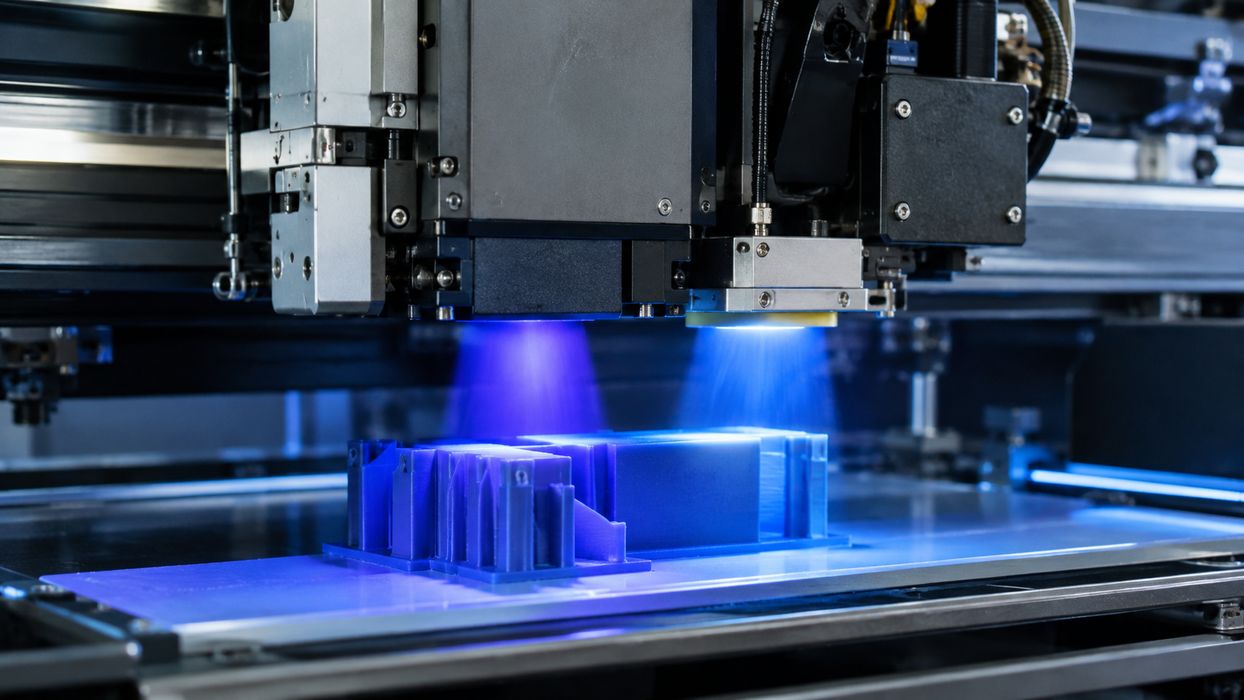
The very last layer of a 3D print can be the worst.
That’s the problem addressed in a new Xerox patent application that describes a change to the usual UV curing process: finish the print with a different wavelength of light.
Their idea applies to the material jetting 3D print process where droplets of UV curable resin are deposited and hardened layer by layer. Each pass adds material, an ultraviolet lamp exposes it, and the process repeats until the object is complete.
But the final surface layer can behave a bit differently from the other layers.
The patent claims that lower layers may be properly cured while the highest layer could be partially uncured. That can mean a tacky surface, even though the part has been “successfully” built. That’s something I’ve often encountered when resin 3D printing.
Am existing solution described in the filing is printing an extra, sacrificial layer over the part. After curing, that layer is removed and the surface cleaned.
But that requires more resin and work, however, and Xerox says the result can still be rough. I am not surprised. There’s also an obvious problem where the part’s geometry has fine details that complicate removal of that extra layer.
Xerox’s proposed solution is to change the curing light instead.
During the build, the printer uses the normal UV source to cure each layer. The patent specifies a wavelength range of 390–400nm, with 395nm given as an example. Today’s resin systems are typically 405nm, and sometimes 365nm.
When the printer reaches the final layer, it uses a second UV source operating at 360–370nm, with 365nm given as an example. (What a coincidence!)
The shorter wavelength supplies higher energy photons. Resin formulations respond to the specific wavelengths they absorb, so changing the light frequency could change how the material cures at this surface. The patent proposes using that to make a smoother final finish.
It’s a pretty small modification to the process, although you do need two light sources. Nothing much else changes, and the shape of the part is the same when printed.
The patent claims also have the light sources operating at different intensities. One example has an operation from 15% to 200% of a normal intensity setting, suggesting that wavelength and exposure strength would both require tuning.
There are some interesting implications for machine design with this patent.
If the second light source can be mounted alongside the first, the method might require not much additional mechanics. A printer controller just selects a the other light source at that point.
The timing is very curious. Although this Chinese patent application was published in just now in November 2026, it is a divisional filing linked to an application from 2018, with a US priority date in 2017. This idea has been around for a long time.
Nevertheless, I like the concept. Instead of trying to fix the sticky surface after printing, Xerox wants to print it properly right on the machine.
Via Espacenet