
Could we change the size and shape of a voxel during 3D printing?
That’s one of several intriguing possibilities described in a patent application published this week in Japan, entitled “Holographic Volumetric Additive Manufacturing”, or HoloVAM.
The application, JP2026537298A, was filed by the University of Southern Denmark. It seems to be a commercialization step taken after the HoloVAM concept was developed by researchers back in 2025.
The technology attempts to overcome some of the limitations of volumetric additive manufacturing (VAM), a new and very interesting method of 3D printing.
In tomographic VAM systems, a transparent container of photopolymer resin rotates while a series of carefully computed light patterns are projected into it. The accumulated light energy exceeds the resin’s curing threshold in specific locations, solidifying the desired object throughout the volume.
There’s no need to repeatedly form layers, and entire objects can be produced in seconds. It’s basically magic.
But there’s something inefficient about the way the light is typically generated.
The patent explains that conventional VAM systems using Digital Light Processing (DLP) projectors can waste considerable light energy. That’s because relatively few of the projector’s micromirrors might be directing light into the resin during any particular exposure. Any mirror not pointing at the vat effectively loses that pixel’s energy.
HoloVAM takes a completely different approach to generating the light patterns.
Instead of selectively directing light toward the resin, the system changes the phase of different portions of a laser beam. When these portions interfere with each other, they create the desired light distribution.
The technique involves combining two digitally generated holograms. One defines the shape of individual projected light spots, while the other defines the overall pattern. The latter hologram is repeated across the spatial light modulator, hence the name “HoloTile” for the underlying projection technology.
This setup reduces interference between adjacent light spots, reducing the speckling that happens sometimes with holographic projections.
The patent describes experimentally demonstrated light projections with efficiencies of 90% or higher. It also describes a 100X speed advantage over conventional digital holography.
That doesn’t mean 3D printing would be 100X faster, but the ability to rapidly generate new holographic patterns opens up some rather interesting possibilities. Rapid printing is usually a good thing.
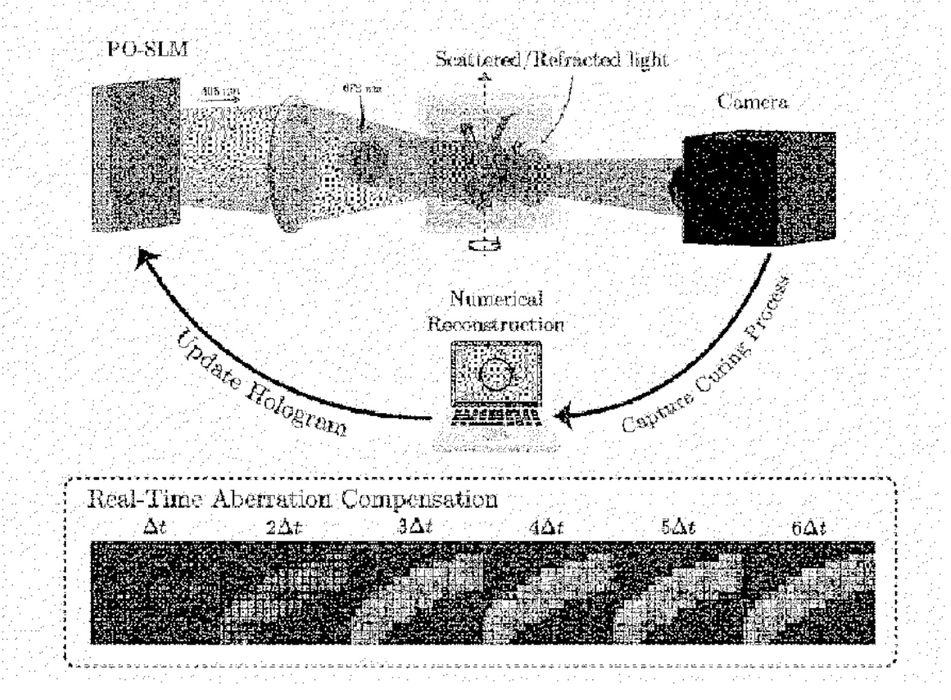
One is using a camera to monitor the light passing through the resin container. The system would analyze the optical distortions and adjust holograms to compensate.
Consider what happens if you’re attempting to 3D print biological structures using a hydrogel containing large numbers of living cells. Those cells scatter light, making it increasingly difficult to accurately deliver light energy to specific locations within the material.
The holographic approach could compensate for at least some of that scattering by deliberately distorting the incoming light pattern.
Then there’s the possibility of changing voxel sizes during printing.
The patent proposes dynamically adjusting the resolution from ten to 100 microns, with larger voxels initially forming the coarse structure of an object and smaller voxels subsequently adding fine details. It’s analogous to using large and small diameter nozzles on FFF systems.
This would be of particular interest when 3D printing biological structures that include features of vastly different dimensions, such as an organ containing tiny blood vessels.
Another fascinating possibility is the generation of what the patent calls “bottle beams”. These are light distributions that surround a dark region, potentially enabling the formation of very small internal cavities that would otherwise inadvertently solidify.
We’ve all become accustomed to thinking about resolution as a property of the 3D printer itself. With HoloVAM, the resolution, and even the shape of the smallest elements being printed, could become something decided in software instead. That’s quite a switch.
Via Espacenet