
Let’s spin those resin prints to remove the wet resin.
That’s the concept behind a new patent application from South Korea’s Graphy, recently published in Japan as JP2026537375A, which describes a device that removes leftover resin from 3D prints using centrifugal force.
Anyone who’s operated a resin 3D printer is knows about the messy post processing steps required to clean and cure prints. Fresh prints are coated with leftover uncured wet resin, which must be removed before the final UV curing step. If you don’t the cure will make those drips part of the print.
Typically this is done by dipping the parts in an alcohol bath and agitating them. The alcohol dissolves the wet resin, leaving behind the solid print. The parts are then dried and post cured with a UV light bath.
There are some problems with this method, as we all know. The IPA gradually becomes saturated with resin and must be replaced. There’s also the possibility of the alcohol affecting the mechanical properties of certain photopolymers, something specifically mentioned by Graphy in the patent application. Oh, and that IPA is toxic, and requires special disposal approaches.
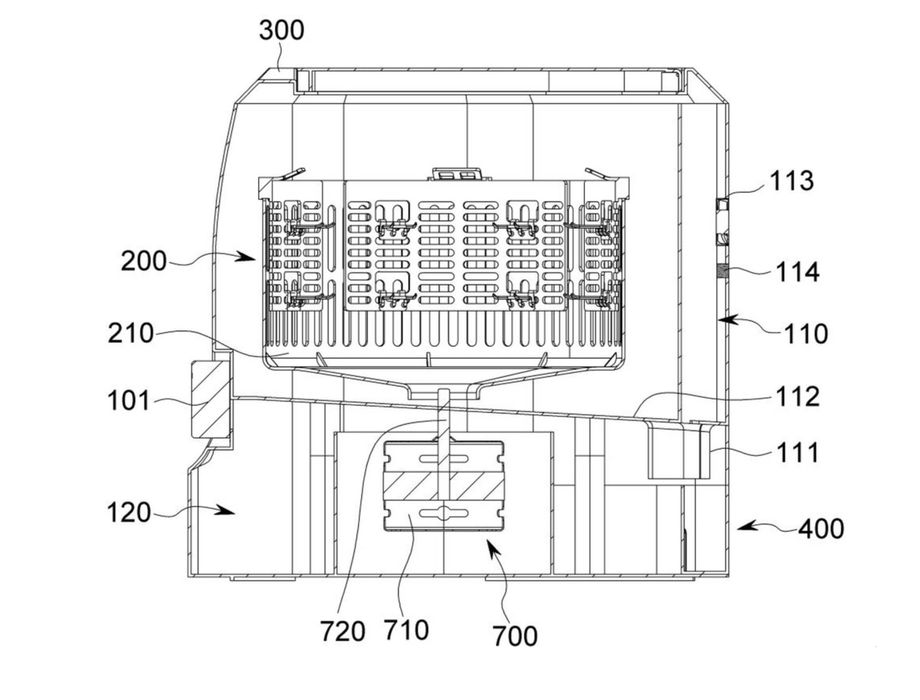
Graphy’s approach is basically a miniature washing machine operating using its spin cycle.
The device includes a cylindrical basket with numerous holes in its sides and bottom. Inside the basket are removable curved panels onto which multiple smaller part holders can be attached.
The patent diagrams show what appears to be dental appliances mounted on these holders. The setup allows multiple parts to be processed simultaneously, and the holders can be removed or exchanged depending on the shape of the parts being processed.
When the motor spins the basket, centrifugal force causes the liquid resin to fly off the prints, pass through the holes in the basket and collect inside the surrounding enclosure.
The bottom of the enclosure is sloped, allowing the resin to flow into a drain and further along into a removable collection tank. No pumping system is required at all.
Graphy adds another interesting feature: heat.
Their device can use either an internal heating element or an external source of hot air, with a temperature sensor controlling the heat supply.
The idea here is that heating the resin should reduce its viscosity, making it easier to remove from the prints. This might be particularly useful for viscous photopolymers, where spinning the parts might not be sufficient to remove all the leftover resin.
But there’s another important aspect of this approach, which could provide a financial benefit.
In conventional resin washing operations, the residual resin is essentially lost. It’s mixed into the washing solution and eventually becomes a waste disposal problem.
Here the resin is collected without being diluted by a solvent. Graphy specifically proposes recycling the recovered material, potentially reducing resin consumption and therefore costs.
I suspect this might be quite attractive in a production environment where expensive specialty resins are used and hundreds of similar parts are processed each day. There could be quite a bit of savings in both resin and washing fluids.
Would this approach work for all resin 3D prints? I’m not so sure.
The dental appliance shapes shown in the patent illustrations seem particularly well suited to the process. More complex parts might have niches or internal spaces where resin would be trapped, depending on how the part is oriented in the spinning basket. Maybe they should also rotate the part’s orientation while spinning?
There’s also the question of how much centrifugal force a relatively delicate print can withstand before post curing. Heating the part could further complicate matters if that heat softens the material, even slightly.
There might be some value in spinning off most of the resin before washing. That alone could noticeably extend the life of the IPA.
Machine developers have spent a lot of effort developing faster and better resin 3D printers. Maybe it’s time to spend more effort on what happens to those prints after printing completes.
Via Espacenet