
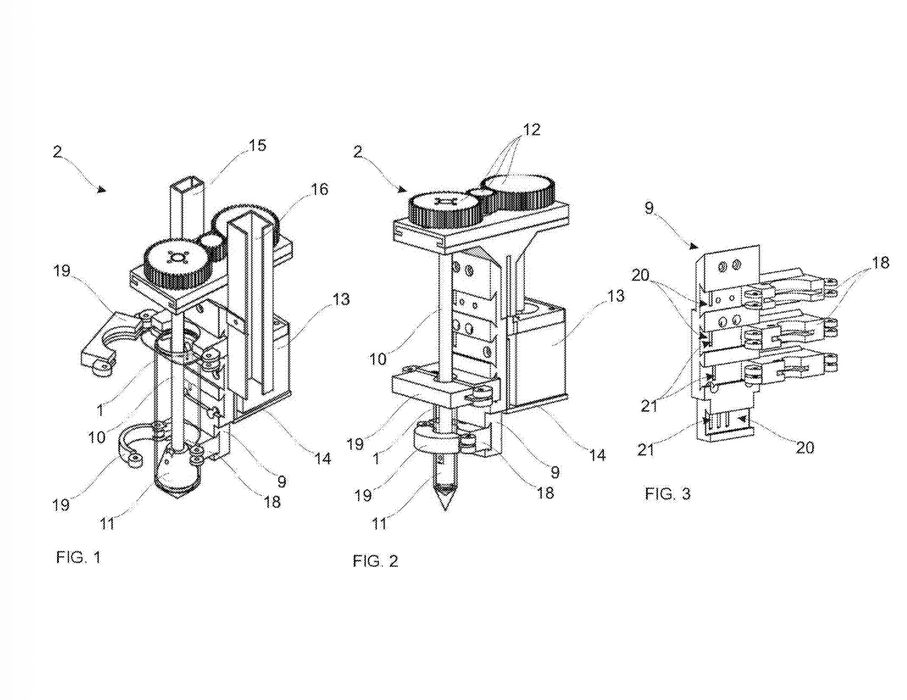
A food 3D printer should be able to clean itself.
An interesting patent application from Istanbul Technical University, US20260344728A1, entitled “Three-Dimensional Food Printer Capable of Processing Fluid/Paste Type Food” seems to do just that.
Food 3D printers typically use a different extrusion mechanism than those found on FFF 3D printers. Food materials in paste or fluid form are loaded into a syringe, and a motor drives a piston to push the material through a nozzle. The motion system moves the syringe around to deposit material in much the same way as a conventional 3D printer.
But there’s a problem at the end of the print job: what happens to the leftover material inside the syringe?
With an FFF 3D printer, you simply leave the filament in the machine until the next job. That’s not something you’d want to do with food materials, which could contaminate the next print job. This is basic kitchen hygiene.
The inventors propose a clever way to clean the syringe without removing it from the toolhead, using ultrasonic vibrations.
The patent document describes a station that would be positioned within reach of the printer’s motion system. The station includes a tank containing a liquid and one or more vibration motors operating at ultrasonic frequencies.
The unusual aspect is the shape of the tank. There’s a concave section on the outside of the tank, essentially a half cylinder, into which the syringe can fit. When the toolhead positions the syringe against this surface, ultrasonic vibrations are transmitted through the liquid in the tank and into the syringe.
Their idea is to distribute the vibrations throughout the syringe, rather than concentrating them at a single point.
The station also includes a separate tank containing cleaning liquid and another for collecting waste liquid.
At the end of a print job, the toolhead would move over the cleaning tank, where water is drawn into the syringe. The toolhead then moves the syringe into the ultrasonic station, where vibrations are applied for a predetermined period. The syringe is then moved over the waste tank, and the dirty water is expelled.
The inventors explain that this process could be repeated multiple times, and even suggest configurations with separate tanks for detergent and rinse water.
That’s a lot of automation for a food 3D printer, particularly if multiple jobs are to be run with different food materials. However, the operator wouldn’t have to take apart and manually clean the extrusion system between jobs.
However, there’s another use for the ultrasonic station that I find perhaps even more interesting.
The inventors explain that the station could also be used to homogenize the material inside the syringe.
Let’s consider a food paste containing several ingredients that tend to separate over time. Depending on how long a print job takes, the material extruded towards the end of the job might have a somewhat different composition than that extruded at the beginning.
The printer could theoretically pause a job, position the syringe against the ultrasonic station and remix its contents before continuing the print.
That might make it possible to print with certain food formulations that would otherwise be unsuitable due to separation during lengthy print jobs.
Their approach makes me wonder if we should be seeing more elaborate automated maintenance systems on food 3D printers. If these machines are eventually to be used in commercial kitchens, the ability to clean themselves between jobs could be critically important.
Via Espacenet