
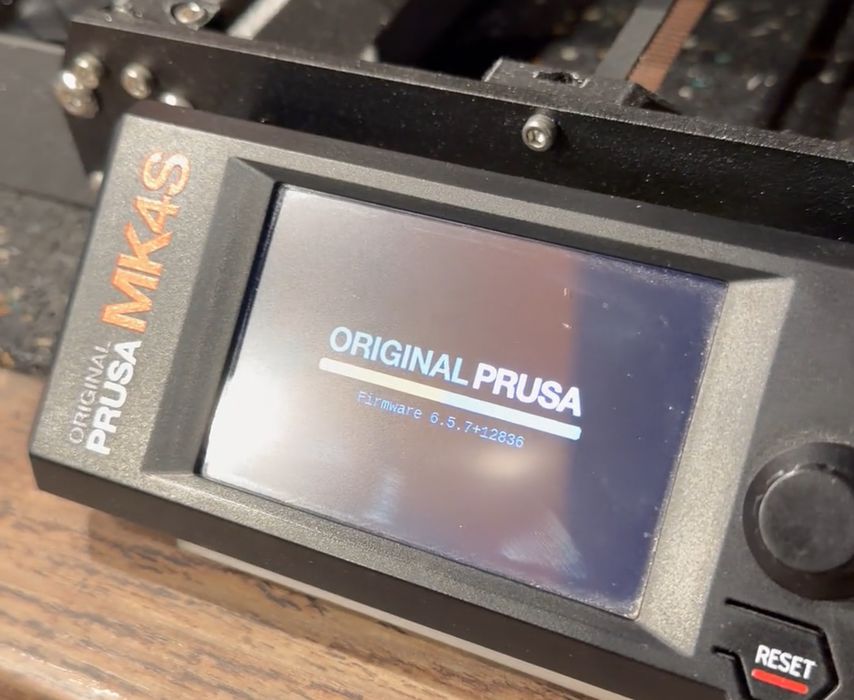
Your 3D printer might be the next target for an AI-powered hacker.
We’ve all been reading increasingly alarming stories of AI systems finding weaknesses in supposedly secure software, sometimes accomplishing in hours what previously required weeks of specialized work by hackers.
Now that capability has touched the 3D printing world, and it won’t be the last time.
Security researcher Yannick Dixken recently spent an entire week investigating the firmware of his Prusa MK4S 3D printer, using Anthropic’s Claude AI system and automated testing tools. He uncovered no less than 14 security findings involving approximately 23 individual defects.
Most concerning was the ability to take control of the printer’s main controller through a network-based attack. To demonstrate his success, he made the printer’s display show Rick Astley.
That’s funny, but it’s not funny.
That particular attack required control of, or interception of communications with, a service used by the printer. It wasn’t a demonstration that any random person on the internet could take over any Prusa machine. Nevertheless, Dixken proved that a serious vulnerability existed in actual production hardware.
The really surprising part was how little time the investigation required.
Dixken is an experienced software professional and security enthusiast, but he had little previous experience with printer firmware. With AI assistance, he was able to systematically examine huge amounts of software, identify suspicious behaviour, and eventually develop a working attack.
This means that the economics of hacking 3D printers have fundamentally changed.
Previously, discovering obscure vulnerabilities in firmware required a lot of specialized expertise and a great deal of time and effort. Those barriers aren’t there anymore since AI tools have become increasingly powerful.
I suspect this development will force a bunch of changes on the 3D printing industry, from top to bottom.
Manufacturers will have to start treating cybersecurity as a key part of product development. Their firmware now typically manages cloud communications, remote monitoring, cameras, network connections, and automated production systems. All of that is potentially vulnerable.
Manufacturers may have no choice but to use the same AI-powered investigation techniques on their own products, repeatedly testing firmware before release.
There’s also the vast installed base of 3D printers to consider.
A vulnerability discovered in one firmware family might affect thousands or even millions of machines already operating in homes, schools, businesses, and factories. Manufacturers must be prepared to distribute security fixes quickly, including for older products that might otherwise receive little attention.
For operators, the situation is also pretty concerning.
We’ve become accustomed to the occasional firmware update showing up with new features, improved calibration, or adding compatibility with accessories. Security updates get a lot less fanfare.
That attitude will have to change.
A compromised printer might behave unpredictably or provide an attacker with access to other equipment on the same network beyond the 3D printer itself. In industrial environments, where printers are integrated into larger production workflows, the consequences could be financially significant.
These are things that could happen. But all operators should now consider their printers just like networked computers, and they now require the same security attention as other equipment.
That means installing security updates as soon as possible, limiting network exposure, and being far more cautious with print files. Organizations may also want to separate 3D printer networks from more sensitive systems.
Fortunately, this particular incident has a positive twist.
Dixken very responsibly disclosed his discoveries directly to Prusa, which investigated the problems and released fixes in Buddy firmware 7.0.0. The vulnerabilities affected fifteen Prusa models, and owners should ensure their machines are running updated firmware. Prusa reported no known real-world exploitation outside the researcher’s demonstration. Dixken also published his investigation AFTER Prusa had released the fixes.
AI tools have dramatically increased the ability to discover weaknesses in 3D printers.
Now manufacturers and operators must adapt to a world where security issues can pop up suddenly.
And that means applying fixes right away.
Via Yannick Dixken