
What if the resin could heat itself?
A patent application from Texas A&M University, US20260364875, describes a way to 3D print thermoset polymers while curing them with electromagnetic energy.
Thermosets are unusual printing materials because they form permanent chemical bonds as they cure. Once hardened, they don’t never soften again when heated. That provides useful mechanical and thermal properties, but getting a printed object to cure evenly can be problematic. Normal exterior heating may take more time and generate thermal differences across a part.
Their proposed solution is to mix tiny particles into the liquid resin that respond to an electromagnetic field. The inventors call these particles “susceptors”. When exposed to radio frequency (RF) or microwave energy, they absorb energy and produce heat inside the polymer itself.
In other words, the heating mechanism IS the material.
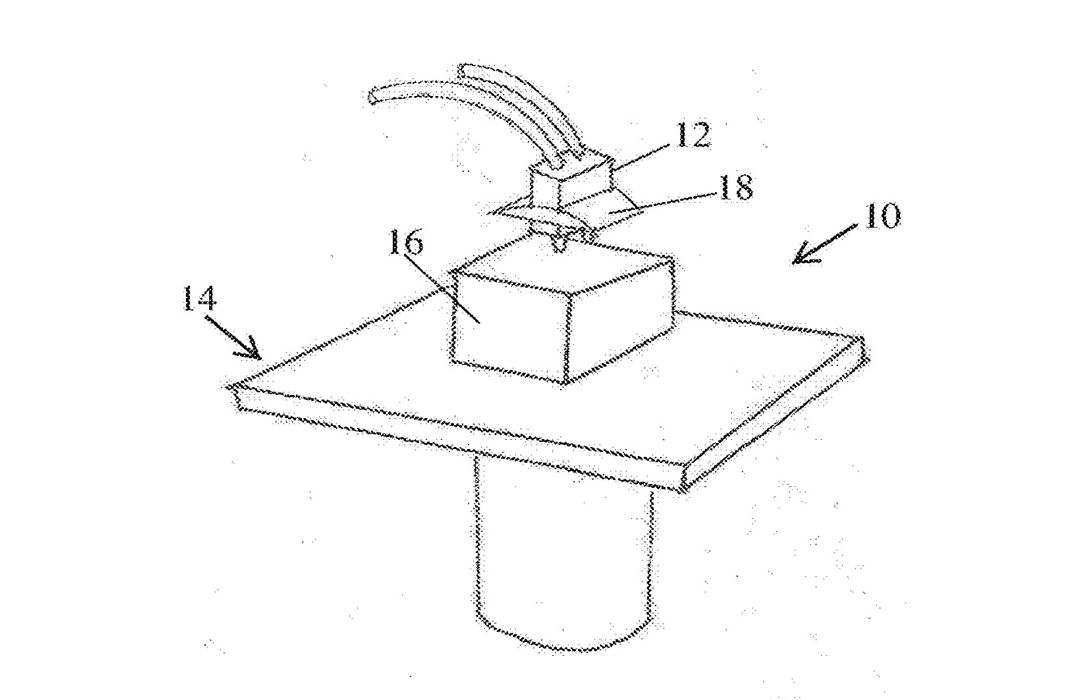
One suggested implementation puts an RF applicator close to the printhead. The printer deposits uncured material, then exposes it to electromagnetic energy, causing the embedded particles to heat the resin and trigger polymerization. Another arrangement moves a printed part beneath an energy source, curing deposited material as the source scans across it.
The patent lists several possible additives, including carbon nanotubes, carbon black and magnetic particles. It also covers a range of thermally curable polymers, but the concrete example is more specific.
The inventors mixed five percent by weight of multiwalled carbon nanotubes into epoxy resin. They spread a roughly one mm layer onto a Teflon surface and scanned it beneath an RF applicator. Additional layers were applied, with the power setting reduced from 1250W for the first layer to 500W for the fifth.
The resulting print was approximately 4.6mm thick. Microscopic images show the layered structure, and the inventors report that heating produced bonding between successive layers. In another comparison, nanotube-filled epoxy cured under the applicator while an unfilled epoxy sample did not fully cure, particularly around its edges.
That’s encouraging, although these are limited demonstrations. The example used material spread onto a surface, not a complete complex object built by a fully integrated printer.
Many resin printing systems depend on light-sensitive chemistry, while normal thermoset processing commonly requires heated tools or ovens. A system that deposits and selectively cures a heat-reactive material could widen the kinds of resins available to additive manufacturing.
I find the idea quite interesting because it moves curing out of a separate oven and into the deposition process itself. Whether that can be done repeatably, at useful scale, is the experiment I’d like to see next.
Via Espacenet