
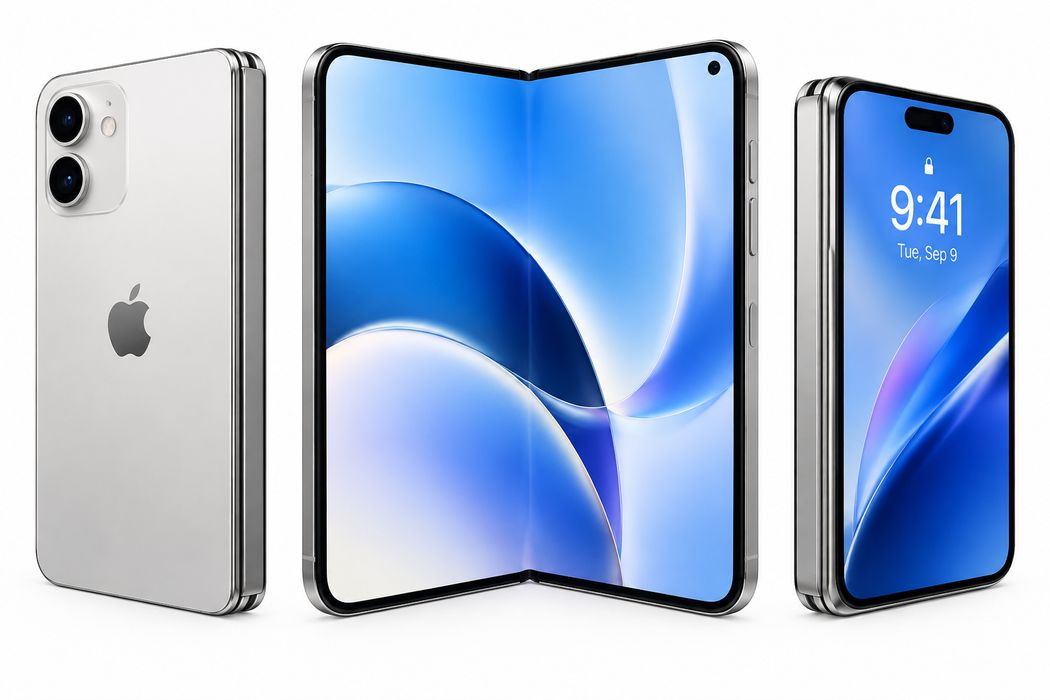
Charles R. Goulding and Preeti Sulibhavi look at why Apple’s latest foldable iPhone could mark another major milestone for 3D printing, following the company’s successful adoption of 3D printed titanium components.
Apple’s first foldable iPhone has arrived, and one of its most interesting features is something most users will never see: a hinge that combines artificial intelligence, precision scanning and 3D printing.
The new iPhone Duo, announced September 9, opens into a 7.6-inch display and closes around a 5.4-inch outer display. It starts at US$1,999, with preorders beginning October 16 and availability scheduled for October 23. But behind the headline-grabbing form factor is a manufacturing story that may be even more significant for the 3D printing industry.
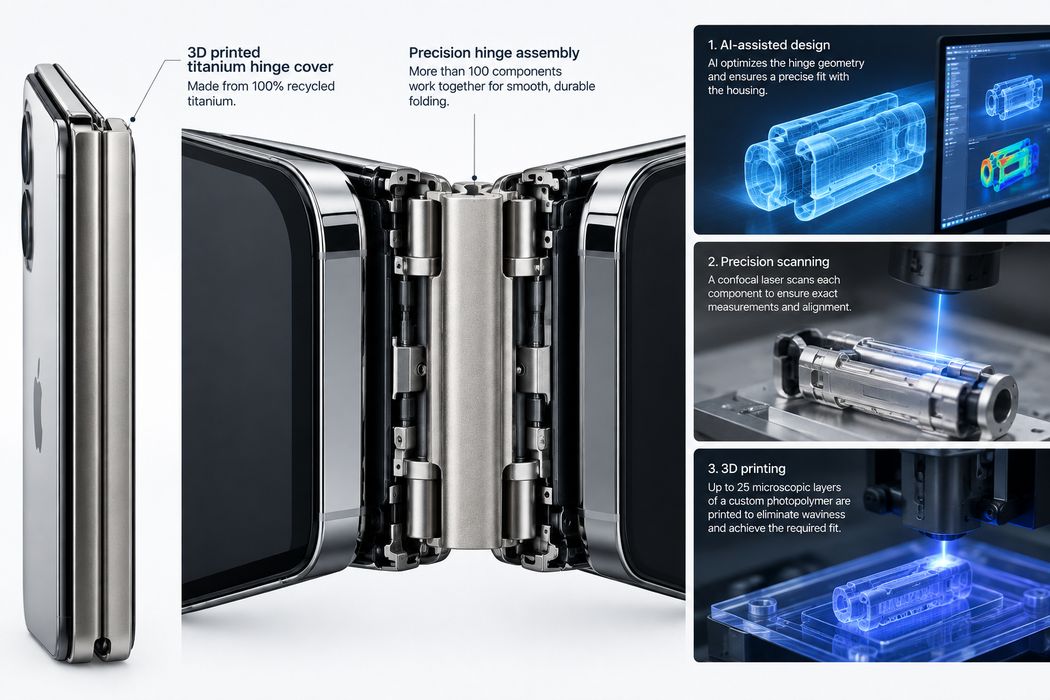
Apple says the hinge assembly contains more than 100 components. Its cover is made from 100% recycled titanium using 3D printing, while AI algorithms and precision laser scanning are used during manufacturing to achieve the required fit and surface accuracy.
For Apple, this is another step in a long evolution of design, manufacturing and supply-chain strategy.
From Steve Jobs to Tim Cook
Apple’s remarkable rise has been shaped by two very different leadership eras.
Steve Jobs was famously associated with product vision and an almost obsessive focus on design. He understood that technology products could become cultural objects when engineering, usability and industrial design were treated as one discipline.
A key figure in that effort was Jony Ive, whose work helped establish the visual language of modern Apple hardware. Ive’s influence extended far beyond individual products, helping Apple build a design culture in which the way something was manufactured was inseparable from the way it looked and felt.
Fabbaloo has previously examined Ive’s continuing influence as he moves into the intersection of design and artificial intelligence in From iPhones to AI Forms: Jony Ive’s New Era of Intelligent Design.
Tim Cook brought a different but equally important expertise to Apple. His background in operations and supply-chain management helped Apple build an enormous manufacturing ecosystem capable of producing highly complex products in huge volumes while maintaining demanding quality standards.
During Cook’s tenure, Apple also moved 3D printing from experimentation toward production. A particularly important example is the company’s 3D printed titanium Apple Watch cases.
Apple says its laser powder bed fusion process uses 100% aerospace-grade recycled titanium powder and cuts raw material consumption by about 50% compared with previous generations. The company estimated that the process would save more than 400 metric tons of raw titanium in 2025.
That history matters because the iPhone Duo hinge is not Apple’s first major experiment with additive manufacturing. It is the next step.
John Ternus and the Foldable Challenge
Apple’s latest transition is now associated with John Ternus, who is CEO as the company introduces the Duo. Ternus has described the device as a major change to the iPhone product line, but the real engineering challenge may be less visible than the two screens.
A conventional smartphone is designed to be opened, used and carried as a rigid object. A foldable phone has a mechanical system at its center that is deliberately subjected to repeated movement.
The hinge therefore has to do several things at once. It must be strong, compact and precise. It has to maintain alignment between the two halves of the phone while also supporting a delicate flexible display. And it has to maintain its performance over repeated folding cycles.
Apple says the Duo uses a precision hinge designed to provide a smooth feel during use. The company has also incorporated high-strength materials, custom adhesives and other structural features into the display and hinge system.
This is where additive manufacturing becomes particularly interesting.
AI Meets 3D Printing Inside the Hinge
Apple’s description of the manufacturing process is unusually revealing.
According to Apple Chief Hardware Officer Johny Srouji, AI algorithms are used to precisely match each individual hinge with its best-fit housing. A confocal laser then scans the topology of every individual unit.
The manufacturing system can subsequently 3D print as many as 25 microscopic layers of a custom photopolymer to eliminate residual waviness and achieve the required alignment.
That is an important distinction.
The AI is not necessarily generating the hinge’s basic geometry from scratch. Instead, Apple is using AI as part of a highly controlled manufacturing and quality-assurance process, allowing individual components to be characterized and matched at the unit level.
This is arguably just as important for additive manufacturing as the more familiar concept of generative design.
The combination of scanning, computation and localized additive manufacturing creates the possibility of manufacturing parts that are individually optimized rather than simply mass-produced to a single nominal specification. For a component as mechanically demanding as a smartphone hinge, that capability could be extremely valuable.
The 3D printed Titanium Connection
The Duo’s hinge cover also extends Apple’s growing use of metal additive manufacturing.
Apple says the hinge cover is made from 100% recycled titanium. The broader device uses grade 5 titanium in its enclosure, while the hinge cover receives a micro-blasted finish that contrasts with the mirror-polished titanium elsewhere on the phone.
Apple’s earlier work with 3D printed titanium Apple Watch cases provides an obvious precedent. In that application, additive manufacturing allowed Apple to reduce material consumption substantially while producing a cosmetic component at production scale.
The hinge application is different, however. Apple is not saying that the entire 100-plus-component hinge is 3D printed. Rather, additive manufacturing is being applied to specific components and to a highly localized finishing process.
That distinction makes the development more interesting, not less.
Industrial 3D printing does not have to replace an entire manufacturing process to be valuable. It can be inserted at precisely the point where conventional manufacturing has difficulty achieving the required geometry, material efficiency, customization or dimensional accuracy.
Apple Is Not Alone
Apple is entering a field where other smartphone manufacturers have already demonstrated what additive manufacturing can do with foldable hinges.
OPPO, for example, worked with Chinese additive manufacturing company Bright Laser Technologies to produce a titanium structural hinge for its Find N5. According to 3D Printing Industry, that process reduced hinge thickness from 0.3 mm to 0.15 mm while increasing rigidity by 36%.
For the Find N6, BLT went further, consolidating 13 individually machined wing-plate components into a single 3D printed structure.
Apple’s approach is therefore part of a broader industry trend. The precise engineering objectives are different, but the underlying lesson is similar: foldable devices create mechanical problems that can be unusually well suited to additive manufacturing.
Why This Matters to 3D Printing
The significance of Apple’s decision extends beyond one expensive smartphone.
Apple is one of the world’s largest consumer-product manufacturers. When a company of this scale adopts 3D printing for a production component, it provides an important validation of additive manufacturing as an industrial technology.
The progression is particularly notable.
First came experimentation and prototyping. Then came production-scale 3D printed titanium watch cases. Now additive manufacturing has entered a critical component of Apple’s first foldable iPhone, alongside AI-driven inspection, matching and localized printing.
This is exactly the kind of convergence that could define the next phase of manufacturing: AI determining how an individual component should be handled, precision sensors measuring what was actually produced, and 3D printing making tiny corrections or creating geometries that conventional manufacturing struggles to achieve.
For the 3D printing ecosystem, that is a much bigger story than simply saying that an iPhone contains a printed part.
The Research and Development (R&D) Tax Credit
Apple’s foldable iPhone development may present IRC §41 research credit opportunities where the work satisfies the qualified research tests. Under IRC §41(d)(1), qualified research generally must involve domestic R&E expenditures under IRC §174A, technological uncertainty, development or improvement of a business component, and a process of experimentation directed at function, performance, reliability, or quality
Potential qualifying activities could include iterative engineering of foldable screen materials, crease reduction, hinge fatigue resistance, drop and bend durability, miniaturized component packaging, battery performance, thermal management, and software-hardware integration. These activities appear most credit-relevant if Apple is evaluating alternatives, modeling or prototyping designs, and testing uncertain technical approaches before commercial production. QREs under IRC §41(b) may include wages for employees performing, directly supervising, or directly supporting qualified research; supplies used in qualified research; qualifying computer-use costs; and 65% of eligible domestic contract research costs
Key exclusions should be screened carefully. IRC §41(d)(4) excludes research after commercial production, adaptation or duplication of existing business components, routine surveys or management studies, ordinary quality-control testing, foreign research, funded research, and certain internal-use software
Software work may still qualify if it supports a qualified research activity or experimental production process rather than routine internal-use functions
Apple’s Research and Development (R&D) Book Per Capita
| Fiscal year | R&D expenditures | Human capital | R&E divided by human capital |
| 2025 | $34.550 billion | 166,000 FTE employees | $208,133 |
| 2024 | $31.370 billion | 164,000 FTE employees | $191,280 |
| 2023 | $29.915 billion | 161,000 FTE employees | $185,807 |
| 2022 | $26.251 billion | 164,000 FTE employees | $160,067 |
A New Chapter for Apple and Additive Manufacturing
Apple’s history shows how much the company’s success depends on leadership that can connect different disciplines.
Steve Jobs pushed product design and the user experience to extraordinary levels. Tim Cook built an operations and supply-chain machine capable of manufacturing those designs at global scale. John Ternus now inherits an Apple that has increasingly sophisticated capabilities in silicon, software, AI, materials and advanced manufacturing.
The foldable iPhone brings many of those disciplines together in one product.
Its success will depend on the quality of the display, software, battery, cameras and countless other components. But the hinge may be the ultimate mechanical test because it has to work every time the owner opens and closes the phone.
And that makes the hinge a fitting symbol for Apple’s next manufacturing era.
If the iPhone Duo succeeds, AI-assisted design and 3D printing will deserve some of the credit. Apple has already demonstrated that additive manufacturing can move from experimental technology to high-volume consumer products. Now it is applying that experience to one of the most demanding mechanical challenges in a new category of device.
Everyone loves a comeback. But only time will tell whether the foldable phone gets one this time around.