
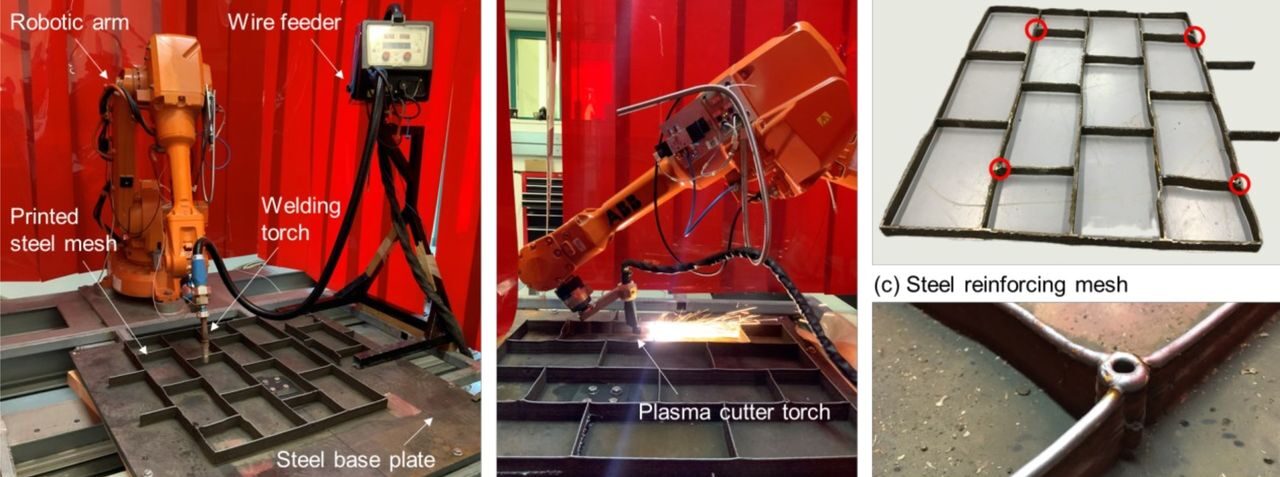
Researchers propose 3D printed steel reinforcement to discreetly strengthen vulnerable unreinforced masonry.
Many historic buildings use unreinforced masonry (URM), and they routinely underperform – break – in earthquakes. Conventional retrofits like external steel frames, shotcrete overlays, or fiber reinforced polymer wraps can be effective, but they are often visually intrusive, difficult to reverse, and challenging to fit to irregular stone or brickwork. A new paper presented at the 18th World Conference on Earthquake Engineering explores an alternative: metal additive manufacturing (AM) to fabricate custom steel inserts and connectors shaped to each wall’s geometry.
The appeal for conservation projects is obvious: If reinforcement geometry can match the masonry exactly, engineers can improve shear transfer and out-of-plane capacity while hiding most hardware within joints, voids, or core holes. That could lower site labor, reduce cutting and patching, and preserve façades that cannot tolerate surface plates or wraps.
Why Metal AM Is Interesting For URM
Metal AM can create complex, topology-optimized features that conventional bending or machining cannot. For masonry, that means shear keys, textured surfaces, and lattices that increase contact area and mechanical interlock with mortar or grout, plus organic transitions that reduce stress concentrations at anchors. Parts can be parametric, letting designers tune thickness and stiffness to each bay or pier.
Process choice would track geometry and batch size. Laser Powder Bed Fusion (LPBF) could produce fine connectors with thin webs and integral textures. Binder jetting with sintering might deliver lower cost at higher throughput for small to medium parts. Wire Arc Additive Manufacturing (WAAM) could address larger plates or brackets where surface finish is less critical. Common steels such as 316L or low alloy grades are well characterized in AM, but heat treatment and surface preparation remain key to predictable performance.
How Custom Steel Inserts Carry Load
The concept focuses on connecting wythes and improving diaphragm anchorage with minimal exposure. Printed inserts would sit within raked bed joints or cored pathways, presenting roughened or ribbed profiles to promote bond with high-strength grout. Low-profile terminations or hidden plates could engage across multiple units, distributing forces without large external fixtures. By tailoring the geometry, designers can target weak interfaces and control crack paths under cyclic loading.
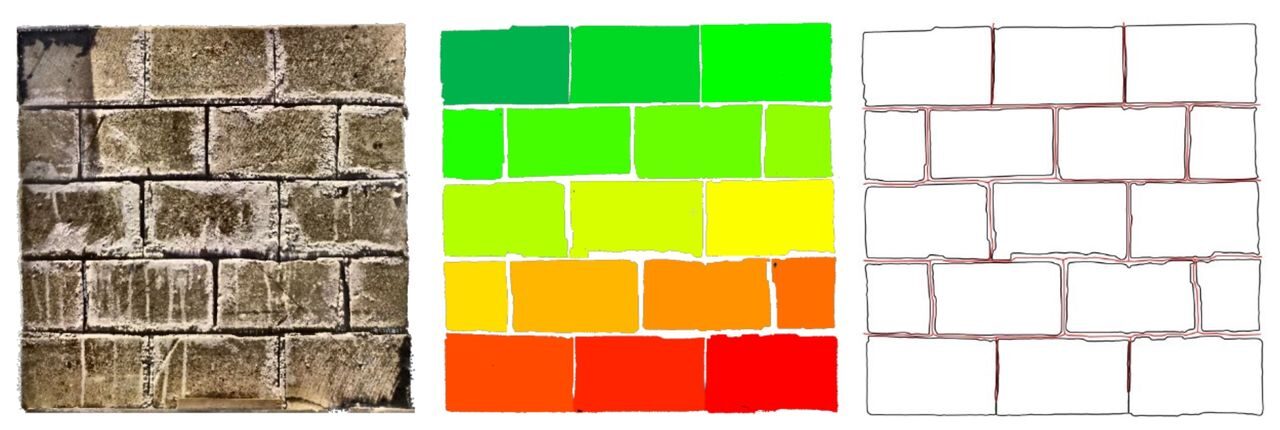
A plausible workflow is “scan to steel”. Workers capture geometry with laser scanning or photogrammetry, generate a mesh, and drive a parametric library that lays out connector families to suit unit size, coursing irregularity, and access limits. Parts are nested for build-volume efficiency, printed, heat treated, cleaned, and coated if needed for corrosion resistance, then installed with non-shrink grout. The approach aims to reduce on-site fitting and drilling, which often drives cost and risk in heritage work.
Limits, Costs And Proof Still Needed
This is early-stage research rather than a commercial kit. The paper points to feasibility and potential mechanics, but full-scale validation would still be a lot of work. Long-term durability in damp, salt-laden environments, fatigue under many small seismic events, and thermal expansion compatibility with masonry all require data. Corrosion behavior at steel-grout interfaces and the influence of AM surface roughness on bond strength are particularly important.
Economics are also an open question. Per-part cost depends on part count, process, and post-processing, and throughput is critical if dozens or hundreds of connectors are needed per building. While AM reduces custom fabrication labor, conventional bent steel or off-the-shelf anchors are cheap and code familiar. For adoption, heritage authorities and engineers will look for standardized designs, repeatable installation procedures, and qualification under frameworks like Eurocode 8 or ASCE 41. None of that is instant.
Expect component and wallet tests first: cyclic shear tests of bed-joint anchors, out-of-plane wall panels on a shake table, and environmental conditioning to probe corrosion and creep. Comparative studies versus FRP anchors and traditional steel ties would clarify where AM adds value and where it does not. Scan-to-print accuracy and on-site tolerance strategies will matter just as much as metallurgy.
If pilot projects appear in seismic regions with plenty of fragile heritage buildings — Italy, Greece, Portugal, New Zealand, or California — we will learn how permitting, cost, and supply chains behave in practice. If 3D printed steel can disappear into the wall while doing real structural work, it could become a quiet but powerful tool in the conservation kit. Sometimes the best retrofit is the one no one notices.
