
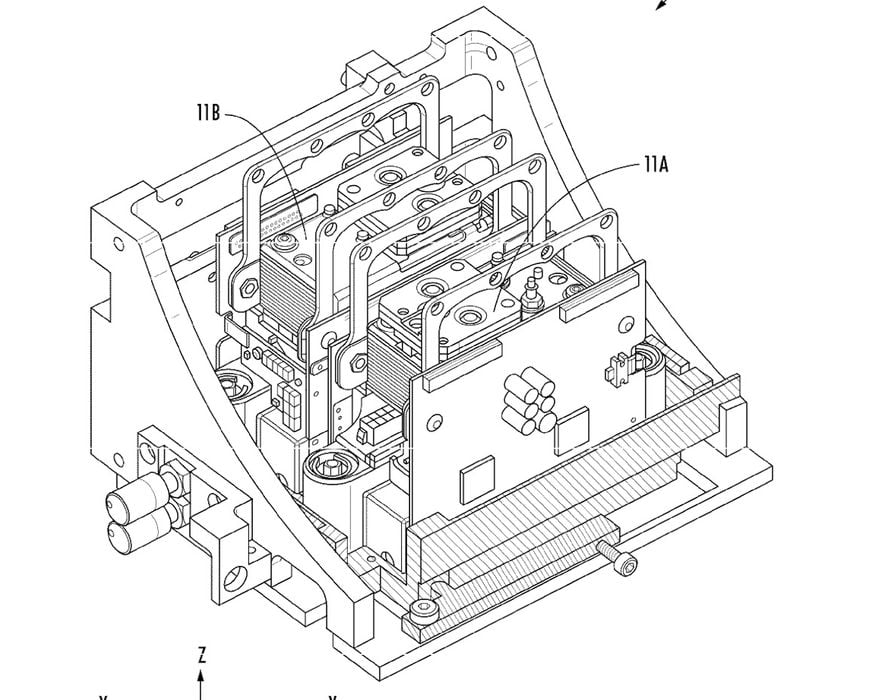
3D Systems has published a European patent application for a printhead mounting and alignment system that could make multi printhead 3D printers easier to calibrate.
The application, EP4748555A1, is titled “Flexure Mounting And Alignment Within A Three-Dimensional Printer.” It was published by the European Patent Office on 27 May 2026, with 3D Systems, Incorporated listed as the applicant.
Why Printhead Alignment Is Hard
The patent focuses on 3D printers using one or more printheads that selectively deposit material droplets. The source describes drop on demand piezo printheads, phase change inks, wax components, tackifiers, monomers, oligomers, catalysts, UV curing, and support materials.
That places the idea in the general neighborhood of material jetting, a technology area 3D Systems has long participated in through its MultiJet related products. The patent itself uses generic language, but the mechanism is clearly about nozzle arrays, droplet placement, and layer formation.
The problem is obvious here: if a printer uses more than one printhead, those printheads must be aligned with high precision. If they are even slightly off, the droplets from one head will not land where the droplets from another head expect them to be.
That can produce visible artifacts, dimensional errors, poor surface quality, or unreliable support and build material interfaces. As machines scale up to larger sizes, add more nozzles, or try to increase throughput with multiple heads, alignment becomes increasingly important.
The Patent’s Mechanical Trick
The proposed system uses flexures to mount and adjust printheads.
A flexure is a deliberately bendable mechanical element. Instead of relying on sliding joints, bearings, or loose adjustment hardware, the mechanism bends in a controlled way while holding the printhead in a repeatable position.
In this case, the patent describes printhead mounts coupled to a printhead carriage using pairs of flexures. An adjustable actuator then changes the printhead mount position while the flexures remain under continuous bending stress.
One version in the patent rotates a printhead mount around the Z axis to correct angular misalignment. Another version moves a second printhead mount along the Y axis to align nozzle arrays. The patent also describes alignment along the X direction by adjusting droplet timing between printheads.
In other words, this is not just a bracket. It is a fine adjustment mechanism intended to line up multiple printheads mechanically and, where needed, through timing correction.
The patent also describes iterative calibration using a test plot: print a pattern, measure the error, adjust the actuator, and repeat until the error is below a threshold. In additive manufacturing the penalty for poor alignment is high because the error accumulates through the part.
Why This Could Matter
This could reduce manual steps during manufacturing, servicing, or possibly field calibration of high precision 3D printers. It could also help support much wider print areas or multi head architectures without requiring every component to be installed perfectly on the first try.
That is likely the real benefit of this patent. A reliable flexure based adjustment system could make the machine more forgiving, while still preserving the accuracy needed for precision drop deposition..
As AM companies push material jetting systems toward greater throughput and repeatability, printhead alignment becomes less of a setup detail and becomes more of a core machine capability, a requirement.
We will have to see whether this method appears in future 3D Systems products.
Via Espacenet
